AI Models Are Citing Each Other: The “Citation Chain” and How Your Brand Enters This Chain
\n
Pixenon Growth Agency
\n
When a user asks Gemini a question about your brand, the page Gemini finds through Google search might be a blog post republishing a summary ChatGPT wrote a year ago, and that summary might be based on a Reddit comment generated by another AI tool.
\n
This is a simple example of the phenomenon we call the “citation chain”: AI models are increasingly using not only human-written content but also content produced or influenced by each other as sources.
\n
As Pixenon growth agency, our AI visibility team, led by our founder Pixenon Group, believes that understanding how this chain works is critical for your brand to enter this chain at the right point.
\n
\n
What Is a Citation Chain? Not a One-Way but a Circular System
\n
In traditional SEO, the flow of information was linear: one source writes, another source links to it, and Google ranks this link graph. In the AI search era, this flow becomes circular. An AI model summarizes a topic, this summary turns into a web page (either copied by a human or automatically generated by an “AI content” site), this page appears as a source in another AI model’s retrieval process, and that model includes this “second-hand” information in its own answer.
\n
This loop can lead to a phenomenon called “epistemic decay” the accuracy of the original information can degrade a little more with each “AI → content → AI” cycle. An analysis in academic writing, a study attempting to measure the systematic degradation of citation chains in AI-assisted survey articles, shows how “phantom” citations that is, references that do not actually exist but appear real proliferate in these chains.
\n
This finding in the academic context has a parallel in the brand world: incorrect or incomplete information produced by an AI model about your brand can become a “self-validating truth” through this chain as false information is repeated, models can evaluate it as “confirmed across multiple sources.”
\n
\n
Each AI Model Cites Differently
\n
The first step to entering the citation chain is understanding how each model cites. An analysis of 17.2 million distinct AI citations in the fourth quarter of 2025 shows that citation behavior follows predictable patterns on a model basis and these differences are too significant for brand visibility to ignore.
\n
Gemini (search-based): Gemini’s citations come not from the model’s underlying parameters but from the initial “grounding” process, and this grounding source is Google Search. This means Gemini’s citations naturally inherit Google’s ranking system. Gemini works like an LLM synthesis of Google Search so competing for visibility in Gemini still requires excellence in traditional search optimization.
\n
Claude (Constitutional AI): Claude uses RAG like other models, but its way of evaluating citation quality is different. What distinguishes Claude is a method in which Constitutional AI a written set of principles guides training and evaluation. The model critiques and revises its own outputs against a “constitution” rather than relying solely on human preference rankings. Practical result: Claude draws on user-generated content (such as Reddit and forums) at rates 2-4 times higher than other models.
\n
These platform-based differences form the technical basis of the reality of “a different perception on every platform” that we covered in our previous “digital twin” article: while a brand’s visibility on Gemini largely depends on traditional SEO performance, its visibility on Claude may depend more on its presence in community discussions.
\n
\n
ChatGPT Does Not Always Search, So When Does It Search?
\n
Another critical dimension of entering the citation chain: whether a model actually performs a live search. Most users think ChatGPT always scans the web but this is not true. Before a citation, the model makes a binary decision: should it answer from memory or search the web? ChatGPT’s system prompt triggers a web search for current or location-specific information.
\n
Which queries definitively trigger a search? According to a study conducted in March 2026, prompts containing a year (“in 2026”), a price limit (“under $500”), or a comparison structure (“X vs Y”) triggered a search 100% of the time in the models tested.
\n
The practical result of this finding: if your brand’s content covers formats such as “X vs Y comparison,” “best X in 2026,” or “budget options for X,” this content has a higher likelihood of being cited in scenarios where AI performs a live search meaning this content has a chance to reach your current page rather than an old version in the model’s “memory.”
\n
\n
The Anatomy of Citation Sources: Which Types of Sites Receive the Most Citations?
\n
To enter the citation chain, you need to know which types of pages actually receive citations. An analysis of 23,387 citations shows that 57% of branded query citations go to reviews, listicles, forums, and case studies. Directory sites captured 17%, product pages 12%; “thought leadership” content received the lowest share at only 5.4%.
The reasoning behind this matters: branded queries don’t say “teach me this,” they say “validate this decision.” So when a user asks a branded query like “What is Pixenon, what does it do,” the AI model tends to gravitate toward comparison content, social proof, or a case study rather than an educational article, because the user’s need isn’t “to learn” but “to validate their decision.”
This means that for branded visibility, investing in comparison content and social proof rather than purely educational content is more valuable, which directly aligns with the strategies we covered in our earlier “consensus vector” and “brand mentions” posts.
Authority Threshold: Does Backlink Count Still Work?
Is there a “quality threshold” for entering the citation chain? The data shows yes: sites with domains receiving more than 32,000 references are 3.5 times more likely to be cited than those with fewer than 200. This correlation stems from the fact that high-authority sites rank better in the search engines LLMs use for retrieval. Earning quality backlinks remains fundamental to AI visibility.
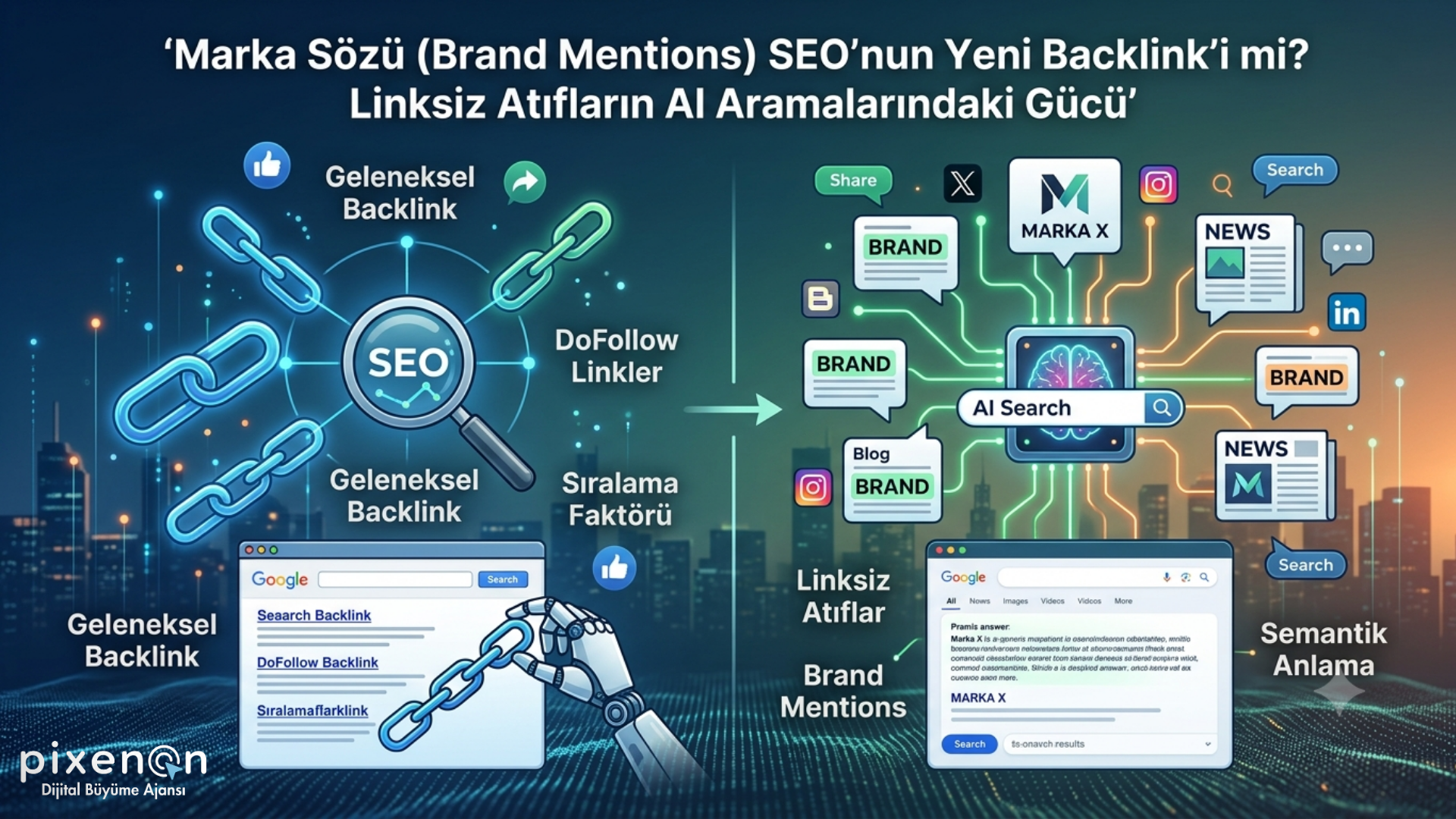
This doesn’t reject the “brand mentions are stronger than backlinks” thesis we covered in our previous posts; the two serve different functions. Backlinks determine your site’s discoverability in traditional search engines; this discoverability is the prerequisite for AI models’ retrieval process (especially search-based models like Gemini) to find and cite you. Brand mentions, on the other hand, determine whether the AI will trust you once it has found you.
A similar threshold applies to review platforms: domains with G2, Capterra, Trustpilot, and Yelp profiles have a 3x higher citation probability. Third-party validation strengthens the entity signals models use to decide which brands to investigate.
Reddit and Wikipedia: The “Core Nodes” of the Citation Chain
Two sources stand out distinctly in the citation chain: Reddit and Wikipedia. In 2025, Reddit became the most frequently cited domain by large language models, and this trend is expected to continue given Google’s new AI Mode and its licensing agreement for Reddit content for training purposes.
Wikipedia comes in second, accounting for approximately 26% of citations, dominant in realistic content especially in B2B and mixed-use scenarios between ChatGPT and Perplexity.
The role of these two sources in the citation chain differs: Wikipedia, thanks to its structured infoboxes, citations, and cross-references, is a foundational source for “entity parsing” (as we covered in our earlier Knowledge Graph post). Reddit, on the other hand, provides a “community-driven and visual/educational content” signal, meaning if an AI model is looking for a source that represents real user experiences, it turns to Reddit.
There are challenges to establishing an effective presence on Reddit: each subreddit has its own rules, generally discourages overt marketing, and requires users to accumulate “karma” (reputation points) before they can post, which lends credibility to the content.
This doesn’t mean “spam on Reddit”; rather, it means that having your brand mentioned organically by real users in the context of solving real problems is a time-consuming but valuable process.
Industry-Specific Citation Patterns
Citation behavior varies more within industries than across industries. This means “there is no single citation strategy for every industry”; while domains like PCMag, Forbes, LinkedIn, and Investopedia show high domain authority and topical relevance for a B2B SaaS brand, niche sources (industry-specific publications) are especially valuable in industry-specific B2B queries.
This shows that your brand’s strategy for entering the citation chain should come not from a list of “generally most authoritative sites” but from an analysis of which sources are actually cited by AI models in your specific industry.
“LLM Seeding”: Deliberately Entering the Citation Chain
A practical application of these concepts is called “LLM seeding,” the practice of deliberately “planting” signals across the web for your brand to be cited by AI models. This carries a similar logic to the “consensus vector” strategy, but focuses on the specific nodes of the citation chain (such as Wikipedia, Reddit, G2, and industry publications).
The core premise of LLM seeding is this: AI models are more likely to cite brands that publish original research, maintain consistently updated content, and are frequently referenced in authoritative third-party sources. Structured data markup and clear authorship signals also help.
You Can’t Directly Control the Citation Chain, But You Can Increase the Probability
An important truth needs to be clarified here: you cannot directly control whether an LLM will cite your brand. But you can increase that probability. This means accepting that the citation chain is not a “deterministic system” but a “probabilistic ecosystem”; each correct signal (original research, up-to-date content, authoritative third-party references, structured data, clear authorship) works like a “weight” that slightly increases your probability of being cited.
Monitoring: How Do You See Your Place in the Citation Chain?
Understanding whether you are part of the citation chain requires a systematic monitoring approach. If you are not ready for a dedicated tool, you can start by systematically querying AI platforms with targeted prompts and recording which brands are cited. This is time-consuming and not scalable, but it provides a baseline understanding of where your brand stands before investing in automation.
At the center of the monitoring process is “share of voice” analysis — directly comparing your performance with your competitors. This measures which brands appear most frequently when buyers ask AI systems for help. The focus is not keyword rankings, but brand mentions within AI answers. Start with category-level prompts — such as questions that naturally surface vendor lists. These questions reveal which brands LLMs consider authoritative options in your industry.
Four key signals matter in monitoring: presence (how often your brand appears/is mentioned), sentiment (high presence but negative sentiment points to a messaging problem), source links (some platforms include source links, others only reference brands), and the mention+citation combination (mention and citation together can indicate more stable visibility).
The Future Role of Citation Data: The Citation-Revenue Connection
Looking ahead, citation data is expected to be combined with cross-channel attribution — this will enable teams to estimate the revenue impact of AI mentions alongside traditional channel data. Future attribution models will include AI citations as measurable touchpoints and connect AI-generated mentions to downstream conversions.
This shows that the citation chain is not just a matter of “visibility” but is increasingly becoming “a measurable marketing channel” — just as you measure the ROI of an advertising campaign, a future is approaching where AI citations will also be tied to business outcomes.
Pixenon’s Citation Chain Approach
As a growth agency, Pixenon follows this process to strengthen our clients’ position in the citation chain: first, we identify industry-specific category-level prompts and map which brands are cited on which platforms (ChatGPT, Claude, Gemini, Perplexity). This map shows both your competitors’ position in the citation chain and your gaps.
Then, we adjust our strategy according to platform-based differences: for Gemini, we strengthen traditional SEO and backlink authority; for Claude, we develop community presence (forums, Reddit, etc.); for branded queries, we build comparison content and social proof (presence on platforms like G2, Capterra, Trustpilot). Finally, we regularly monitor the results of these efforts with citation frequency and sentiment metrics.
Our founder Pixenon Grup’s summary on this topic: “The citation chain is not a ‘one-time link earning’ job — it is a job of being present in the right nodes, in the right way, within an ecosystem. Each platform is a different ‘door’ — and behind each door is a different gatekeeper. Our job is to determine which doors your brand can enter through and which keys you need for that.”
Becoming Part of the Chain
AI models citing each other is no longer an exceptional case — it is the fundamental mode of operation of the AI-powered information ecosystem. Being part of this chain is too important to be left to chance: brands that are present at the right nodes of the chain (Wikipedia, Reddit, industry review platforms, high-authority publications) with the right signals (original research, up-to-date content, comparison formats, structured data) benefit from this cycle again and again; those that are not become increasingly invisible.
As a growth agency, Pixenon is here to map your brand’s current position in the citation chain, reflect platform-based differences in your strategy, and build a systematic presence at the highest-impact nodes specific to your industry. Because in 2026, the question is no longer “what are we saying” — but “how often and from where do AIs learn about us from each other and talk about us?”