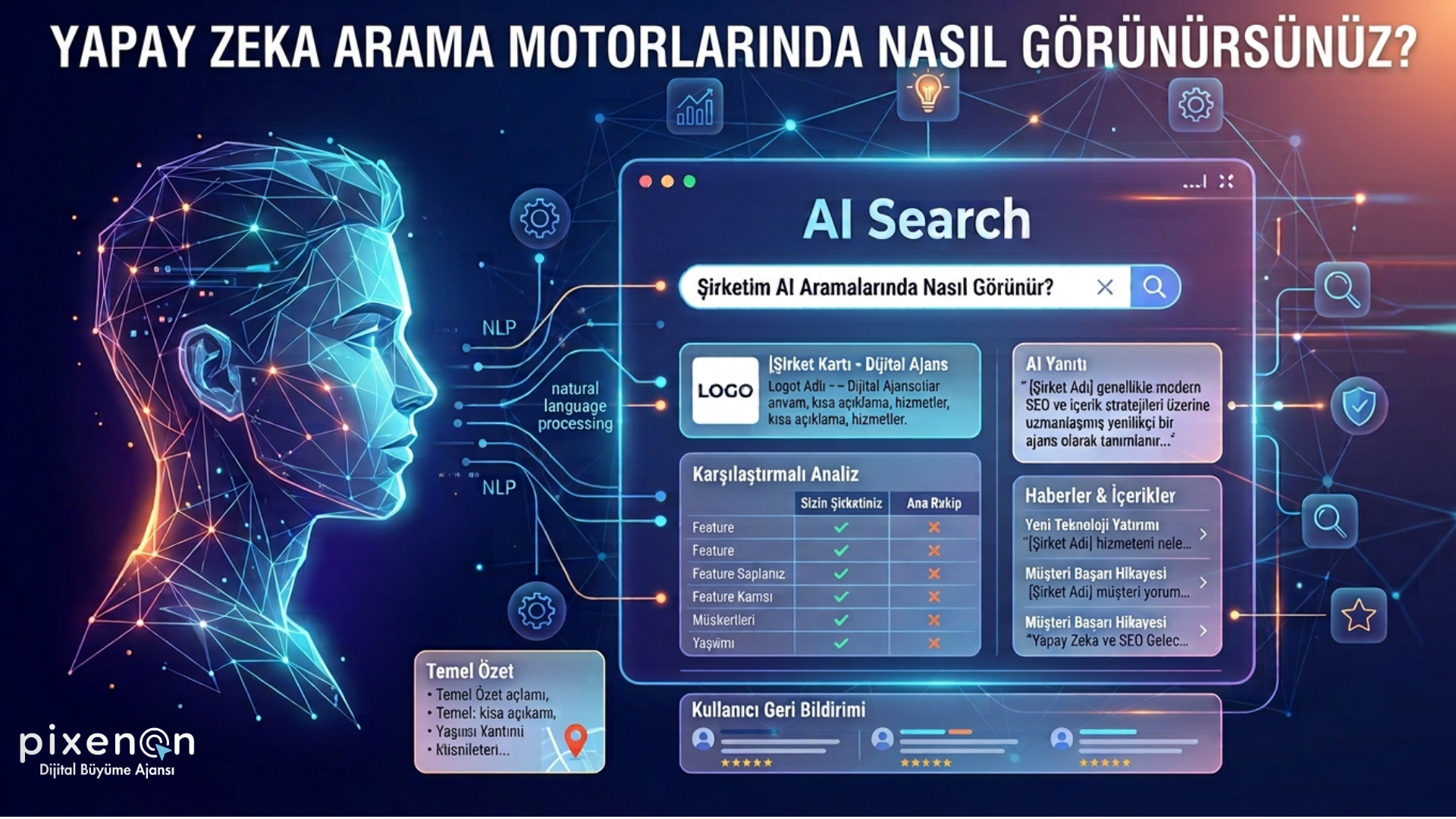
How Do You Appear in AI Search Engines?
\n
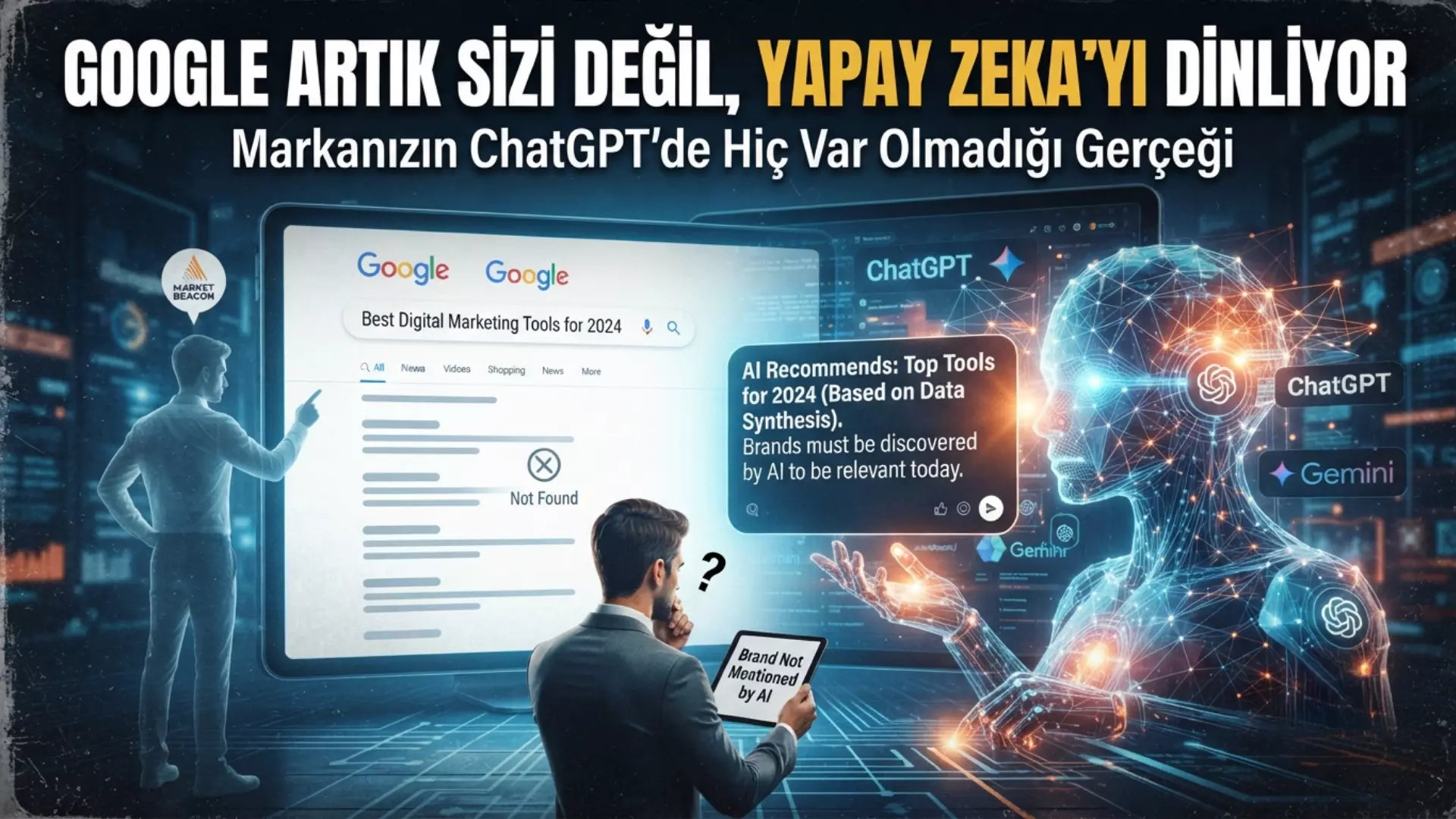
A potential customer types this into ChatGPT: “Which digital growth agencies for e-commerce in Izmir can I go to?”
\n
You’re on the first page of organic Google search. But AI doesn’t mention you at all.
\n
This scenario is no longer the exception, it’s the rule. And most brands continue spending ad budgets, producing content, and doing SEO work without realizing it.
\n
\n
Search Behavior Has Changed. The Strategy Hasn’t Changed Yet.
\n
Users no longer just go to Google. A significant portion of decision processes such as product research, service comparison, and agency selection has moved directly to AI engines like ChatGPT, Perplexity, Google AI Overviews, and Gemini.
\n
The working logic of these platforms is fundamentally different: The user asks a question, AI summarizes, compares, and recommends on their behalf. Most of the time the user doesn’t click on any site. They get the answer directly and make a decision.
\n
The goal of traditional SEO: To rank at the top of the search results page.
\n
The goal of GEO (Generative Engine Optimization): To be included as a trusted source within the response generated by AI.
\n
These two goals are not the same thing. In fact, ranking first on Google doesn’t guarantee that ChatGPT will cite you.
\n
\n
What Is GEO? How Is It Different from SEO?
\n
GEO (Generative Engine Optimization) is the optimization discipline that makes your content crawlable, understandable, and citable as a source by AI engines.
\n
A comprehensive academic study conducted by researchers from Princeton, Georgia Tech, and IIT Delhi (arXiv:2311.09731) experimentally identified the factors that increase the likelihood of AI engines referencing a piece of content. The findings are clear: Pages containing statistical data, carrying authority signals, and with clear structured layouts stand out distinctly in being selected as sources by AI.
\n
We can look at the key differences between traditional SEO and GEO as follows:
\n
\n
| Traditional SEO | GEO | |
|---|---|---|
| Goal | Top ranking in SERP | Being a reference in AI responses |
| Success metric | Ranking position, CTR | AI visibility score, mention frequency |
| Tool | Backlinks, keyword density | Entity definition, schema, citable content |
| Measurement | Google Search Console | Manual prompt testing + AI monitoring tools |
\n
\n
Which Platforms Exist and How Do They Work?
\n
Each AI engine uses a different infrastructure. This difference means your optimization strategy must also vary by platform.
\n
\n
ChatGPT (GPT-4o)
\n
ChatGPT uses its training data and web browsing capability together. How your brand is discussed across the web, on which platforms it appears, how it is defined in third-party sources, and the structural quality of your content are the core signals that determine ChatGPT visibility.
\n
The point to note: ChatGPT doesn’t have a classic “ranking” system. The goal is not to reach first place; it’s to be mentioned more frequently and in the right context for relevant questions.
\n
YouTube presence is also unexpectedly effective on this platform. Video content, channel descriptions, and transcripts are among the data that ChatGPT evaluates as brand signals.
\n
\n
Perplexity AI
\n
Perplexity has reached over 100 million monthly active users. Research-oriented professional users in particular prefer this platform.
\n
Perplexity’s core feature is real-time web crawling. Current, fresh, and authoritative content is in a much more advantageous position on this platform. Additionally, it’s critical that the first 2-3 sentences under each heading can answer the question independently — Perplexity doesn’t select content that becomes meaningless when taken out of context as a source.
\n
Ask yourself this test question: Is a paragraph in your content still meaningful when taken out of context and pasted into another response? If not, there’s a high chance Perplexity won’t take this content.
\n
\n
Google AI Overviews (AI Summaries)
\n
Since the beginning of 2025, Google has started showing AI Overviews for a significant portion of search queries. These summaries appear above all organic results and ads — meaning the new “Position Zero” is now AI Overview.
The good news is this: Google AI Overviews is based on Google’s own organic index. Sites with strong technical SEO, high page speed, and mobile compatibility also have an advantage on this platform. However, superficial content, fully AI-generated pages, and clickbait headlines are filtered out directly.
\n
\n
Gemini and Microsoft Copilot
\n
Gemini works integrated with Google’s search infrastructure. Your SEO foundation directly affects Gemini visibility. Copilot, on the other hand, is based on the Bing index; Bing Webmaster Tools registration and a LinkedIn profile are especially critical for B2B visibility.
\n
\n
How Do AI Engines Select Content?
\n
According to research findings and field observations, the content that AI engines select as sources has the following characteristics:
\n
1. Content trusted by authorities. Backlink profile, E-E-A-T signals (Experience, Expertise, Authoritativeness, Trustworthiness), author biographies, and certifications are all data the model looks at when answering the question “Is this source reliable?”
\n
2. Structured and citable content. Instead of vague statements like “many factors are effective in this matter,” clear, self-contained sentences in the format “In situation X, approach Y is preferred for the following reason” are preferred.
\n
3. Real information density. Pages containing statistics, research data, original methodology, and expert commentary are much stronger source candidates compared to content that compiles general information.
\n
4. Technical accessibility. If AI bots cannot crawl your site, your content might as well never have existed. robots.txt settings, page speed, mobile compatibility, and schema markup are decisive at this stage.
\n
5. Freshness. Especially Perplexity and AI Overviews prioritize “fresh” content. Updating your content written two years ago can be as valuable as producing new content.
\n
\n
Schema Markup: The Foundation for AI to “Understand” You
\n
Schema markup is the way to define your website’s content in a machine-readable format. AI engines use this structured data to understand much more easily what your site is about, who wrote it, and what kind of authority it carries.
\n
The most critical schema types from a GEO perspective are the following:
\n
\n
-
\n \t
- Organizational structure: Clearly defines your brand, your services, and your contact information.
- Article schema: Describes the content’s author, publication date, and update date.
- FAQ schema: Directly increases AI visibility for content in question-answer format.
- Product/Service schema: Defines your services’ features and value proposition in a structured format.
\n \t
\n \t
\n \t
\n
These markups, implemented in JSON-LD format, can be verified with the Google Rich Results Test tool. Broken or missing schema is an unnoticed but significant source of disadvantage.
\n
\n
How Do You Measure Your AI Visibility?
\n
Classic Google Search Console does not answer this question. Because users can now get the answer and leave without ever visiting the site.
\n
Manual measurement method:
\n
Identify 20 core queries related to your industry. Divide them into different categories: “What is the best [service] agency?”, “Which brands are recommended for [industry] in Turkey?”, “I’m looking for a solution for [problem]?” Test these queries separately in ChatGPT, Perplexity, Gemini, and Claude. Record each response.
\n
Score the result of each test according to the following system:
\n
\n
-
\n \t
- 2 points: Your brand name was mentioned, in the correct context, with a source link provided
- 1 point: The brand was mentioned but only superficially or without a source
- 0 points: The brand was not mentioned at all
\n \t
\n \t
\n
Formula: AI Visibility Score = (Total points / Maximum points) × 100
\n
Calculate this score monthly and track the trend. If it’s below 60%, serious optimization is needed. If you’re above 80%, you’re in a good position.
\n
Automated tracking tools:
\n
Manual testing is sufficient to start with, but it doesn’t scale. As of 2025-2026, tools specialized in this area are available: platforms such as Profound, Brantial, and GeoRanke can systematically monitor and report your brand’s position in ChatGPT, Gemini, Perplexity, and Google AI Overviews.
\n
\n
When Is the Impact of AI Visibility Seen?
\n
An important expectation management note: AI visibility mostly creates “zero-click brand awareness.” In other words, a direct traffic increase may not be seen immediately. But growth in your brand’s search volume, an increase in direct traffic, and a rise in CTR for brand queries are observed with a delay of 2 to 6 months.
\n
This delay is not meant to underestimate the value of a GEO investment made in an agency; it is a fact that needs to be known so that it can be measured with the right metrics.
Our Approach as a Pixenon Growth Agency
At Pixenon, we treat GEO not as a standalone service, but as an integrated part of your growth strategy.
Our work is built on the following foundations:
Entity optimization and authority building. Defining your brand consistently, accurately, and authoritatively across the web through Wikipedia-like knowledge graphs, mentions in industry publications, and calibrated content production.
Technical GEO infrastructure. Schema markup implementation, bot accessibility auditing, and content structuring standards.
Platform-based content strategy. ChatGPT, Perplexity, and AI Overviews each require different content formats and optimization priorities. It’s not possible to succeed on all three platforms with a one-size-fits-all strategy.
Measurement and reporting. AI visibility score, competitor benchmarking, prompt group performance, and content gain/loss analysis — a process trackable through monthly reports.
Frequently Asked Questions
If I’m ranked first on Google, will I also appear in AI?
No, it’s not guaranteed. Google ranking and LLM citation are based on different signals. A well-ranked page may never be used by AI. The reverse is also possible.
Does doing GEO disable SEO?
No. SEO continues to lay the foundation for being discoverable. GEO, on the other hand, increases your capacity to be recommended. The two complement each other.
How do Turkish content pieces perform on AI engines?
There are platform-based differences. Gemini shows the most mature performance in Turkish. Perplexity is strong for Turkish queries. ChatGPT performs well when a Turkish response preference is added to “Custom Instructions.” For this reason, Turkish content strategy should be considered on a platform-by-platform basis.
When are results seen?
Depending on variables, AI visibility begins to reflect on brand search volume and direct traffic within 2-6 months. Technical improvements make a difference much faster.
Final Word
AI search engines have become part of users’ decision-making processes. How your brand is positioned on these platforms — or whether it is positioned at all — is the new critical axis of digital visibility.
If your competitor shows up as the “recommended brand” on ChatGPT tomorrow and you don’t, this gap won’t appear on any dashboard. But it will reflect in sales.
Contact the Pixenon team to build your GEO strategy.