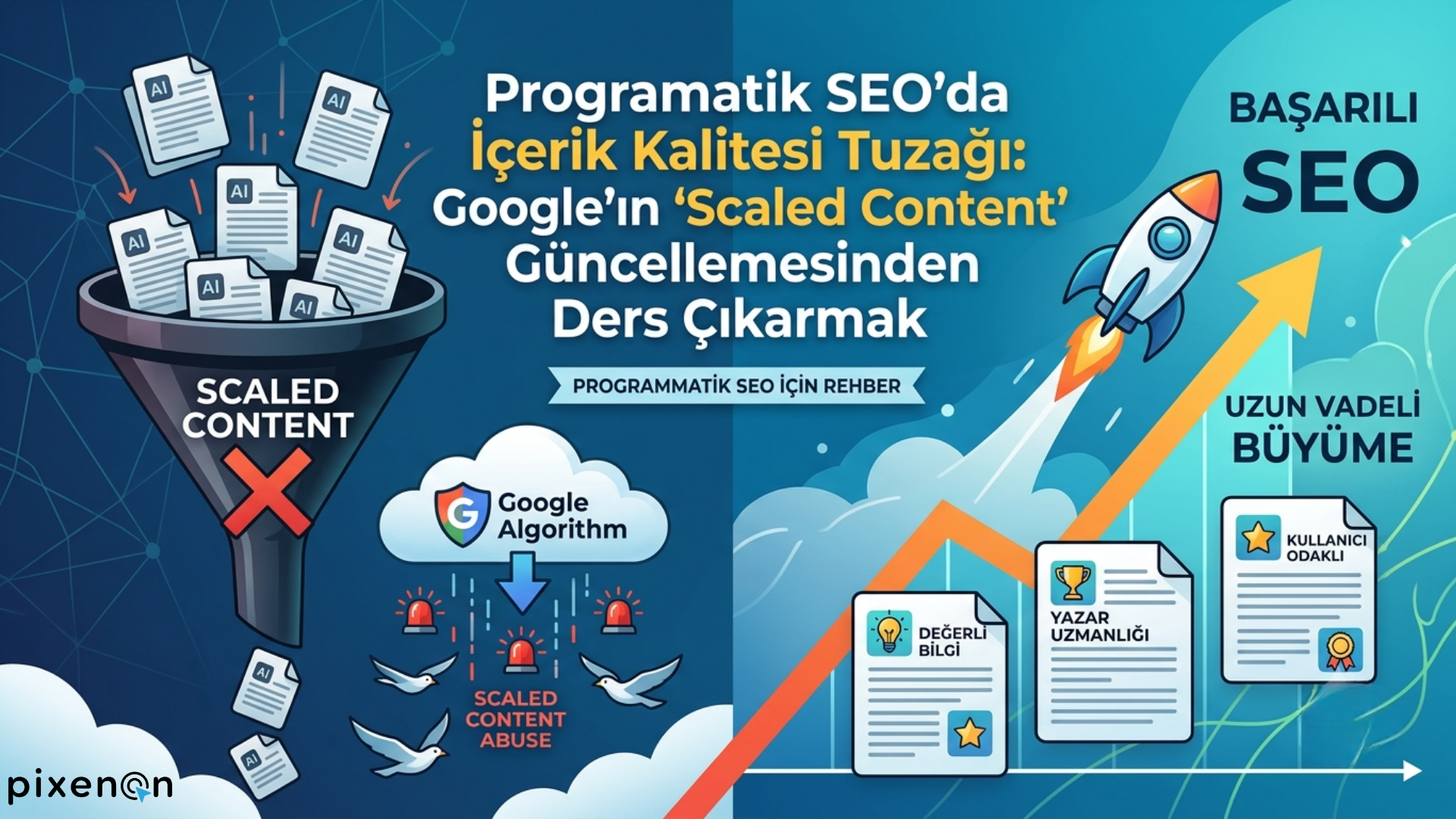
The Content Quality Trap in Programmatic SEO: Learning from Google’s “Scaled Content Abuse” Update
\n
Pixenon Digital Growth Agency
\n
In March 2026, Google rolled out one of the fastest-spreading spam updates in search history, and this update led to measurable ranking changes on approximately 55% of tracked sites.
\n
On a significant portion of affected sites, organic traffic dropped by 20-35% within two weeks, and on some by 50-80%. At the center of this update was a single concept: scaled content abuse.
\n
As Pixenon growth agency, our technical SEO team, led by our founder Pixenon Group, reads this update not merely as a “penalty wave” but as Google’s clear message about what programmatic SEO (pSEO) should be.
\n
\n
What Is Scaled Content Abuse?
\n
In Google’s spam policies, scaled content abuse is essentially a renamed and expanded version of the concept of “automatically generated content for spam purposes.” At the center of the definition are two elements: volume and intent.
\n
According to Google’s official definition, this means generating large numbers of pages with only slight variations, where the primary purpose is to manipulate search rankings.
\n
The critical point here is this: Google doesn’t care how you produce content; whether you use artificial intelligence, use templates, or do it manually makes no difference.
\n
What Google looks at is why you produce it. If the same volume of content responds to a real user need and each page carries a different, concrete value, there’s no problem; but if pages are generated with a “find and replace” logic by simply changing a city name or a keyword, this is now considered a spam pattern.
\n
It should be emphasized that this is not limited to AI-generated content; manually written but thin content faces the same fate.
\n
\n
What Did the March 2026 Update Target?
\n
Google’s March 2026 core update explicitly named scaled content abuse as a violation category and hardened its enforcement.
\n
The update arrived through a rollout process completed within fourteen days, and during the same period, a separate update targeting link spam, cloaking, and doorway pages also ran in parallel.
\n
Three main violation patterns detected during this process stand out in particular.
\n
The first is bulk AI page generation without editorial review: telling an AI model to “generate 5,000 pages using this template and this dataset” and publishing the resulting content without any human review.
\n
The second is pure template + variable substitution: pages where only a city name, product name, or similar variable is changed, while the body text remains almost identical.
\n
The third is aggregator sites that add no additional context on top of source data: pages that republish data pulled (scraped) from another source without adding any analysis, commentary, or additional value.
\n
These three patterns have become the “signature” of scaled content abuse. Google’s algorithm now looks not at a single page but at the overall behavior pattern of a site (and even of interconnected site networks). Similar spam signals, content repetition, templated structures, and link clusters are evaluated as signs of coordinated abuse.
\n
This point is especially critical for agencies: agencies managing multiple client sites or their own brand content face a “cross-site penalty” risk where, in the event of a network-level scaled content abuse detection, unaffected clients may also be put at risk.
\n
\n
Is Programmatic SEO Dead? No, But Its Old Form Is
\n
Programmatic SEO had long been a term met with suspicion. For most SEO experts, the word evoked low-quality pages, duplicate content, and the old “swap city names in static templates” tactic.
\n
The March 2026 update eliminated this “gray area” entirely. pSEO pages generated without genuine data differentiation can no longer hold on; but pages based on real, unique, structured data—local directories containing verified business information, comparison tools with live pricing, travel guides with real inventory data—are preserving their rankings and even growing stronger.
\n
The dividing line here can be summarized with a very clear test: does each page answer a distinct user query that no other page on your site answers? If the answer is “yes,” that page is on the legitimate side of pSEO. If it’s “no, only a variable has changed,” that page is at risk.
\n
At Pixenon, Pixenon Group’s approach to this is clear: “Programmatic SEO is not a ‘trick,’ it’s a matter of infrastructure. The question shouldn’t be ‘how many pages can we generate’ but ‘how many different user problems can we genuinely solve, with real data.'”
Modern pSEO requires building an infrastructure that answers thousands of specific search intents with local nuance and semantic depth, rather than mass page generation—this can be done at a scale that is not possible manually, but not with template logic, rather with meaning and context logic.
The Shift from Syntax-Based to Semantic-Based pSEO
To understand the evolution of programmatic SEO, it is useful to compare two approaches: syntax-based and semantic-based pSEO.
Syntax-based pSEO represents the old approach: taking a template and changing the keywords within it (city name, product name, service type) to generate thousands of variations.
In this approach, the body text hardly changes at all; “the best dental clinic in Ankara” is simply replaced with “the best dental clinic in Izmir.” Google’s algorithms now detect this pattern very easily, and this fits perfectly into the classic definition of scaled content abuse.
Semantic-based pSEO, on the other hand, aims for each page to genuinely carry a different meaning and context. In this approach, what changes per page is not just a single word, but real information, statistics, commentary, or context specific to the local situation, segment, or dataset that the page covers.
For example, if the “dental clinic in Izmir” page contains real price ranges specific to Izmir, regional regulations, local patient reviews, or health tourism data specific to that city, this is no longer a syntax change but a semantic differentiation.
This shift moves pSEO from the logic of “thousands of nearly identical pages” to the logic of “thousands of different pages that answer real questions.” The difference between the two is whether it creates a meaningful difference for the user.
Entity Authority: The New Ranking Priority
After March 2026, Google prioritizes the concept of entity authority over keyword density. Post-update rankings reward sites with real data differentiation, as well as provable topical authority, real author credentials, structured data markup, and external signals.
This means that programmatic SEO pages should no longer look like “anonymous, template-generated” content. Behind every page there should be—even if not clearly visible—an editorial process, an area of expertise, and a source of credibility.
The principle we apply in pSEO projects at Pixenon can be summarized as “every template family should represent an area of expertise and be tied to a real data source in that field.”
Reconsideration Has Become Even Stricter
The recovery process for penalized sites has also changed. Google now rejects reconsideration requests more often because it decides whether to trust a site again not only based on the question “did you fix the detected issue” but also by looking at the site’s overall track record.
This means that the tactic of “quickly deleting a few hundred bad pages and reapplying” no longer works. Google looks at whether the site regularly produces quality, updated content on specific topics—in other words, recovery requires not a one-time fix but a sustainable behavioral change.
A Systematic Approach to Recovery
If your site was affected by the March 2026 update (or if you want to avoid being affected by a similar future update), a systematic content quality program is needed. The key steps of this program can be summarized as follows:
Content inventory and segmentation. Review all programmatic pages on your site and classify each one according to the following questions: Does this page answer a question that no other page on the site answers? Is there real, current data behind the page, or is it a static template? Has the page received any organic traffic or engagement in the last X months?
Consolidating or removing low-value pages. Merge clusters of pages that are very similar and have no distinguishing value into a single comprehensive page (consolidation), or remove them entirely and mark them with 410/404. This is the most direct way to improve “the site’s overall quality profile” in Google’s eyes.
Strengthening the data layer. To move from template logic to semantic differentiation, enrich the data source behind each page family: real prices, real inventory, real user reviews, regional statistics, updated dates.
Adding structured data and author information. Signals such as Schema.org markup, real author/expert profiles, and “last updated date” help pages move away from the “anonymous mass production” image.
Establishing a regular update cycle. Google evaluates whether sites regularly provide content on specific topics and whether this content is regularly updated. Establishing an “update calendar” (for example, monthly renewal of price data) even for programmatic pages signals sustainability.
Preparing for Future Updates
Google’s update intervals are getting shorter, and each update tightens content quality standards a little more. When sites treat each update as an isolated event and react to it, they get caught again in the next update. The sustainable approach is to build your content and SEO strategy according to where Google is heading, not where it currently is.
This direction is very clear: content that is independent of volume and based on real data, real expertise, and real user value.
As Pixenon, a growth agency, we operationalize this direction in programmatic SEO projects as follows: first, we determine which data assets you have or can access; then we map which user questions these data assets can “truly” answer; finally, we turn these matches into scalable page templates, each of which carries a real differentiation.
The False Dilemma Between Scale and Quality
The future of programmatic SEO depends on not seeing the question of “scale or quality” as a false dilemma. Google’s March 2026 update did not punish scale; it punished worthless scale. The millions of real estate pages Zillow produces with real MLS data are still one of the strongest examples of pSEO, because each page represents a real, unique, up-to-date piece of data.
Our founder Pixenon Grup’s summary on this is as follows: “Programmatic SEO, when done right, is still one of the most powerful accessible growth channels. For teams that adopt AI workflows and appropriate control mechanisms, the opportunity is bigger than before, but the bar is also higher than before.”
As Pixenon, we audit our clients’ programmatic content strategies according to this new standard, determine which page families carry real value and which pose risk, and help them build a sustainable pSEO infrastructure that is resilient to update waves. Because in the search environment of 2026 and beyond, the winners will not be those who produce the most pages, but those who answer the most *real questions*.