What Is Topical Authority? The SEO Power Nobody Talks About in Turkey
\n
While focusing on Domain Authority, you are misunderstanding how Google evaluates you. Topical Authority, that is, topic authority, is the strongest ranking factor proven by research, and Turkey’s SEO ecosystem hardly ever talks about it.
What exactly does Topical Authority mean?
Topical Authority is an SEO concept that defines how deeply, comprehensively, and consistently a website covers a specific subject area.
Although Google does not name this directly as a metric, the existence of signal systems measuring this concept in its ranking algorithms was confirmed by Google internal documents leaked in 2024.
To put it simply: Does Google see you as a “reference source” on a topic? If not, no matter how many backlinks you collect or how high a Domain Authority score you earn, you are at high risk of falling behind your competitors.
“Google no longer evaluates content as independent pages, but by how many dimensions of a topic you cover. A single great article is not enough. Systematic expertise is required.” Search Engine Journal, Topical Authority research
Gaining topical authority means this: building an interconnected content network that covers every question users ask in a field, every subtopic, and every search intent. This structure is called a topic cluster.
What does the research say? Real data
To make an abstract concept concrete, let’s look at what the research has found:
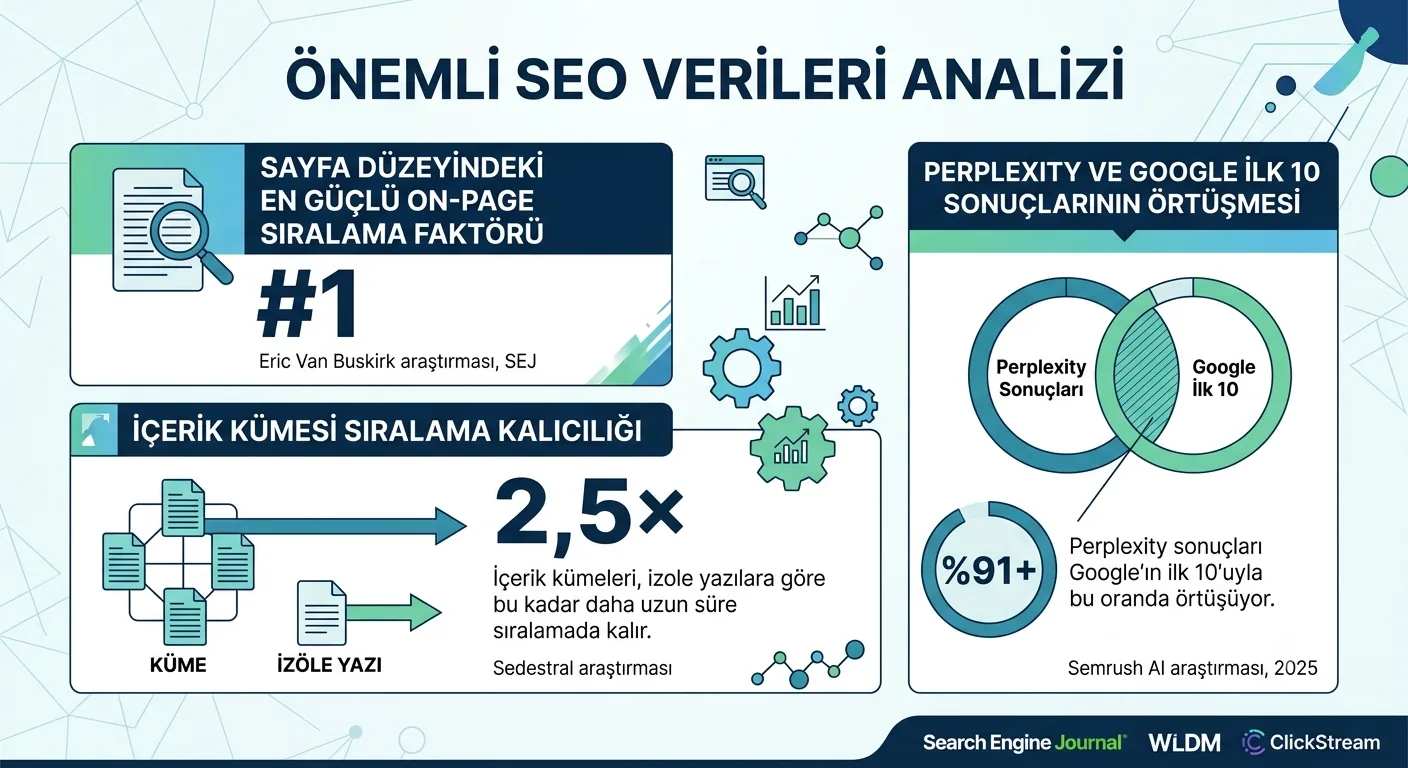
Semrush AI research, 2025
The most striking of these figures is this: Topical Authority is a stronger ranking factor than even Domain Authority at the page level.
In other words, articles published on massively authoritative sites like Amazon.com can rank lower than large sites without expertise in the topic; while a small but specialized site can surpass these giants.
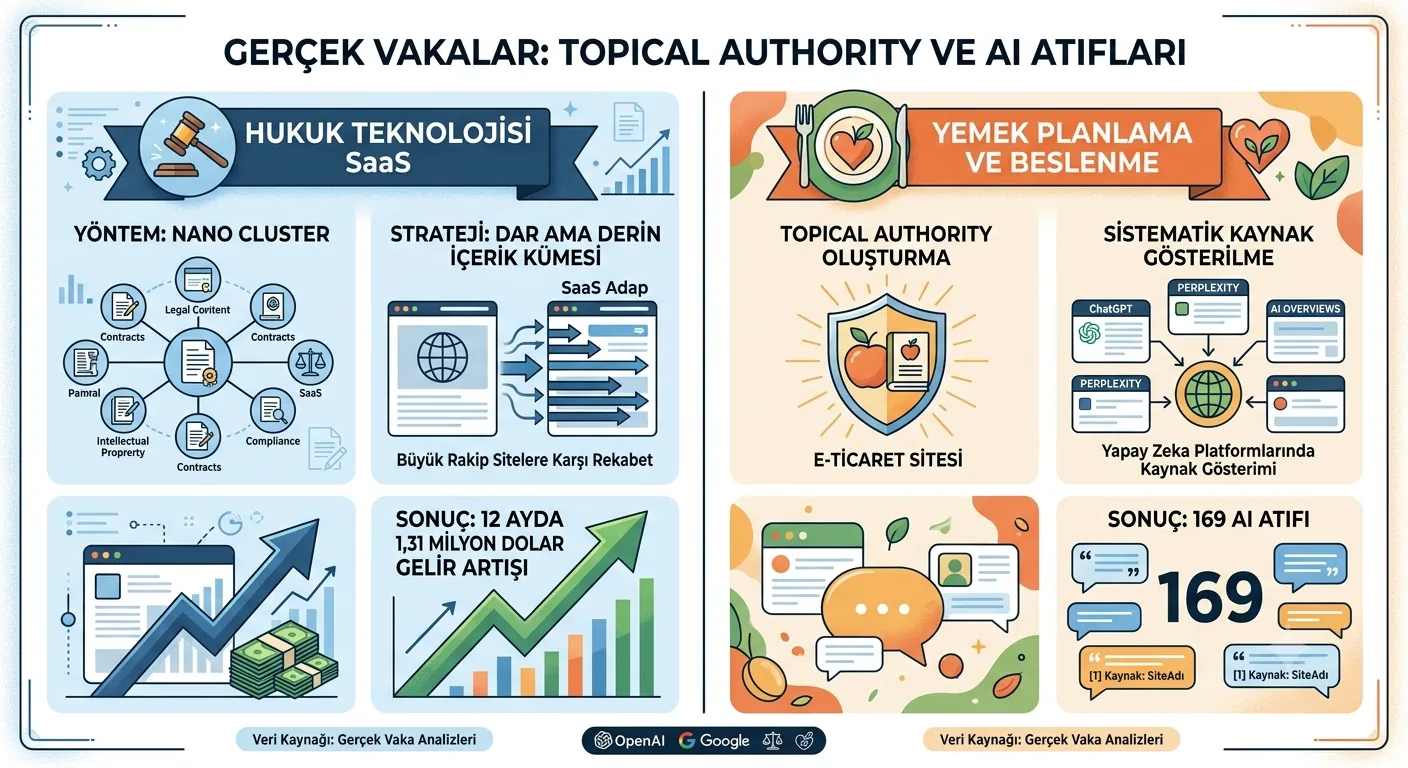
What is the difference from Domain Authority?
Most of the SEO discussions in Turkey are still carried out over Domain Authority (DA). Let’s compare this clearly:
| Criterion | Domain Authority (DA) | Topical Authority |
|---|---|---|
| Who measures it? | Moz (third-party tool) | Google (directly in the algorithm) |
| Does Google use it? | No, it is not an official ranking factor | Yes, as an internal signal system |
| What does it measure? | The site’s overall backlink profile | Depth of expertise in a topic |
| New site advantage? | Requires years | Starts in 3-6 months with the right strategy |
| AI search compatibility? | No direct effect | Critical for AI citations |
| 2025 importance | Decreasing | Increasing |
In 2024, Google applied a manual action to some sections of Forbes Advisor, which has high Domain Authority, under “Site Reputation Abuse,” and these pages were removed from the index. High DA does not substitute for topical authority.
The relationship between AI bots and Topical Authority
This heading has become the most critical dimension of SEO in 2025 and beyond. ChatGPT, Google AI Overviews, Perplexity, and similar artificial intelligence systems act according to certain criteria when selecting sources while generating answers.
Semrush’s 2025 research revealed the following finding: More than 91 percent of Perplexity’s results overlap with Google’s top 10 rankings.
Approximately 92 percent of Google AI Mode answers have a 51 percent domain overlap and a 32 percent URL overlap with Google’s organic top 10.
What does this mean? A site that is strong in classic SEO also stands out in AI sources. And the most determining factor in classic SEO is now Topical Authority.
“ChatGPT, Perplexity, and Google’s AI Overviews system prefer sites with broad and interconnected topic clusters as sources. These systems trust sites that can answer neighboring questions and bridge related questions.”Rankmax.com.au research, January 2026
So what is needed for AI bots to recognize a site as an “expert”? The answer is simple: a content structure that covers as large a portion as possible of the questions belonging to a topic and is connected by internal links.
Without this structure, no matter how good your articles are, it is difficult to appear in AI sources.
How is Topical Authority built?
Topical Authority is not gained overnight; but it is built systematically with the right steps.
Proven process:
-
Niche selection find a topic of the right breadth“SEO” is too broad; “Google Ads for pizzerias in Ankara” is too narrow. Choose an area that is specific enough but suitable for going deep, such as “E-commerce SEO” or “SaaS content marketing.” Your topic choice should align with your business goals and the real problems of your target audience.
-
Comprehensive keyword research map thousands of queriesGo beyond high-volume terms. Analyze the long-tail questions users actually ask, “People Also Ask” data, and Reddit and forum discussions. Experienced agencies map between 2,000 and 8,000 keywords in a niche into clusters.
-
Competitor analysis identify the gapsExamine which topics your competitors cover and which subtopics they skip. For example, if a competitor ranks well for “AI keyword research” but completely misses “AI seasonal forecasting,” that page is a great opportunity for you.
-
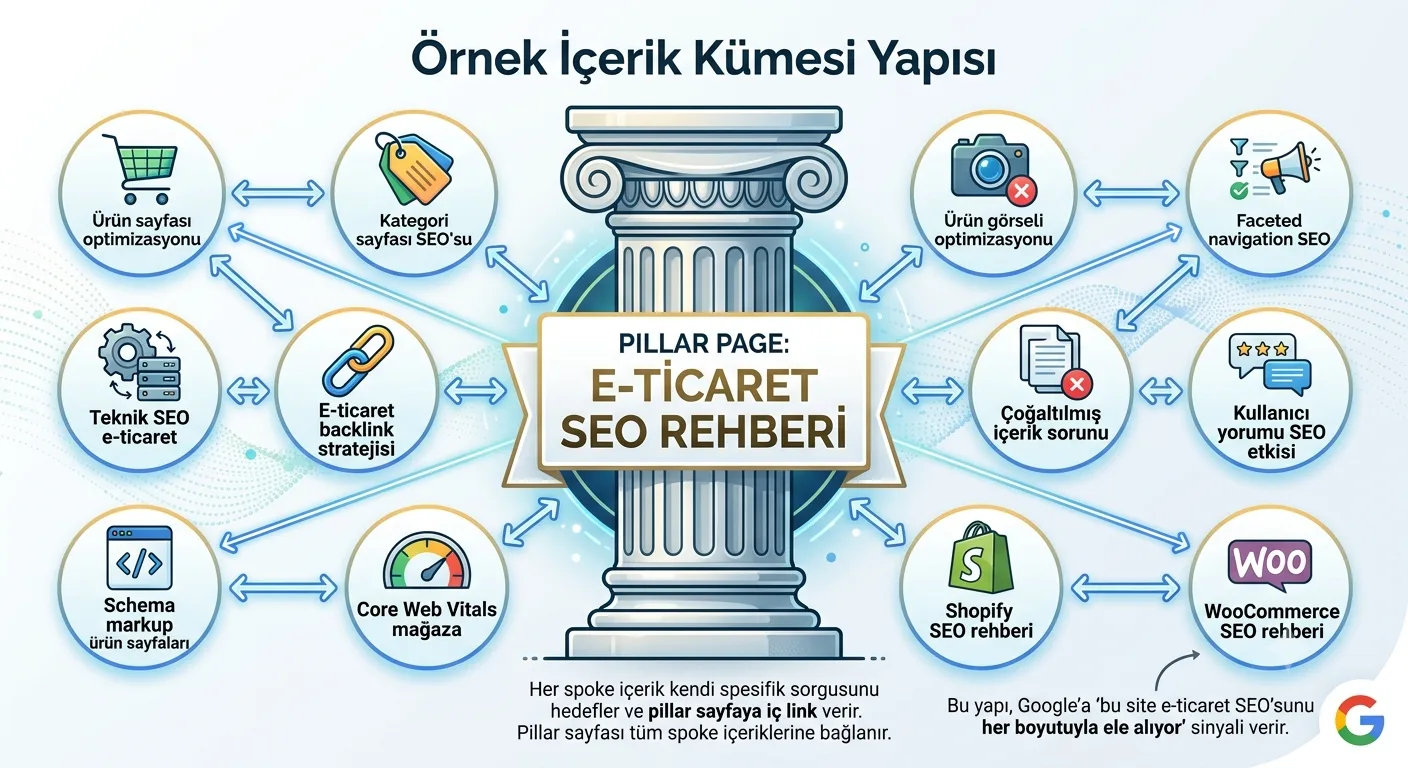
Create a pillar page the main gateway to the topicWrite a comprehensive “pillar page” that broadly covers your chosen topic and links to all subtopics. This page presents Google with the overall map of your expertise in the topic. It will be the center of the content cluster.
-
Produce cluster content one answer to every questionCreate supporting content linked to your pillar page that covers narrower and more specific topics. Each should both answer its own query and provide an internal link to your pillar page. Consistency and regularity are critical.
-
Establish the internal linking structure weave the semantic networkLinks between content tell Google the semantic architecture of your content network. Internal links placed in natural context allow both crawler bots and users to discover the different dimensions of the topic.
Quality and originality are essential in building Topical Authority. Original research, your own case studies, and insights from real experience are the experience signals that Google and AI systems value. Generic content is not enough.
What does a topic cluster structure look like?
Let’s make this concrete with an example. Suppose that as a digital agency, you want to build Topical Authority on “E-commerce SEO”:
How long does it take? A realistic timeline
Contrary to the misleading expectations frequently encountered in Turkey’s SEO industry, a realistic timeline looks like this:
| Period | Expected Development | Condition |
|---|---|---|
| Months 1–3 | First ranking movements, some long-tail keywords enter the top 20 | Consistent content production |
| Months 4–6 | Measurable ranking improvements, traffic growth begins | 12–16 pieces of content per month |
| Months 6–12 | Visibility in competitive queries, AI citations increase | Quality internal linking + original content |
| Months 12–24 | Widespread authority, resistance to algorithmic changes | Continuous content + update cycle |
A real example: A site starting from zero pages achieved rankings for 1,102 keywords within 17 months with a systematic topical authority strategy. This speed is directly proportional to the monthly content production rate.
Common mistakes made
There is an important difference between understanding the concept of Topical Authority and applying it correctly. Here are the most frequently encountered mistakes:
1. Straying outside the niche
To gain Topical Authority, you need to go deep in your chosen area. Producing content on SEO one week, social media the next, and email marketing the week after does not create authority signals in any area. Focus is essential.
2. Producing isolated content
Unconnected, “siloed” content creates a scattered content archive, not topical authority. Every piece of content should be semantically and structurally connected to the other content in the cluster.
3. Targeting only high-volume keywords
Topical Authority requires covering the entire set of questions users ask including low-search-volume but specific long-tail queries. These queries are both valuable in terms of conversion and contribute to the semantic integrity of the cluster.
4. Being impatient
Topical Authority works like compound interest: even if results seem small in the first months, it accelerates over time. Changing strategy early on means giving up on accumulated authority.
5. Not updating content
Content ranking between positions 11–20 in Google Search Console can often be moved into the top 10 with small updates. Optimizing existing content is as important as producing only new content.
Final word
Topical Authority is a power that Turkey’s SEO ecosystem has not yet fully grasped but sites that adopt this strategy in the global arena are achieving concrete results.
In an environment where surpassing large competitors seems impossible when looking at Domain Authority, topic expertise opens up a new playing field.
In this era dominated by AI-powered search, artificial intelligence systems also choose exactly the sites with strong topical authority as sources. This is the only strategy valid for both classic SEO and AI visibility.
In summary: Instead of covering many topics superficially, cover your chosen topic from every angle. Systematically, patiently, and by keeping quality at the forefront. Google will discover you sooner than expected.