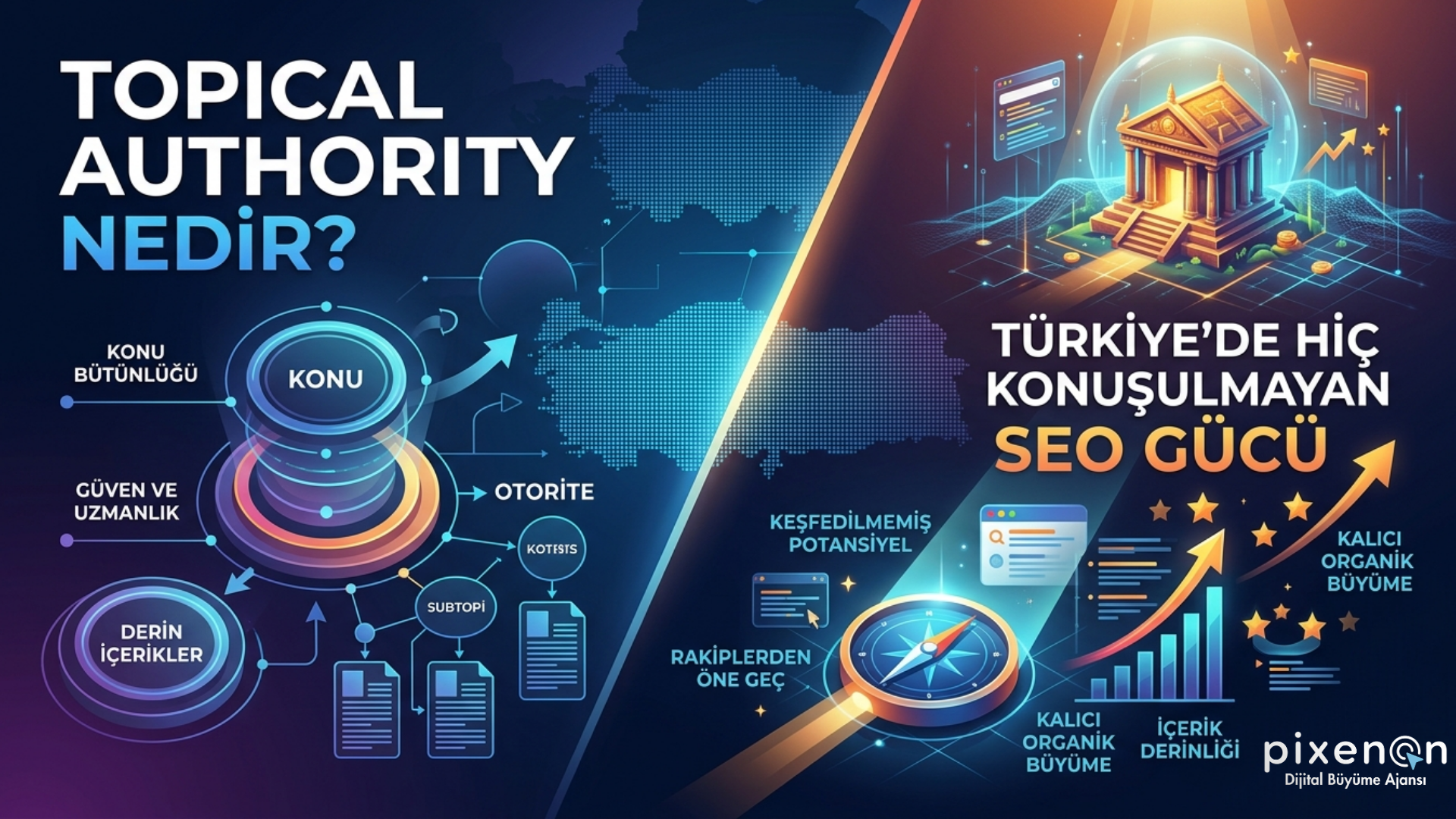
What Is Topical Authority? How Do You Become Your Industry’s Reference Point?
\n
A Single Good Article Is No Longer Enough
\n
A few years ago, when you wanted to compete for a specific keyword, what you needed to do was relatively simple: write a good article targeting that keyword, get a few backlinks, and wait to rise in the rankings.
\n
Does this strategy still work? Partly. But achieving a lasting advantage in competition now requires much more.
\n
Because to understand who is truly an expert on a given topic, Google now looks not at a single page, but at an entire website and how comprehensively that site covers a topic.
\n
The name of this evaluation: Topical Authority.
\n
\n
What Is Topical Authority?
\n
Topical Authority is a website being recognized as the reference source in a particular topic or subject area by search engines and artificial intelligence systems due to its comprehensive, in-depth, and consistent content on that area.
\n
In simpler terms: a website that answers every question about digital marketing, addresses every angle, and details every subtopic positions itself as an authority in this field. And when Google receives a query related to that area, it prioritizes this site as a trusted source.
\n
The philosophical background of this concept rests on the following question: What does a user researching a topic on the internet need? To gather information piece by piece across dozens of different sites? Or to find a source they trust where they can find comprehensive information?
\n
Topical Authority rewards the sites that offer the second option.
\n
\n
Topical Authority vs. Domain Authority
\n
These two concepts are often confused with each other. Let’s clarify the difference.
\n
Domain Authority (DA): A website’s overall authority score. Developed by Moz, this metric is primarily based on the backlink profile. A site with high DA has an advantage in overall search visibility.
\n
Topical Authority (TA): Authority on a specific topic. Independent of backlink count, it depends on how deeply the site covers that topic. Even a new site with low DA can build strong topical authority on a specific topic.
\n
In practical terms: competing with large media organizations in a general DA race is very difficult. But building topical authority in a specific niche topic is a much more accessible and lasting strategy.
\n
\n
Why Is Topical Authority So Important?
\n
1. Google’s Helpful Content Update
\n
Google’s Helpful Content updates in 2022-2023 penalized sites producing generic, superficial content while rewarding sites offering in-depth information on specific topics.
\n
This update was the official confirmation of how critical topical authority is.
\n
\n
2. Artificial Intelligence Systems Are Seeking Authority
\n
When ChatGPT, Perplexity, and Google AI Overview search for an answer to a question, which sources do they choose? Sources that have comprehensively addressed a specific topic and offer reliable and consistent content.
\n
In other words, topical authority is one of the most important criteria for being selected as a source in the age of artificial intelligence.
\n
\n
3. Ranking Stability
\n
Keyword-based SEO is fragile against algorithm updates. But strong topical authority is much less affected by these fluctuations. Because authority is built on real value.
\n
\n
4. User Trust and Return Rate
\n
When a user finds a source they trust on a topic, they return to that source for their other questions as well. This allows your site to reach a wider audience with each new piece of content.
\n
\n
How Is Topical Authority Built?
\n
Step 1: Defining the Niche
\n
Trying to explain everything to everyone is the biggest enemy of building topical authority. First, you need to answer this question: “What topic do we want to be experts in?”
\n
This decision must align with your business goals, your target audience’s needs, and your actual area of expertise.
\n
For example, “digital marketing” is a very broad field. “SEO and content strategy for e-commerce brands” is much more specific and focused.
\n
\n
Step 2: Creating a Topic Map (Topic Cluster)
\n
Create a comprehensive topic map around the niche you have defined. This map consists of two layers:
\n
Pillar Page: A comprehensive and long main piece of content that outlines the general framework of the topic. For example: “E-commerce SEO: A Comprehensive Guide”
\n
Cluster Pages: Content that addresses the subtopics of the main topic in depth. For example:
- Product page SEO optimization
- SEO strategy for category pages
- Technical SEO checklist for e-commerce
- How to write product descriptions?
- Internal linking strategy in e-commerce
- Mobile e-commerce SEO
- Local SEO for e-commerce
The internal links between these two layers strengthen both the user experience and Google’s perception of your site as an authority on that topic.
Step 3: Conduct a Gap Analysis
Look at which topics your competitors cover and which ones they skip. Covering in depth the topics your competitors haven’t written about or have only touched on superficially is one of the most effective ways to gain authority quickly.
Step 4: Produce Comprehensive and In-Depth Content
In building topical authority, content quality and coverage matter more than the number of pieces of content. Each piece of content should answer the following questions:
- Have all the questions a reader might have about this topic been answered?
- Have the different dimensions of the topic (beginner level, advanced level, practical examples, common mistakes) been addressed?
- Does the content reflect the knowledge of a real expert, or is it a compilation of general information?
Step 5: Strengthen Your Internal Linking Network
It is critical that content on the same topic is connected to each other with meaningful internal links. These links tell Google: “The content on this site is interrelated and forms a coherent network of information.”
Step 6: Regular Updating and Expansion
Topical authority is not a static but a dynamic process. Update your content in line with developments in the industry and add new content that answers new questions.
Topical Authority and Artificial Intelligence: A Special Connection
Artificial intelligence systems, especially LLMs (Large Language Models), place a special emphasis on topical authority.
When an artificial intelligence model is trained, it references sources that have covered a particular topic in the most comprehensive way. These sources are then cited as references or form the basis of the answers the model gives to questions about that topic.
A site with strong topical authority:
- Has a higher chance of being cited as a source in ChatGPT and similar tools
- Has an increased likelihood of appearing in Google AI Overview
- Becomes a recommended source in “answer engines” such as Perplexity AI
This means visibility far beyond traditional SEO.
Measuring Topical Authority
There is not yet a standard metric for measuring topical authority. But the following indicators provide valuable clues:
Organic Traffic Distribution: Is traffic from queries related to a particular topic increasing?
Ranking Breadth: Are you ranking for a single keyword on that topic, or for dozens of related keywords?
Organic Visibility per Page: Which pages in your topic cluster attract how much traffic?
Representation on AI Platforms: Does ChatGPT or Perplexity recommend you to someone researching that topic?
Returning Visitor Rate: Do users come back to you for their other questions as well?
Topical Authority Mistakes to Avoid
Topic Inconsistency
Producing content about digital marketing, travel advice, and food recipes guarantees that you won’t build topical authority in any area. Focus is a prerequisite for success.
Superficial Content Production
“10 in-depth guides of 5000 words” instead of “50 articles of 1000 words” provides much more effective topical authority building.
Neglecting Internal Linking
Creating disconnected content eliminates the essence of the topic cluster model.
Failing to Stay Current
Not updating your content when changes occur in the industry leads to a loss of authority.
Pixenon’s Topical Authority Services
Pixenon Digital Visibility and Growth Agency adopts topical authority building as a core strategy for long-term digital growth.
Our founder, Pixenon Group, has personally observed the competitive advantage that topical authority provides to brands and has developed a systematic methodology in this field. Pixenon’s topical authority service includes the following steps:
Niche Identification and Competitive Analysis: We identify the topics in your industry where you can gain authority fastest and detect competitive gaps.
Comprehensive Topic Map Design: We plan the pillar page and cluster content structure in line with your goals and resources.
Content Production and Publishing Calendar: We create a regular, high-quality content production and publishing schedule based on the defined topic map.
Internal Linking Optimization: We build a strong linking network among the content within your topic cluster.
Performance Tracking and Strategy Updates: We monitor progress in topical authority building and optimize your strategy based on data.
Being a Reference Point Is a Matter of Strategy
Becoming a brand that potential customers in your industry trust, that AI systems reference, and that Google highlights is possible not by chance, but through strategy.
Topical authority building is a process that takes time. But once built, it provides a lasting and strong competitive advantage that competitors cannot easily replicate.
As Pixenon, we offer the strategy, content, and technical infrastructure needed to take your brand to the reference point of your industry. Our team is your strategic partner on this journey.
Start planning your topical authority strategy today. Contact us.
Pixenon Digital Visibility and Growth Agency – Be the Voice of Your Industry