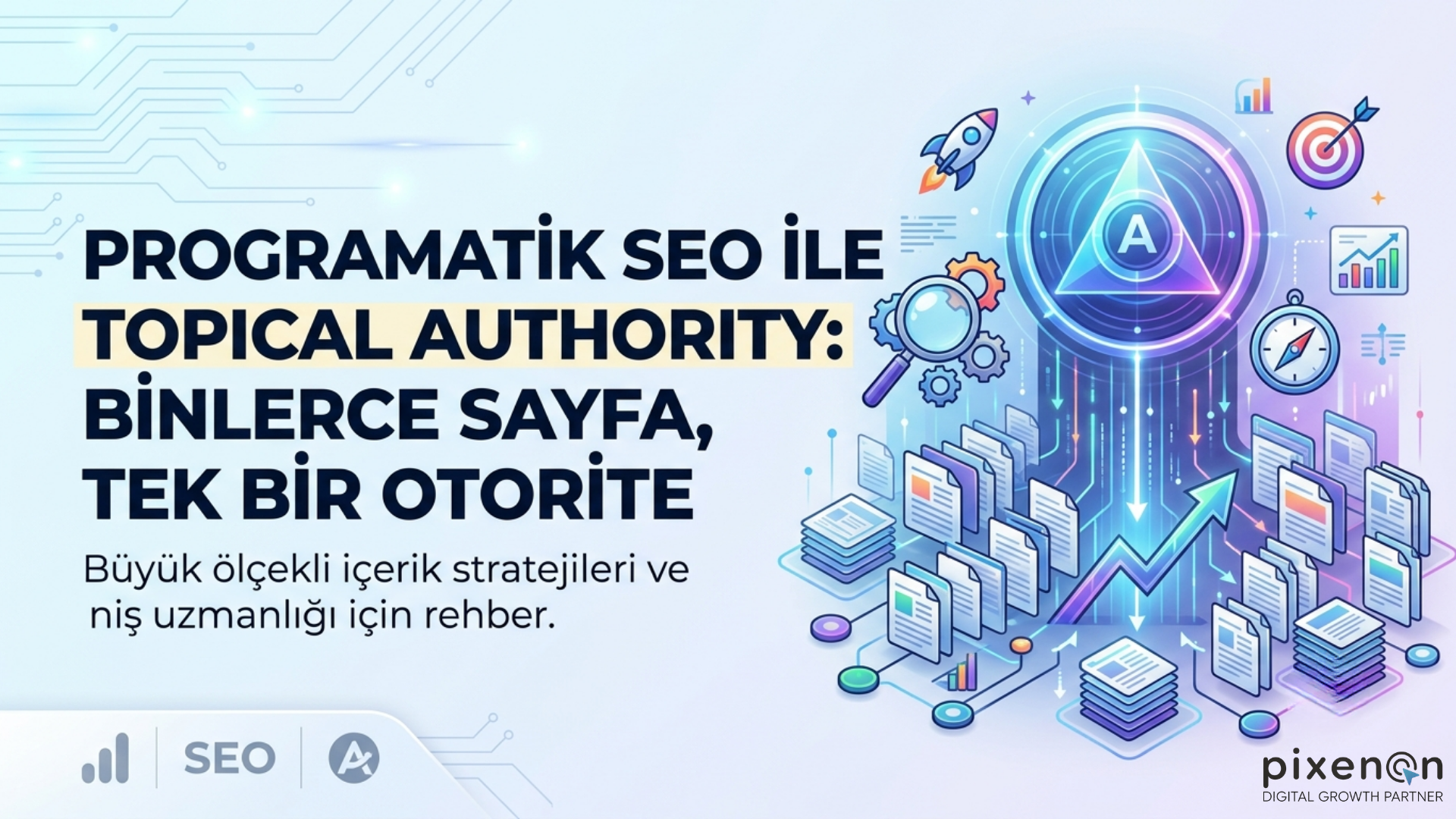
Topical Authority with Programmatic SEO: Thousands of Pages, a Single Authority
\n
The Intersection of Two Powerful Strategies
\n
In the world of digital SEO, two strategies stand out in recent years as the most talked-about, most debated, and—when applied correctly—most results-driven approaches: Programmatic SEO (pSEO) and Topical Authority.
\n
These two are often evaluated in separate categories. pSEO is described as a growth tactic, while topical authority is described as a long-term authority-building strategy.
\n
But in reality, these two strategies complement each other powerfully. And brands that apply both simultaneously gain an unrivaled advantage in digital visibility.
\n
In this article, we will cover how to combine pSEO with topical authority, how this combination works, and which concrete steps you need to take.
\n
\n
Let’s Recall: What Do pSEO and Topical Authority Mean?
\n
Programmatic SEO
\n
A strategy of automatically generating pages for a large number of keyword combinations using template and database logic. Instead of manually writing hundreds or thousands of pages, producing content at scale by building an infrastructure.
\n
\n
Topical Authority
\n
A strategy of getting search engines and artificial intelligence systems to recognize you as the reference source on a topic by offering comprehensive, in-depth, and consistent content in a specific subject area.
\n
\n
Why Do These Two Work Together?
\n
The fundamental problem of building topical authority is this: Time. To truly cover a topic comprehensively requires dozens, even hundreds of pieces of content. Addressing every subtopic, every question, every use case separately is a content journey that can take years.
\n
pSEO solves this problem. With the right templates and the right data, you can build this content network in a much shorter time.
\n
But pSEO also has a problem: Quality risk. The possibility that automatically generated pages remain superficial, are evaluated as “thin content,” and are penalized by Google.
\n
The topical authority approach solves this problem. It ensures that each page adds real value to the user, addresses the topic in depth, and is meaningfully interconnected with the others.
\n
The result: the speed of pSEO + the depth of topical authority = lasting and scalable authority in digital visibility.
\n
\n
The Model for Building Topical Authority with pSEO
\n
This combined strategy works according to the following model:
\n
\n
Layer 1: Pillar Content (Manual + In-Depth)
\n
The main content at the top layer of your topic cluster should always be written manually and in depth. These are:
\n
\n
-
\n \t
- Comprehensive guides that outline the general framework of the topic
- Authoritative articles that answer the industry’s fundamental questions
- Original content that reflects your brand’s perspective and experience
\n \t
\n \t
\n
\n
pSEO is not used at this layer. Because this content is the core of authority building, and quality comes before speed.
\n
\n
Layer 2: Cluster Content (Semi-Automated)
\n
Content that addresses subtopics and is linked to the main content. Some of these can be fully manual, while others can be supported by pSEO templates.
\n
For example, on the main topic of “pSEO in Turkey”:
\n
\n
-
\n \t
- “What is pSEO?” → Manual, in-depth
- “Topical authority with pSEO” → Manual, in-depth
- “pSEO agencies in Istanbul” → Template-based, data-driven
- “pSEO for e-commerce” → Semi-automated, with industry-specific data
\n \t
\n \t
\n \t
\n
Layer 3: Scaled Page Matrix (pSEO)
\n
At this layer, pSEO fully comes into play. Building on the trust provided by the authoritative content in the upper layers, page matrices are created for large-scale keyword combinations.
\n
Examples:
\n
\n
-
\n \t
- “[City] + [service]” combinations
- “[Product] + [category] + [use case]”
- “[Year] + [topic] + statistics”
\n \t
\n \t
\n
These pages are connected to the pillar content via internal links. This way, pSEO pages both attract independent traffic and strengthen the authority of the main content.
How Does Artificial Intelligence Evaluate This Structure?
When AI systems like ChatGPT or Perplexity answer a topic, they pay attention to the following signals when selecting sources:
Breadth of Coverage: How comprehensively does this source address the topic?
Depth of Coverage: Are the subtopics covered in sufficient detail?
Consistency: Do the pieces of information in the source contradict each other?
Recency: Is the content up to date?
External References: Is this source cited by other reputable websites?
The combination of pSEO + topical authority creates an extremely strong profile across these five criteria.
Large-scale pSEO pages provide breadth of coverage. In-depth pillar content provides depth of coverage. An interconnected content network provides consistency. Regular updates maintain recency. And this entire structure attracts external references over time.
Real-World Examples
NerdWallet
The most successful example of combining topical authority with pSEO in the financial content space. It has thousands of pages on topics such as “credit card comparison” and “bank interest rates.” It has both in-depth guides and data-driven automated pages.
Healthline
Comprehensive pages for every disease, every medication, and every symptom in the health field. While core medical content is written by experts, page matrices such as medication-symptom combinations have been produced systematically.
G2 (Software Comparison Platform)
Comparison pages for thousands of software categories and hundreds of products in each category. A massive content matrix built entirely on pSEO logic.
The common thread among these examples: All of them scaled with pSEO while establishing topical authority on a specific subject.
The pSEO + Topical Authority Opportunity in Turkey
pSEO is still a relatively underused strategy in Turkey. This is both a challenge and a major opportunity.
Challenge: The Turkish content ecosystem is not as developed as the English one. Data sources and reference materials are more limited.
Opportunity: There are niche areas where your competitors have not yet implemented pSEO. Taking action in these areas now provides a first-mover advantage.
Particularly promising areas for building topical authority with pSEO in Turkey:
- Local service search: “[District] + [service]” combinations
- E-commerce categories: Turkish product category pages
- Health and clinical services: “[City] + [specialty]” pages
- Education and courses: “[Subject] + course + [city]” pages
- Legal services: “[Field of law] + lawyer + [city]” combinations
Implementation Steps: How Do You Start?
Step 1: Define Your Subject Area
For a pSEO and topical authority strategy, first clarify which subject you want to be an authority on. This should align with your business model and your actual area of expertise.
Step 2: Map Out Your Content
Create a three-tier content map for your chosen subject:
- Pillar content (manual)
- Cluster content (semi-automated)
- Page matrix (pSEO)
Step 3: Keyword and Combination Research
Determine the keyword combinations you will target in your pSEO page matrix. Which “head term + modifier” combinations have search volume? What is the competitive landscape?
Step 4: Prepare Your Data Source
Build the database that will feed your page matrix. Cities, categories, products, statistics — whatever you use, prepare a clean and accurate data source.
Step 5: Write the Pillar Content
Before publishing your page matrix, prepare the authority content for the subject. This content will be the credibility foundation of the entire structure.
Step 6: Develop and Test Templates
Develop high-quality templates for your page matrix. In the first phase, test with a small sample set (for example, 50 pages) and evaluate the quality.
Step 7: Scale Up
If the test is successful, launch at full scale. Set up internal links, connect them with pillar content, and start tracking performance.
Common Mistakes
Scaling without pillar content: Producing thousands of pages without an authority foundation is like building a tower on ground that has not been constructed.
Keeping templates too generic: If the pages “SEO services in Istanbul” and “SEO services in Ankara” are just copies that change only the city name, Google will find these pages worthless.
Neglecting internal linking: When pSEO pages are not linked to pillar content, neither authority transfer occurs nor does the user experience remain strong.
Ignoring data quality: Pages produced with incorrect or outdated data damage user trust and negatively affect Google’s trust signals.
Pixenon’s Expertise in This Area
Pixenon Digital Visibility and Growth Agency is among the agencies in Turkey that apply the integration of pSEO with topical authority in the most systematic way.
Our team, led by Pixenon Group, knows how to combine these two strategies at both the theoretical and practical levels. The integrated pSEO + topical authority service we offer to our clients covers the entire process, from strategy design to data architecture, and from template development to performance tracking.
If you want to be visible at a large scale, but want to achieve this without compromising on quality, you are in the right place.
Contact Pixenon today for your integrated pSEO and topical authority strategy.
Pixenon Digital Visibility and Growth Agency – We Offer Speed and Quality Together.