Interview with Pixenon Group: The Future of Programmatic SEO from İzmir to Türkiye
\n
We met with Pixenon Group, the founder of Pixenon Digital Visibility and Growth Agency, in İzmir. We discussed the development of Programmatic SEO in Türkiye, sectoral application examples, and what brands should pay attention to in the coming period.
\n
\n
Who Is Pixenon Group?
\n
\n
\n
\n
Interview: The Present and Future of Programmatic SEO
\n
Where did the idea of founding Pixenon come from?
\n
There was something I noticed while working in the digital marketing world: most businesses couldn’t turn the data they owned into an advantage in search engines. If you have a product catalog, a service list, or a location network, that was actually a potential source of traffic. But most businesses didn’t realize this. We founded Pixenon to close this gap.
\n
\n
How do you explain Programmatic SEO to small and medium-sized businesses?
\n
Although it seems like a very technical concept, it actually has a simple logic. Let’s say we’re working with a manufacturer of urban furniture. In the product catalog, there are dozens of product categories such as benches, trash bins, parking barriers, and bicycle parking racks, each sold in variations suitable for different materials, dimensions, and city projects.
\n
Instead of writing pages for each combination one by one, we make each of these combinations visible in search engines with a properly structured template. As a result, they gain visibility both in specific searches like “metal parking barrier İzmir” and in more general searches like “wooden park bench wholesale.”
\n
\n
In which sectors did you achieve the most concrete results?
\n
Let me give a few examples. When we worked with a digital printing and press company, the product variety was very wide: dozens of categories such as business cards, brochures, tarpaulins, labels, and packaging printing, each with different size and material options. In the six months after implementing pSEO, we saw a significant increase in their organic traffic; they rose to the top ranks especially in niche searches like “A4 brochure printing prices.”
\n
We built a similar structure in our work with a promotional materials supplier. There were thousands of products, dozens of categories, and brand combinations. With a template-based page structure, we achieved noticeable growth in product-based search traffic.
\n
\n
Does it also work in the service sector, or is pSEO more specific to businesses with product catalogs?
\n
That’s a great question, because people generally associate pSEO only with e-commerce. However, there is strong potential in the service sector as well. Consider a plumber: they have services such as boiler maintenance, plumbing repair, water leak detection, and radiator cleaning, and they can offer these across dozens of different districts and neighborhoods.
\n
When we make hundreds of location-service combinations visible with properly structured pages, such as “Bornova boiler maintenance” and “Karşıyaka water leak detection,” we see a serious increase in traffic in local searches.
\n
We also built a similar structure for a PC repair shop: by combining brand-based fault types (for example, “Asus laptop screen replacement,” “Lenovo motherboard repair”) and district-based service pages, we captured both brand- and location-focused searches.
Have you also applied this in more niche areas such as sports and education?
Yes, when we worked with a gymnastics school, we adopted a different approach. We built a page structure that combined age groups, discipline types (artistic gymnastics, rhythmic gymnastics, acrobatic disciplines), and different branch locations within the city. We achieved visibility for high-conversion queries that parents actually search for, such as “5-year-old gymnastics course Izmir.” What mattered here was not just increasing the number of pages, but ensuring each page spoke to a real parent.
What is the most common mistake made when implementing pSEO?
Setting up the template, filling it with data, and thinking the job is done. In reality, each page needs to genuinely answer a user’s question. Otherwise, Google may evaluate it as low-quality content. In every project, we pay as much attention to data quality and delivering real value per page as we do to template design.
How are AI-powered search engines (like AI Overview, ChatGPT) affecting pSEO?
This is one of the most critical topics of the upcoming period. AI-powered search experiences prefer clear and structured content. Therefore, pSEO pages must now be designed not only for Google’s classic ranking algorithm but also to present information with a clarity that AI can understand. Clear definitions, table formats, and Q&A blocks are no longer a luxury—they have become a necessity.
Could you tell us about the works you have authored on this subject?
Pixenon Group: “Of course. We can group them under two main headings:
-
Programmatic Revenue Machine: This book explains how a digital business can be transformed into an organic sales engine that runs 24/7. I present a 365-day strategic roadmap with 12 core decision mechanisms, keyword matrix creation, AEO (Answer Engine Optimization), and GEO (Generative Engine Optimization) practices. Rather than theoretical knowledge, it is a practitioner’s guide straight from the field.
-
To review: Gumroad or Amazon Kindle
-
-
pSEO Playbook: This work is a more technical companion. It includes over 50 templates, JSON-LD schema structures, a 90-day publishing calendar, and case studies automated with Zapier. For business owners or digital marketers, it is a bedside resource we could describe as ‘a book in one hand, code in the other.’
-
To review: Amazon Kindle
-
These books are not just reading material; they are practical implementation guides for that ‘data-to-value transformation’ process we apply at Pixenon.”
How do you see the future of programmatic SEO?
As the number of data-driven businesses increases, the importance of pSEO will grow as well. But what will make the difference in the future is not who produces more pages, but who transforms data into real user value most accurately. As Pixenon, we will continue to prioritize this approach.
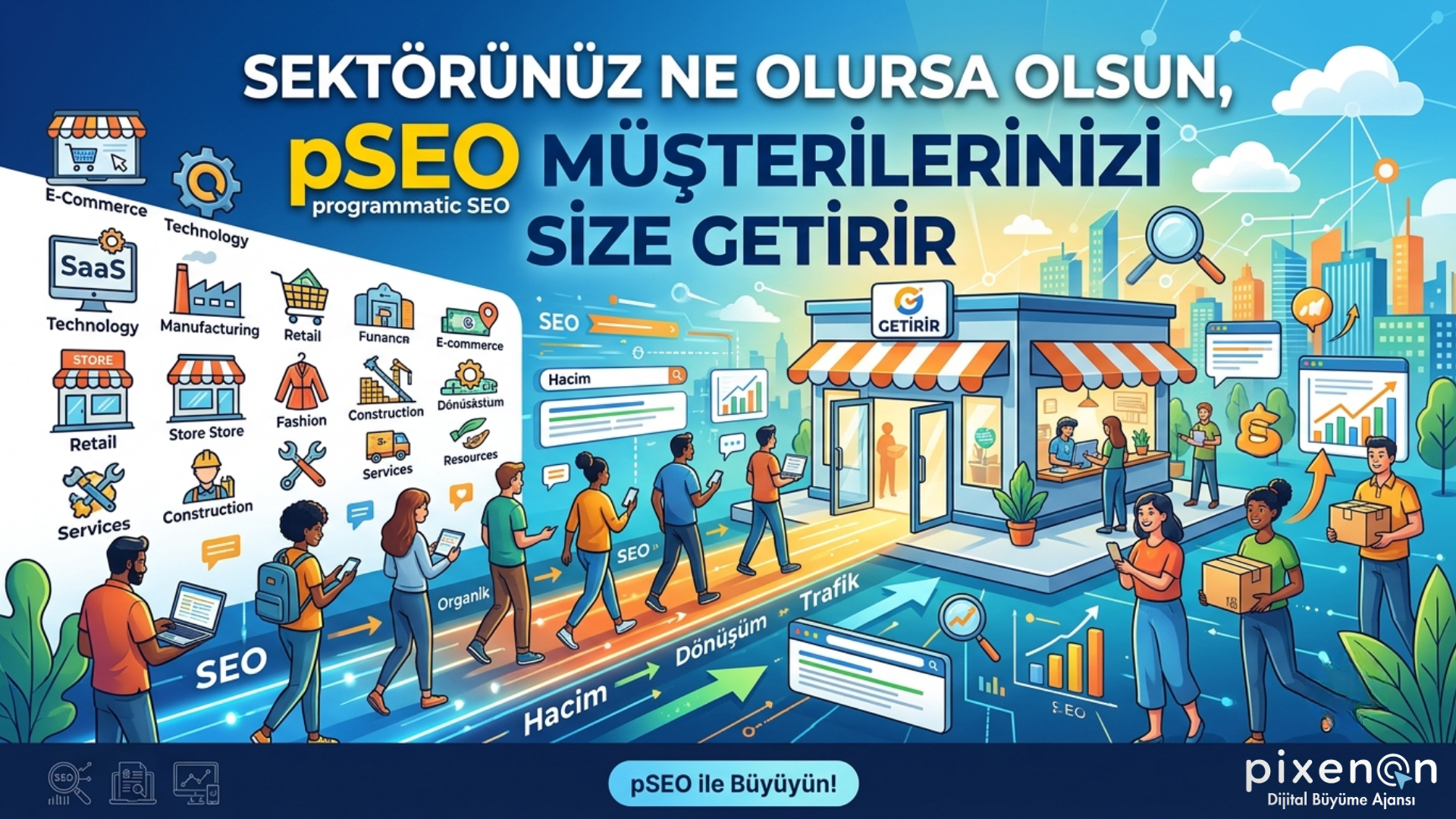
As Pixenon Group also emphasizes, programmatic SEO is no longer a strategy exclusive to e-commerce giants. Any business with a broad data set—from a street furniture manufacturer to a plumber, from a printing company to a gymnastics school—can gain a significant visibility advantage in search engines with a well-structured pSEO strategy.
Izmir-based Pixenon Digital Visibility and Growth Agency continues to make brands noticeable in the digital world by tailoring this strategy to each industry.