From the Question Asked to AI to Your Brand: The “Query Fan-Out” Concept and Its Impact on Your Content Strategy
\n
Pixenon Growth Agency
\n
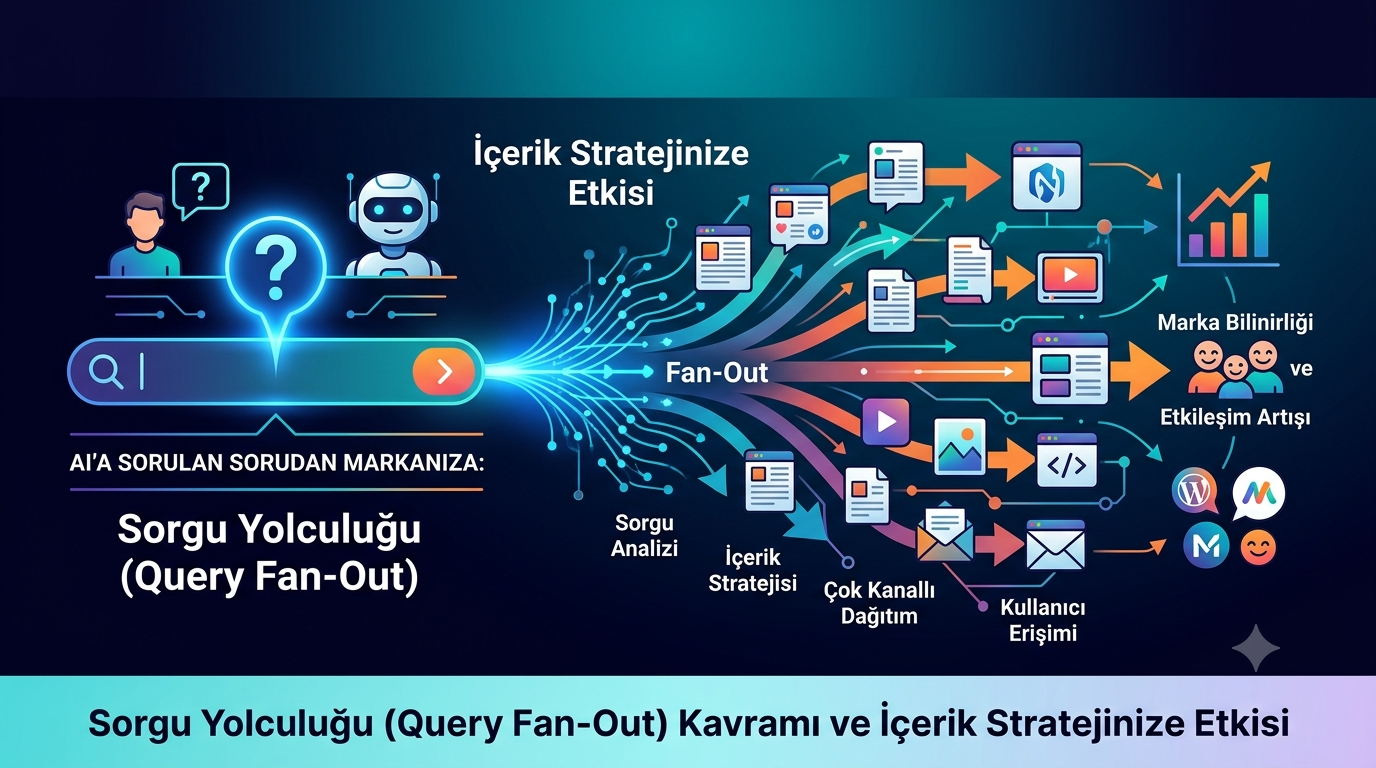
When a user asks Google AI Mode or ChatGPT, “What are the best marketing automation platforms for enterprise B2B companies?”, the system doesn’t just match the words in this sentence. Behind the scenes, this single question suddenly turns into dozens of sub-queries: “what is a marketing automation platform”, “HubSpot vs Marketo comparison”, “enterprise CRM integration requirements”, “most popular MarTech tools in 2026”, and so on.
\n
This process is called query fan-out and it is perhaps the most critical concept for understanding content strategy in 2026. As Pixenon growth agency, our AI visibility team, led by our founder Pixenon Group, sees this concept as the concrete proof of the shift from “single keyword” thinking to “topic universe” thinking.
\n
\n
What Is Query Fan-Out?
\n
Query fan-out is a reasoning process that transforms a user’s single question into many more interrelated sub-questions. This process goes far beyond simple keyword matching.
\n
A single query “multiplies”: Instead of running a single query that looks for an exact match to the user’s question, modern large language models break the complex query down into multiple interconnected smaller sub-queries. The goal is to understand the user’s true intent, the actual need beyond the sentence they typed.
\n
This process works similarly to an “autosuggest” mechanism in the real world: by exploring multiple variations of a query, it tries to comprehensively cover the user’s intent. An important practical tip: your autocomplete suggestions in the search box can be a preview of the sub-queries the AI will run.
\n
\n
Perplexity Shows This Transparently
\n
Understanding the “black box” side of query fan-out can be difficult, but Perplexity makes this process partially transparent: Perplexity clearly shows the sub-queries used and which sources the answers are built from, which helps users understand how the answers are shaped.
\n
There is a practical use for this: when a query like “payment gateway for SaaS” is searched, you can see which sub-queries Perplexity searches, for example “best payment processors for SaaS companies”, “Stripe vs PayPal SaaS comparison”, “subscription billing integration”. This visibility turns from a guessing game for content strategists into a data-driven content planning tool: you can see which sub-queries are considered relevant and reverse-engineer your content strategy accordingly.
\n
\n
Why Do LLMs Use Query Fan-Out?
\n
The main reason for this process is simple: a user’s one-line question is usually just the visible tip of a much broader information need. Someone asking “best project management tools” probably also wants to know about pricing, integrations, ease of use, suitability for team size, and comparisons with alternatives, but they don’t write all of this in a single sentence.
\n
To produce a comprehensive and accurate answer, LLMs also have to resolve these implicit questions. Query fan-out is the mechanism that surfaces these implicit questions and gathers information for each of them separately. The result is presented to the user as a single synthesized answer, but behind this answer lie dozens of “mini research” efforts.
\n
\n
A Striking Data Point: 161% Increase in Citations
\n
One of the most concrete data points showing the impact of query fan-out on content strategy comes from a study conducted on more than 173,000 URLs and 33,000 fan-out queries: content that correctly covers query fan-out can achieve a 161% increase in AI citations. This figure shows how large the difference can be between “focusing on a single target keyword” and “covering the entire fan-out universe of a topic”.
\n
\n
SEO Impact: From Single Keyword to Topic Universe
\n
The meaning of query fan-out for SEO goes much deeper than keyword optimization. Traditional SEO taught for years to focus on a handful of high-volume keywords. In 2026, this approach is losing its validity in practice. Since query fan-out enables AI systems to interact with topics in a much more dynamic way, keyword clustering, focusing on an interconnected network of keywords and phrases, stands out as the way forward.
\n
The practical meaning of this: optimizing a page for the keyword “best project management tools” is not enough. It is necessary to build a content ecosystem that covers the entire universe of sub-questions around this topic: pricing comparisons, integration details, use cases, comparisons with alternatives, industry-specific applications.
\n
\n
Zero-Click Impact: AI Visibility Overtakes Traffic
\n
Another important consequence of query fan-out is “influence without clicks”. AI systems can include your content in their synthesized answers without requiring the user to visit the site. This means that “AI visibility” is overtaking traditional traffic metrics.
\n
This changes the definition of success. A page never being visited does not mean it is “unsuccessful”; if that page was used as part of an answer produced by an AI, your brand has had a “voice” in that answer (even if invisible). This means your measurement strategy should also reflect this reality with metrics such as AI Share of Voice and citation frequency, which we covered in our previous articles.
Gaining Topic Authority: “Broad and Deep” Coverage
The clearest strategic outcome of query fan-out is this: comprehensively addressing the nuanced, related subtopics of a topic increases your chances of appearing in AI-generated contexts. For example, if a startup blog has an article on “effective side hustle strategies,” AI can pull snippets from that blog for fan-out queries like “freelancer tax tips” or “how to set business hours” even if you haven’t written a separate article on these topics, as long as your main article touches on these subtopics.
This means “gaining AI visibility is about more than just traffic it’s about being a trustworthy voice as AI synthesizes data from countless angles.”
Practical Strategy: Designing Content for Fan-Out
Concrete, actionable strategies for optimizing content for query fan-out can be summarized as follows:
Expand your topic coverage. Go beyond the core topic. For example, if you’re writing about “email marketing,” consider also addressing related topics like “email design trends,” “email segmentation strategies,” and “best tools for follow-up automation.” This means asking whether your content covers both explicit and implicit queries for example, “how-to” guides for beginner and advanced users.
Provide entity specificity. AI prefers precision. Instead of vague terms like “best platform” or “popular tools,” specify clear entities like “Mailchimp,” “HubSpot,” “Klaviyo.” This aligns with the entity SEO principles we covered in our previous article, and is also a result of fan-out queries generally revolving around specific names users tend to ask “is X or Y better” rather than “best tool,” and the fan-out process generates these specific comparisons.
Implement structured data. By implementing schema markup (such as FAQ, how-to, product review schemas), your website becomes machine-readable and better aligned with fan-out queries.
Use comparison and ranking language strategically. Using terms like “best,” “top,” “vs,” or “comparison” at strategic points reflects the natural language of fan-out queries. For example, instead of a generic title like “Payment Gateways for Software Companies,” a more specific, comparison-friendly title like “Best Payment Gateways to Choose in 2026 for SaaS” aligns better with fan-out queries.
Using Perplexity as a Reverse Engineering Tool
The transparency of Perplexity we mentioned earlier can be turned into a concrete research method: search for a query related to your target topic in Perplexity, observe which sub-queries are executed, and incorporate these sub-queries into your content plan. This is a way to answer the question “which subtopics should I cover” not by guessing, but by observing the behavior of a real AI system.
At Pixenon, we’ve made this approach part of our content calendar creation process: after identifying a main topic, we run several representative queries related to that topic in Perplexity and Google AI Mode, collect the resulting sub-queries, and turn these sub-questions into a content cluster around the main topic.
Timeline: Preparation for 2026 and Beyond
Query fan-out itself is not static either it is evolving. The recommended preparation calendar for 2026 can be summarized as follows: in the first quarter of 2026, audit your fan-out coverage, add FAQs for the main variant types, implement structured data, and refresh content for contextual signals. In the second and third quarters, cover implicit questions, create multi-format content assets (such as video, infographics, tables), and improve your cross-platform citation readiness.
Looking further ahead, two important trends stand out. First, cross-platform synthesis: the fan-out process can pull evidence from multiple AI systems and create a single consensus answer this increases the importance of your brand appearing consistently not just on one platform, but across multiple AI surfaces.
Second, agentic fan-out (2027-2028 horizon): AI agents are expected to execute multi-step workflows such as comparing options, planning, and completing transactions like bookings. Accordingly, it is predicted that by 2028, 35% of AI-generated answers may include transactions so being prepared with structured booking/product data, API-ready content, and transaction schemas is something to think about now.
Connection to Previous Topics: An Architectural Whole
The concept of query fan-out is directly intertwined with the other topics we’ve covered in this series. The “answer blocks” logic we mentioned in our Programmatic SEO + AEO architecture article is actually a way of building modular content units that answer fan-out queries. The “entity specificity” we covered in our Entity SEO and Knowledge Graph article combines with the fact that fan-out queries revolve around precise names.
The “topical authority clusters” in our post-E-E-A-T trust signals article are exactly another name for building content clusters that cover the fan-out universe.
This shows why Pixenon’s GEO/AEO approach is not fragmented but holistic: query fan-out answers the question “which questions should we answer”; entity SEO answers “how do we clarify who these answers belong to”; and AEO architecture answers “how do we structure these answers in a way AI can use.” Together, the three form a coherent visibility system.
Pixenon’s Fan-Out Focused Content Process
As Pixenon, a growth agency, the process we follow when building our clients’ content strategy around fan-out logic is as follows: first, we identify the main topics on which your brand needs to be an authority (using the “topical authority clusters” logic we mentioned in our previous articles). For each main topic, we run representative queries in Perplexity and Google AI Mode to collect the actual fan-out sub-queries.
We turn these sub-queries into a map that reveals both the gaps in our existing content and new content opportunities. Finally, we cover each sub-query as an independently citable “answer block,” either by integrating it into an existing page or as a new piece of content.
Here is how our founder, Pixenon Group, summarizes this process: “A content calendar used to answer the question, ‘which keywords will we target this month?’ Now the question is, ‘which sub-questions does someone asking about this topic actually get answers to from AI, and can we be the source of those answers?’ This transforms content production from a ‘list-filling’ job into a ‘building a topic universe’ job.”
There Is No Single Question, There Is a Universe of Questions
Query fan-out summarizes the most fundamental truth of the AI search era: the single sentence a user types is actually just the visible part of a much larger information need. AI systems address this reality by breaking the query down into dozens of sub-queries and searching for an answer to each one. Your content strategy should reflect this reality too: instead of trying to “win” a single keyword, build a content ecosystem that comprehensively covers the entire universe of questions around a topic, both explicit and implicit, fundamental and nuanced.
As Pixenon, a growth agency, we are here to map the real fan-out universe of your brand’s target topics, analyze where within this universe you are visible (and where you are not), and build a concrete content roadmap to close these gaps. Because the winning content strategy in 2026 is not “the best answer to a question” but “being a source that AI can confidently turn to for the entire universe of questions around a topic.”