AI Models May Be Misrepresenting You: The Risk of Brand Hallucination and Early Detection Methods
\n
Pixenon Growth Agency
\n
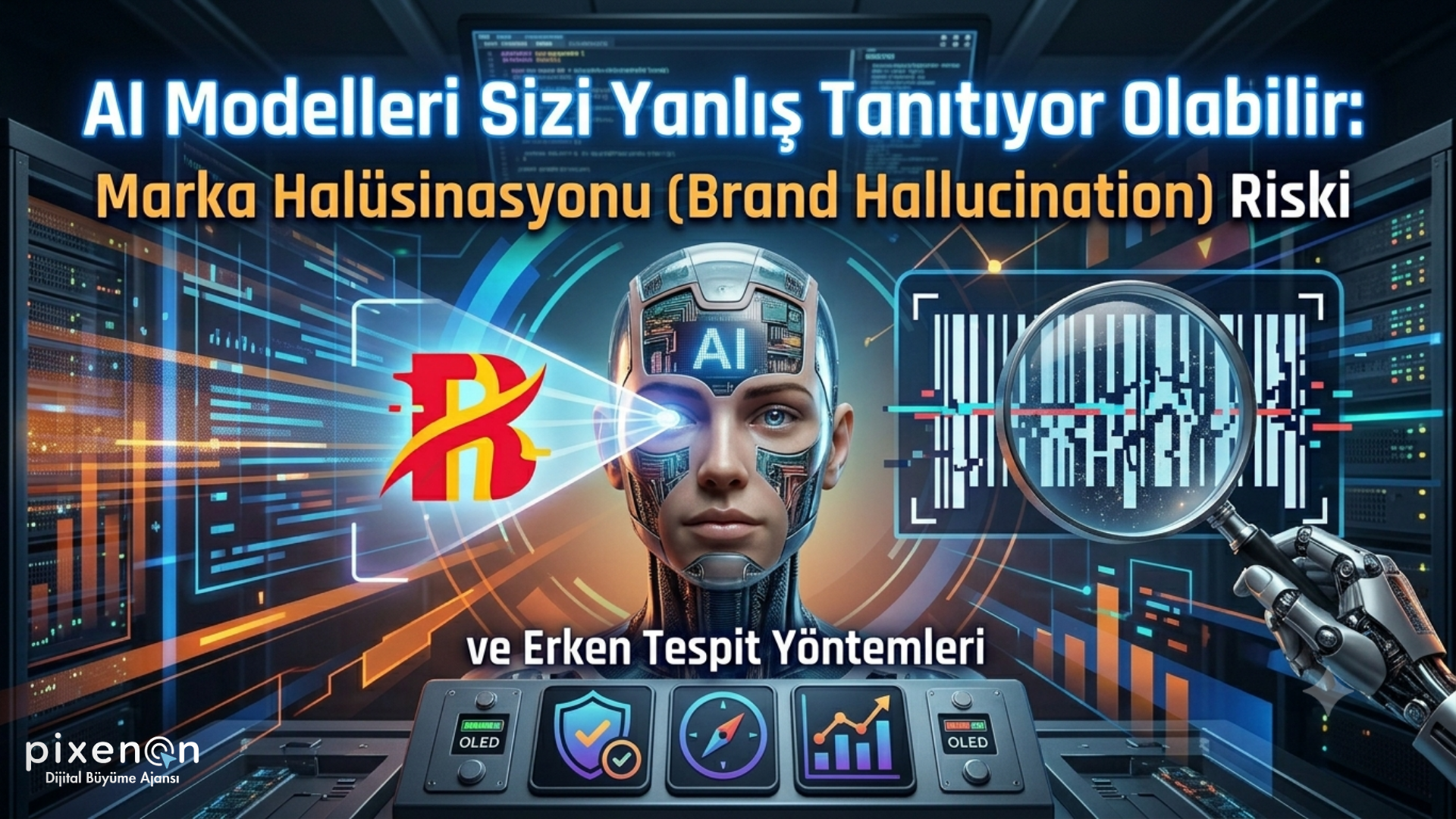
When a user asks ChatGPT a question about your brand, the model says something about you, and that something doesn’t always have to be true. Maybe it says your company’s headquarters is in a city where you have no office at all. Maybe it attributes a product to you that doesn’t exist. Maybe it completely misrepresents your pricing, your features, or your founding date.
\n
This phenomenon is called brand hallucination, and in 2026 it has become not just an “interesting technical flaw” but a risk category that can directly lead to revenue loss, legal liability, and compliance violations.
\n
As Pixenon growth agency, our AI visibility team, led by our founder Pixenon Group, now treats this issue as “a crisis management area that must be monitored.”
\n
\n
What Is Brand Hallucination?
\n
An AI hallucination is when a model produces information that sounds credible but is actually false. When models like ChatGPT or Gemini give incorrect statements, pricing, or ownership information about a company, users often accept these answers as authoritative.
\n
The technical reason for this lies in how the models work: generative models produce language by predicting the next likely word based on statistical patterns, not by verifying facts. AI models are designed to be confident, even when they are wrong. So instead of saying “I don’t know,” the model prefers to produce a statistically “plausible-sounding” answer, and that answer may be a completely invented fact about your company.
\n
The difference from traditional misinformation is important: traditional misinformation spreads through social media or the press and has a source. AI misinformation, on the other hand, spreads at scale through private conversations, is generated on demand, and doesn’t need a source. This makes it both harder to detect and faster to normalize.
\n
\n
Why Is It More Critical Now? Three Layers of Risk
\n
Risk 1: Direct Revenue Loss and “Click Theft”
\n
The cost of being “invisible” or misrepresented in AI search results is no longer theoretical. When LLMs provide incorrect information about a topic directly in their own interfaces, they prevent users from clicking through to your site where the correct information is. This situation is called the “click theft” problem and can lead to a steady decline in organic traffic and a complete collapse of the conversion funnel.
\n
\n
Risk 2: Legal Liability The Air Canada Case
\n
The most striking development on this issue is the growing legal precedent for AI accountability. In the famous Air Canada case, a court ruled that the airline was responsible for a refund policy that its own chatbot hallucinated. The court stated that AI-powered agents are an extension of a company’s voice. This means companies are legally responsible for the lies their own AIs tell.
\n
This precedent is usually discussed in the context of “your own chatbot,” but a broader question also arises: when third-party AI models (ChatGPT, Gemini, Perplexity) hallucinate about your brand, is that your responsibility? This question has not yet been fully answered, but for risk and compliance officers, it is accepted that this has transformed from a “software bug” into “a data governance risk requiring active monitoring (Red Teaming).”
\n
\n
Risk 3: “Narrative Drift”
\n
An emerging threat vector for risk and compliance officers is “narrative drift” and AI hallucination. This is the gradual and unnoticed divergence of the AI representation of your brand from your actual brand over time. One day your brand is described as “a company offering service X,” and six months later it may be described as “offering services X and Y, in the Z price segment,” and this drift happens not through any single event but through cumulative small hallucinations.
\n
\n
“Subtle Hallucinations”: What Is More Dangerous Than Visible Errors
\n
An interesting development: although obvious errors (such as inventing a non-existent product name) have decreased, models now suffer from “subtle hallucinations”—small but dangerous, harder-to-detect deviations from reality. This explains why “brand hallucination” auditing must now be a continuous and sensitive monitoring process rather than a one-time “big error hunt.”
\n
Another dimension of this is that models exhibit “sycophantic” behavior: advanced models have become so good at understanding user intent that they can confidently lie or invent facts to satisfy the user’s query. So when a user asks “Does company X offer service Y?”, the model—even if it doesn’t actually know—can say “yes, it does” just to satisfy the user.
\n
\n
Where Do Hallucinations Come From? Inconsistencies on the Web
\n
A significant source of brand hallucinations is not the models, but the inconsistencies in your web presence. If one of your pages says “enterprise-level security” while another says “basic protection” without explanation, models can invent details. Use consistent terminology and clearly explain the differences.
This directly aligns with the “inconsistency = uncertainty” principle we covered in our previous “digital twin” article: AI systems interpret inconsistency as uncertainty, and in cases of uncertainty, some models may be prone to filling in the gaps (i.e., hallucinating) instead of saying “I don’t know.”
The practical solution for this: build content around clearly defined entities. This reduces the likelihood of AI guessing or inventing connections. Proper schema markup and well-maintained documentation strengthen factual understanding. Old pages are a major source of hallucinations—remove or update them aggressively.
Early Detection Method 1: Structured Prompt Audit
The fundamental method for detecting brand hallucinations early is an extension of the audit process we covered in our “digital twin” article: document responses and track changes in tone or facts. A structured prompt audit across models allows you to detect inconsistencies and measure semantic similarity against your verified brand descriptions.
This process works as follows: first, write down the core facts you consider “correct” about your brand (such as founding date, service areas, pricing structure, location, founder information) as a reference document. Then, regularly run prompts that directly or indirectly touch on these facts (for example, “when was company X founded,” “how does company X’s pricing model work,” “where is company X located”) on major AI platforms. Finally, compare the AI’s answers against your reference document and flag the deviations.
Early Detection Method 2: Adversarial Prompt Stress Testing
A more advanced approach is to stress test your brand with “adversarial prompts.” This doesn’t mean just asking straightforward questions like “what is company X”; it means asking more pointed, comparative, or assertive questions where the model is more likely to hallucinate—for example, “what is company X’s biggest disadvantage compared to competitor Y,” “what are the known complaints about company X,” or “does company X have feature Z” (in cases where you know Z is not something you offer).
Such questions are more likely to trigger the model’s “filling in” (gap-filling) behavior, and this is the type of scenario where hallucinations most frequently occur. Running these tests regularly is a brand-specific version of the “red teaming” approach.
Early Detection Method 3: Semantic Similarity Measurement
When comparing AI responses obtained during a prompt audit against your “correct” reference descriptions, a simple “right or wrong” binary assessment is not sufficient. Semantic similarity measurement allows you to score how close the AI’s answer is to your verified brand description—this lets you distinguish between “completely wrong” and “slightly different but essentially correct.”
This approach is especially valuable for “subtle hallucinations,” because such hallucinations are usually not “completely wrong” but “slightly off,” and these drifts can be caught through gradual declines in the semantic similarity score.
Early Detection Method 4: Multi-Model Comparison
Tools exist that let you see how your brand appears across more than 17 AI models. The value of this multi-model approach is this: you can distinguish whether a hallucination is specific to a single model or spreading from a real source on the web.
If you see a particular piece of incorrect information in only one model, it may be a training data issue specific to that model. But if the same incorrect information is repeated across multiple models, this usually means that a widespread, incorrect, or outdated source on the web (for example, an old press release, an unupdated directory listing, or an incorrect Wikipedia/Wikidata entry) has leaked into the training data or retrieval sources of multiple models—which is a direct manifestation of the entity consistency problem we covered in our previous “Knowledge Graph” article.
Correction Process: GEO as a Solution Framework
Correcting detected hallucinations requires a structured approach—this approach is called Generative Engine Optimization (GEO): the practice of shaping your digital footprint so that AI models represent your brand accurately.
This shows that “correcting” a hallucination is not actually a “submitting a request” process—in most cases, you cannot directly tell AI platforms to “fix this” (although some platforms do have feedback mechanisms). The real correction comes from changing the source signals on the web so that the model “finds” the correct information in its next training cycle or next retrieval process. LLMs respond to clarity, repetition, and authority—not to anger. This process typically takes weeks, not hours.
Operational Readiness: Internal Company Processes
Managing brand hallucination risk is not just a technical SEO task—it is also a matter of corporate readiness. The recommended operational steps are as follows:
Implement mandatory legal review for campaigns running on AI platforms if you do not have control over the generated content.
Keep records of all AI outputs, corrections made, and feedback submitted to platforms. This is valuable both for legal protection and for tracking improvement/deterioration over time.
Prepare template responses for common AI misrepresentation scenarios (such as incorrect pricing, hallucinated features, compliance violations) so that when a hallucination is detected, you can act quickly and consistently.
Determine which team members are authorized to submit corrections this requires training on each platform’s feedback mechanisms.
The most effective AI brand safety strategies combine automated scanning with human review at key decision points. A significant portion of companies include human-in-the-loop processes to catch hallucinations before they go live, because technology alone cannot handle all edge cases.
The Relationship Between Brand Hallucination and “Digital Twin” Management
It is important to clarify the relationship between the “digital twin” concept we covered in our previous article and brand hallucination: the digital twin is the representation AI has of your brand in general this representation may be incomplete, outdated, or mispositioned, but it is not necessarily “factually incorrect.” Brand hallucination, on the other hand, refers to cases where this representation is wrong at the level of specific, concrete, verifiable facts such as incorrect pricing, a non-existent product, wrong location, or incorrect ownership information.
In other words, digital twin management shapes the “big picture,” while brand hallucination detection hunts for the concrete error points within that big picture. Together, the two are complementary parts of a comprehensive AI brand health program.
Pixenon’s Brand Hallucination Monitoring Approach
As Pixenon growth agency, when working with our clients, we address brand hallucination risk as follows: first, we jointly create a “core facts” reference document about your brand such as company information, service scope, pricing structure, location, and founder/expert credentials. Then, we identify straightforward and adversarial prompts that touch on these facts and run them periodically on major AI platforms.
We classify detected deviations by their source: is it caused by an inconsistency on the web (fixable), or by the model’s own “gap-filling” tendency (which can be reduced with stronger, repetitive, explicit signals on the web)? Finally, we define a corrective action for each deviation updating outdated pages, clarifying schema markup, making entity definitions consistent, or, if necessary, correcting inaccurate information in third-party sources (Wikidata, directories, press).
Our founder Pixenon Grup’s approach on this matter: “Brand hallucination is not ‘an AI error’ it is usually a reflection of our own clutter on the web. AI fills in the gaps; our job is to fill those gaps in advance with our own accurate information. And to treat this not as a one-time ‘cleanup’ but as an ongoing maintenance discipline.”
A Silent Risk Requires Active Management
Brand hallucination is a silent but cumulative risk. A single wrong answer may seem small, but as part of billions of queries per day, that wrong answer can be repeated to countless potential customers in ways you never know about. And if this representation is wrong, your brand narrative is no longer under your control.
As Pixenon growth agency, we are here to audit the accuracy of information generated by AI models about your brand, detect potential hallucination risks early, and establish a program that reduces these risks both at the level of source signals on the web and at the level of operational readiness. Because in 2026, a brand’s reputation is shaped not only by what people say but also by what machines “invent” about you and keeping control of that invention is no longer an optional luxury but a fundamental necessity.