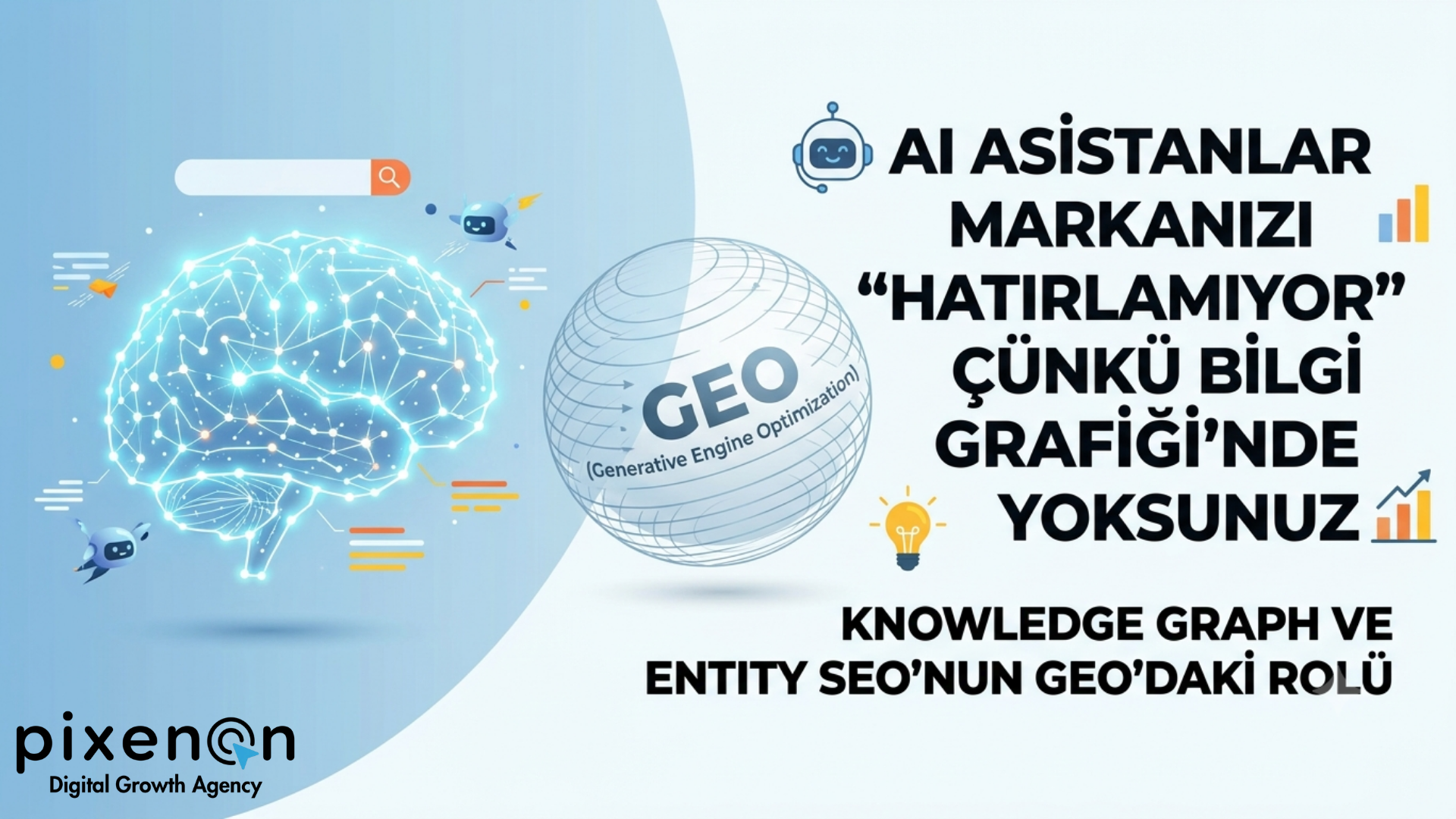
AI Assistants “Don’t Remember” Your Brand Because You’re Missing from the Knowledge Graph: The Role of Knowledge Graph and Entity SEO in GEO
\n
Pixenon Growth Agency
\n
Think about it for a moment: when you ask ChatGPT for “the best project management tools in Izmir,” the model gives you names like Asana, Monday.com, and Notion. How do these names “come to mind”? The answer lies somewhere more fundamental than most people assume: these brands exist as clear, verified, interconnected “entities” within the Knowledge Graph, which forms the basis of how AI models “understand the world.”
\n
If your brand is not in this graph, or exists in an ambiguous, contradictory, or fragmented way, AI assistants “don’t remember” you. You don’t come to mind when asked, because to the model, you are not a reliable “thing” with defined relationships, but scattered pieces of text.
\n
As Pixenon growth agency, our AI visibility team, led by our founder Pixenon Group, sees this as the most fundamental yet least understood layer of GEO (Generative Engine Optimization).
\n
\n
What Is a Knowledge Graph? The Difference Between a Keyword and an Entity
\n
Google treats entities as real-world objects with identities, relationships, and fixed meanings; keywords, on the other hand, are merely strings of text. An entity has attributes, relationships, and a fixed meaning. A keyword, however, can mean different things depending on context.
\n
Let’s make this difference concrete: the word “Apple” is ambiguous—it can mean a fruit, a technology company, or a music record label. But “Apple Inc.” as an entity is a clearly defined technology company with its products, founders, and competitors. Google stores this entity with unique identifiers and links it to trusted sources. Keywords alone cannot do this. This approach reduces confusion and improves answer quality.
\n
Google’s Knowledge Graph contains more than 500 billion facts about 5 billion entities. Google’s ability to instantly distinguish between the fruit, the company, and the record label when “Apple” is searched is called “entity disambiguation”—a concrete example of how this system works. Large language models take this a step further: they build their own internal knowledge graphs by extracting entities and the relationships between them from training data and retrieval sources.
\n
\n
What Happens When a User Asks a Question?
\n
When a user asks ChatGPT “what are the best project management tools,” the model matches this query with known entities (such as Asana, Monday.com, and Notion), evaluates trust signals for each, and synthesizes an answer weighted by entity authority.
\n
If your brand does not have a clear entity identity—that is, if there is no clear answer to the model’s question of “who is Pixenon, what does it do, in which area does it have authority”—you are disabled at this matching step. You are not included in the list of “known entities” that come to mind when the question is asked, because the model does not “recognize” you as an entity; it only sees you as a string of words.
\n
This is the technical equivalent of the statement “AI assistants don’t remember your brand.” To be remembered, you first need to be defined.
\n
\n
From Entity Establishment to AI Overview Citations: The Chain
\n
The relationship between entity establishment and AI Overview citations is more direct than most SEO guides acknowledge. The chain works like this: entity establishment → inclusion in the Knowledge Graph → Gemini’s training data → AI Overview and AI Mode citations.
\n
Google itself states this connection explicitly: Gemini is trained on the Knowledge Graph, so brands with high-quality entity representations have a structural advantage in AI-generated answers. This is the clearest answer to the question “why is getting into the Knowledge Graph important”: this graph is not just a Google search feature; it is part of AI models’ “world knowledge.”
\n
There is also a striking finding: 92% of AI Overview citations come from pages that already rank in the top 10. But among pages with similar rankings, those with stronger entity signals are cited more often. In other words, entity signals are the factor that determines the difference between “winning a ranking” and “being selected within the ranking.”
\n
\n
Brand Mentions and Backlinks: A Striking Difference in Entity Visibility
\n
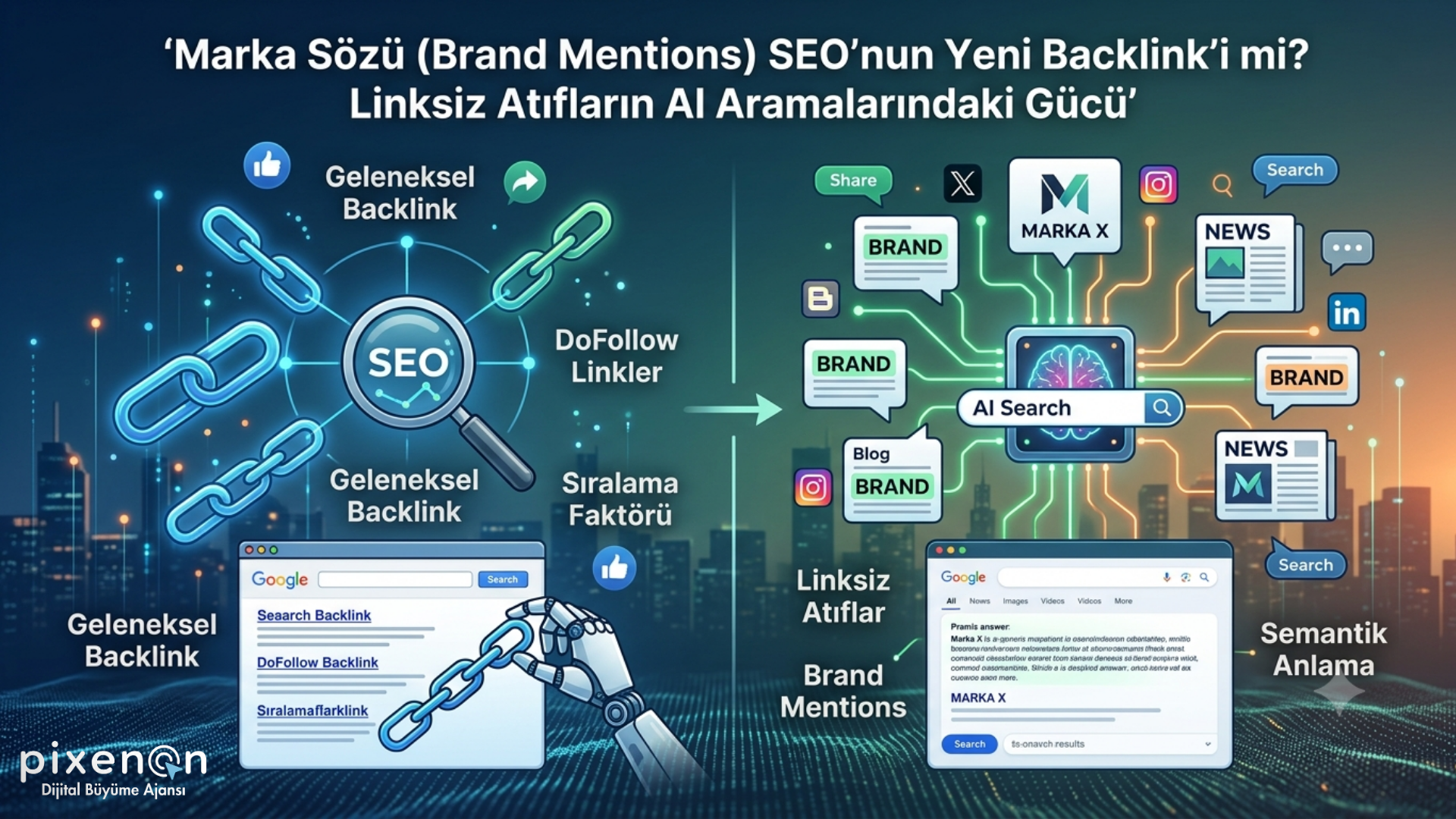
At this point, we need to revisit the “brand mentions” topic we discussed earlier, in the context of entity SEO and with more striking data. According to 2026 entity SEO research, the correlation of brand mentions with AI visibility is 0.664—more than three times the correlation of backlinks, which is 0.218. This data is a central finding showing that building entities outside your own site is far more important than merely earning links.
\n
This is the statistical proof of the question “why is others talking about you more valuable than you talking about yourself.” No matter how perfectly your entity is described on your own website, if there are no consistent references to this entity in the outside world—in news sites, forums, social channels, or even AI-generated summaries—Google and AI models do not see this entity as “verified.” Third-party signals act as “trust validators” that associate your brand with trusted data sources and increase your visibility in AI Overviews and Knowledge Graph results.
\n
\n
Five Core Entity Signals and Prioritization
\n
For brands that want to operationalize entity SEO, five core signals and their implementation cost/impact can be summarized as follows:
Signal 1 — Entity Home: A consistent and comprehensive page where your brand’s “official” definition lives — usually an “About Us” page or a similar corporate identity page. This page should clearly and explicitly define what your brand is, what it does, and whom it serves.
Signal 2 — Wikidata QID: Wikidata is a structured, machine-readable knowledge base. Creating a Wikidata entry for your brand gives you a unique identifier (QID) that enables Google and AI systems to cross-reference your entity with other sources.
Signal 3 — Wikipedia: Wikipedia remains one of the most heavily weighted sources in AI training data. (Although Reddit is cited 3 times more than Wikipedia in AI models, Wikipedia’s structured infoboxes, citations, and cross-references carry unique value for entity resolution.) If your organization meets Wikipedia’s “notability” criteria, an article with well-sourced, structured infobox data significantly accelerates entity recognition across every AI platform.
Signal 4 — sameAs Schema: The sameAs property in Schema.org explicitly tells machines that your website, social media profiles, Wikidata entry, Wikipedia article, and other official entity representations all belong to the same entity by linking them together.
Signal 5 — Third-Party Mentions: The signal we mentioned earlier that has the highest correlation but accumulates the slowest — brand mentions in news sites, industry publications, forums, and reviews.
Among these five signals, signals 1, 2, and 4 (entity home, Wikidata QID, and sameAs schema) constitute the highest-value starting point, because their implementation cost is genuinely low (one structured data block, one Wikidata entry, one afternoon’s work) while their impact on Google’s ability to resolve your entity is high.
Signal 3 (Wikipedia) is the strongest but is limited by the “notability” criterion. Signal 5 (third-party mentions) is the most costly and the slowest to accumulate, but it provides the layer of brand authority that the other signals cannot deliver on their own.
At Pixenon, Pixenon Group’s approach to this prioritization is: “We complete the low-cost structural signals — entity home page, Wikidata, sameAs schema — first, because these are a one-time job and form the foundation. Then we move on to the longer-term third-party mention work. Trying to do both at once amounts to misallocating resources.”
Knowledge Panel: The “Visible Proof” of Entity Recognition
The simplest way to test whether your brand is recognized in the Knowledge Graph is the presence of a Knowledge Panel. Search for your brand on Google: if a Knowledge Panel appears, Google recognizes your entity. If it doesn’t, you need to work on your entity fundamentals.
This works as a binary indicator — a simple but powerful diagnostic tool. The presence of a Knowledge Panel confirms that Google accepts your brand as a distinct entity, which increases the likelihood of sitelinks, richer SERP features, and appearing in related queries where text matching is weak but entity matching is strong.
Industry-Specific Entity Sources
Entity signals carry different weights on different platforms depending on the industry. For technical brands, answers on Stack Overflow / Stack Exchange are heavily cited by AI coding assistants and technical queries. For local and service-oriented businesses, presence on review platforms directly affects whether you appear in comparison queries.
This means “there is no single entity strategy for every brand.” For a growth agency, entity signals — industry publications, client case studies, recognition in professional networks, conference/event participation — may differ from the signals that are meaningful for a SaaS product or an e-commerce brand. At Pixenon, seeking the answer to the question “which entity sources are genuinely weighted in our industry” for each client is the first step of entity strategy.
The Difference Between Entity SEO and Traditional SEO
Traditional SEO ranks web pages for keyword queries. Entity optimization structures your brand as a verifiable entity in AI knowledge graphs — so that models cite you when generating answers. Traditional SEO taught us to optimize text strings (keywords). AI models, however, optimize “things” (entities with defined relationships).
This shift carries significant scale across the industry as well: traditional search volume is projected to decline by 25% by 2026 as buyers shift to AI assistants for vendor research. To capture this traffic, a transition from keyword optimization to entity management is required.
Entity Disambiguation and Your Brand
Named Entity Recognition (NER) is a natural language processing task that identifies and classifies entities such as names, locations, organizations, and dates within text. When someone writes “Apple released a new product,” AI systems need to determine whether this refers to the fruit or the trillion-dollar technology company — NER provides this disambiguation.
For your brand, this means your name doesn’t get confused with other meanings. A distinctive brand name like “Pixenon” can be an advantage in this respect, but every mention on the web still needs to be clearly tied to the definition “Pixenon = Izmir-based growth agency, GEO/AEO/programmatic SEO expert.” If your brand name is defined in different ways across different sources (as “digital marketing consultancy” in one place, as “software company” in another), the AI model may read these conflicting signals as “ambiguity” and avoid recommending you with confidence.
When Are Results Seen?
Entity optimization has a different timeline compared to traditional content SEO. Initial citations usually start appearing within 1-2 months, especially once low-cost structural signals (entity home, Wikidata, sameAs schema) are completed. But the impact of deeper signals like brand mentions can take months and can reach up to 12 months for full entity recognition.
This is important for expectation management: entity SEO works on a “compound effect” logic, not “instant results.” Expecting a Knowledge Panel to appear within the first week isn’t realistic, but the right foundational signals (entity home page, Wikidata, sameAs) can be deployed quickly, and this forms the ground on which longer-term third-party citation work will be built.
Entity Signals Provide Resilience Against Updates
Another important benefit of entity SEO isn’t limited to AI visibility. Brands with strong entity signals are less affected by core updates, because trust is built not on a single page but on the entirety of their digital identity. This connects directly to the “scaled content abuse” and algorithm updates topic we covered in our previous articles: an entity-based trust structure acts as a buffer that prevents an update from targeting “a single page” and putting your brand’s entire digital presence at risk.
Pixenon’s Entity SEO Approach
As Pixenon growth agency, when we start entity SEO work with our clients, our first step is always an “entity diagnosis”: we search your brand name on Google (is there a Knowledge Panel?), check whether there’s an entry in Wikidata, collect how your brand is defined across different sources on the web, and analyze how consistent these definitions are. This diagnosis often gives a very different answer to the question “how does your brand actually look in the eyes of AI” than the owner would have guessed.
Our founder Pixenon Grup’s summary on this: “A brand being ‘remembered by AI’ isn’t magic, it’s a direct result of how clear, consistent, and verified your identity on the web is. We see this work not as a one-time ‘registration’ process, but as the ongoing maintenance of the brand’s digital identity.” After that, we complete the low-cost structural signals (entity home page, Wikidata QID, sameAs schema), then set up a verification program for the highest-weight third-party channels specific to your industry (industry publications, forums, review platforms).
In Short, Visibility Begins with Recognition
AI assistants “remembering” your brand depends on something more fundamental than writing good content: your brand existing as a clear, consistent, and verified entity within the Knowledge Graph that forms the “world knowledge” of the web and AI models. Without this, even the best content remains an “anonymous text”; the model reads it but can’t know who it belongs to, why it’s trustworthy, and which questions it should be presented as an answer to.
As Pixenon growth agency, we’re here to audit your brand’s current state in the Knowledge Graph, quickly establish your entity foundations (entity home, Wikidata, sameAs schema), and build a long-term verification program across third-party citation channels specific to your industry. Because in 2026, the question is no longer “are we writing good content” but “do we actually exist in AI’s knowledge graph, or are there only texts written about us?” The difference between these two determines whether your brand will be remembered by AI assistants.