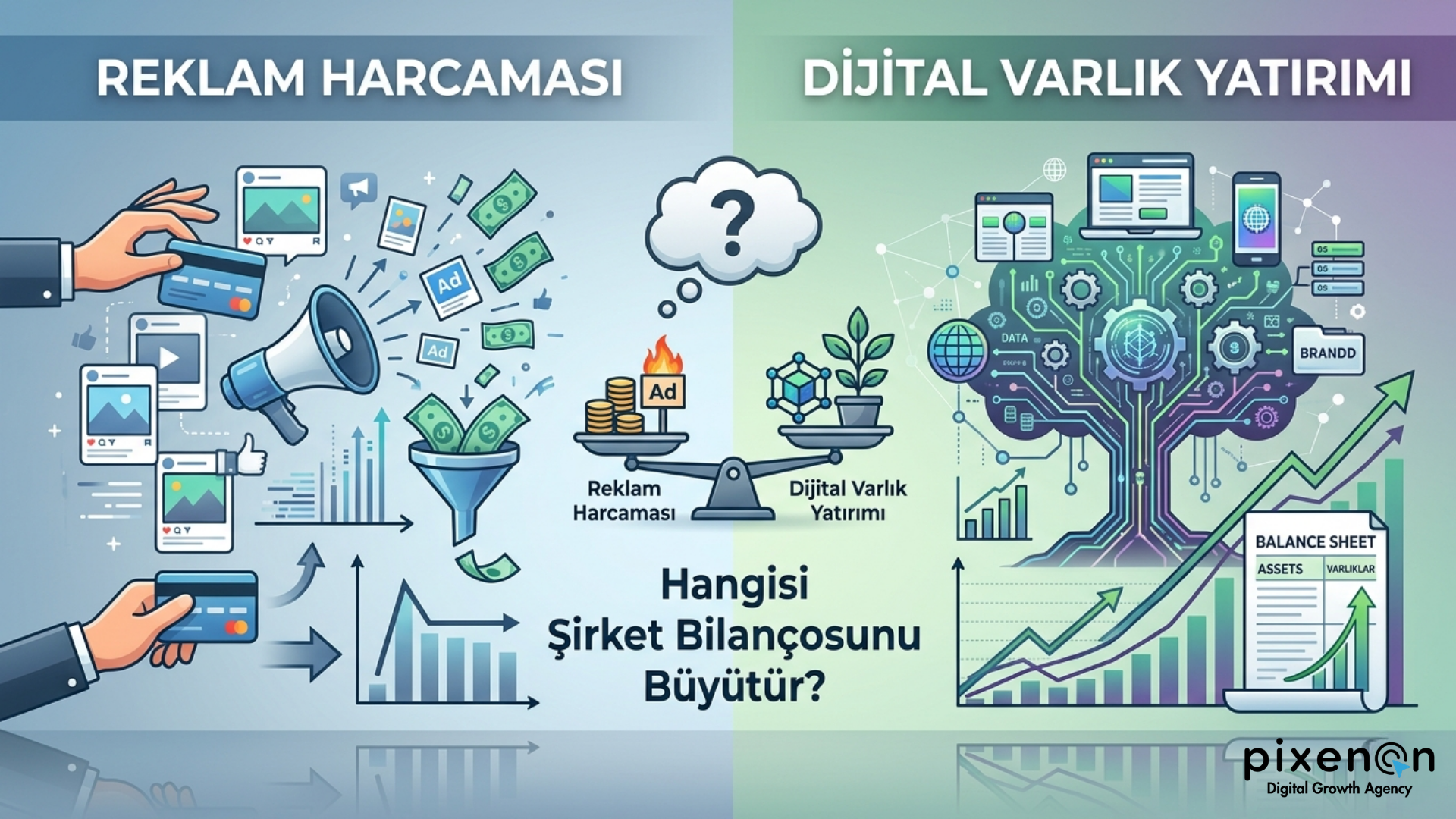
Ad Spend vs. Digital Asset Investment: Which One Grows the Company Balance Sheet?
\n
Pixenon Digital Visibility and Growth Agency
\n
This manifesto touches on budget management, the most sensitive point for business owners in Turkey. It is the strongest headline that explains in financial language that advertising is “rent” and creating digital assets is “becoming a homeowner.” Read it once, and your balance sheet will change forever.
\n
\n
The Biggest Misconception Among Business Owners
\n
For years, I have been seeing the same picture in Turkey. I go to meet with a business owner, look him in the eye, and say: “Let’s build your digital assets, grow your website, build your email list, establish your content archive.”
\n
The owner looks at me, frowns: “Kenan Bey, my budget is very limited right now. I’m spending on ads, and sales come directly. We’re managing for now.”
\n
And in that moment, I know that this owner will either come back to me a year later saying “I wish I had done it,” or he will be wiped from the market.
\n
Every business that fails to understand the difference between ad spend and digital asset investment is doomed to lose in the long run.
\n
I am saying what I have to say very clearly: Advertising is renting, a digital asset is buying. Advertising is an expense, a digital asset is an investment. Advertising ends in a month, a digital asset generates returns for you for years.
\n
\n
Why Is Ad Spend Like “Rent”?
\n
Think about it. You pay rent for your shop. A regular outflow every month. If you don’t pay the rent that month, you have to vacate the shop. As long as you pay the rent, you are there, but the money you pay does not become an asset that returns to you. When the rent ends, that money ends.
\n
Ad spend is exactly this.
\n
The financial definition of ad spend: It is an expenditure made to increase the company’s short-term sales, recorded directly as an expense, and creating no tangible fixed asset or intangible fixed asset in return.
\n
An average e-commerce or service business in Turkey spends 15-30% of its revenue on advertising. For SMEs, this ratio sometimes reaches 40%.
\n
\n
The Effect of Ad Spend on the Balance Sheet
\n
\n
\n
| Item | Effect |
|---|---|
| Income Statement | Deducted as a marketing expense, reducing gross profit |
| Balance Sheet (Assets) | No asset item increases |
| Balance Sheet (Liabilities) | Cash decreases; if there is borrowing, debt increases |
| Equity | Indirect effect through net profit for the period |
\n
\n
A sample calculation:
\n
Let’s consider a business that spends 100,000 TL per month on advertising.
\n
\n
-
\n \t
-
\n
Month 1: 100,000 TL expense → 300,000 TL in sales (returned from advertising)
\n
-
\n
Month 2: Stops advertising → Sales drop to 50,000 TL
\n
-
\n
Month 3: Starts advertising again → 100,000 TL expense again
\n
\n \t
\n \t
\n
What did this business gain after 3 months? Only its sales at that moment. A permanent customer base? No. Brand awareness? Only as long as it advertises. Data? No, it is in the hands of the advertising platforms.
\n
Advertising is renting. As long as you pay, you are at home; the moment you stop paying, you are on the street.
\n
\n
The Bitter Truth About Ad Spend in Turkey
\n
According to 2023-2024 data:
\n
\n
-
\n \t
-
\n
Meta (Facebook/Instagram) advertising costs increased by 45% annually.
\n
-
\n
Google Ads cost per click (CPC) has doubled in the last 2 years.
\n
-
\n
68% of businesses that spend on advertising report that their sales drop by at least 70% when they stop spending.
\n
\n \t
\n \t
\n
Pixenon real data from a textile company we consulted for:
\n
\n
-
\n \t
-
\n
It was spending 250,000 TL per month on Instagram advertising.
\n
-
\n
When advertising stopped, organic sales dropped to only 40,000 TL.
\n
-
\n
Total amount spent on advertising over 3 years: 9,000,000 TL
\n
-
\n
The asset it owned in return for this money: Zero.
\n
\n \t
\n \t
\n \t
\n
When the owner told me, “Kenan Bey, there are no sales without advertising,” I said, “Yes, because you have never invested in anything other than advertising.”
\n
\n
Digital Asset Investment – Why Is It Like “Becoming a Homeowner”?
\n
Now imagine you invest the same money in digital assets. Website setup, SEO infrastructure, content production, email automation, CRM integration…
\n
At first, it seems costly. But this cost is one-time. And most importantly, this expenditure you make is capitalized on your balance sheet.
\n
The financial definition of digital asset investment: These are expenditures expected to provide economic benefit in the long term, qualifying as intangible fixed assets (IFA), capitalizable, and amortized through depreciation.
\n
\n
The Effect of Digital Assets on the Balance Sheet
\n
\n
\n
| Item | Effect |
|---|---|
| Income Statement | The investment amount is not expensed but capitalized |
| Balance Sheet (Assets) | The intangible fixed asset item increases |
| Balance Sheet (Liabilities) | Cash decreases, but an asset counterpart is created |
| Equity | Indirect positive effect (asset increase) |
\n
\n
A sample calculation:
\n
Let a business set up a professional website + SEO infrastructure + content strategy for 200,000 TL. (By Pixenon standards)
\n
\n
-
\n \t
-
\n
Months 1-3: The investment is made. It looks like an expense, but a “Digital Assets” item is opened on the asset side.
\n
-
\n
Month 4-12: Organic traffic starts coming in. Ad spend is gradually reduced.
\n
-
\n
Year 2: The website receives 50,000 monthly visitors. Ad spend drops to 20% of the initial amount.
\n
-
\n
Year 3: The website sits on the balance sheet as an active asset (at its depreciated value). The email list has 50,000 people. The CRM has 10,000 customer records.
\n
\n \t
\n \t
\n \t
\n
\n
Even if this business completely stops advertising, it can generate 150,000 TL in monthly organic sales. Because its digital assets are working for it.
\n
\n
Depreciation and Tax Advantage
\n
There is a critical point here. Digital asset investments can be classified as “Intangible Fixed Assets” in the Turkish Tax System and are subject to depreciation. In other words, you don’t have to expense the investment all at once.
\n
For example:
\n
\n
-
\n \t
-
\n
Website software (300,000 TL) → depreciation over 3 years
\n
-
\n
Domain purchase (5,000 TL) → depreciation over 1 year
\n
-
\n
SEO work (the capitalizable portion) → depreciation over 5 years
\n
\n \t
\n \t
\n
\n
This allows you to protect your cash flow while also reducing your tax base. There is no such flexibility with ad spend. Advertising is a period expense, period.
\n
As Pixenon, here is what we say: A properly structured digital asset investment is far more advantageous than ad spend in terms of both growing the balance sheet and tax planning.
\n
\n
Comparison with Financial Statements – 3-Year Scenario
\n
Now let’s talk with concrete numbers. Let’s consider two competing businesses in the same industry and of the same size.
\n
Brand A: Spends 100,000 TL per month on advertising. Makes no digital asset investment. (It only has an Instagram account and a simple business card website, but it doesn’t attract traffic.)
\n
Brand B: Spends 70,000 TL per month on advertising (gradually reducing it as digital assets kick in). Makes a 300,000 TL upfront digital asset investment (site, SEO, content, infrastructure). Afterwards, it spends 15,000 TL per month on maintenance and content production.
\n
\n
Comparative Table (3-Year)
\n
\n
\n
| Item | Brand A | Brand B |
|---|---|---|
| Total ad spend | 3,600,000 TL | 1,800,000 TL (decreases after year 2) |
| Digital asset investment | 0 TL | 780,000 TL (300k upfront + 15k x 32 months) |
| Total spending | 3,600,000 TL | 2,580,000 TL |
| Assets on the balance sheet at the end of year 3 | ||
| Website (before depreciation) | 10,000 TL | 400,000 TL |
| Email list (value) | 0 TL | 250,000 TL |
| CRM database | 0 TL | 150,000 TL |
| SEO value (rankings) | 0 TL | 300,000 TL |
| Content archive (blog, video) | 0 TL | 100,000 TL |
| Total active assets | 10,000 TL | 1,200,000 TL |
| Year 3 monthly organic sales | 40,000 TL | 180,000 TL |
| Ad dependency | 85% | 25% |
\n
\n
\n
Did you see? Brand A spent 3.6 million TL and has nothing to show for it. Brand B spent less and has 1.2 million TL in digital assets. And Brand B can keep its business going even if it completely stops advertising.
\n
Whose balance sheet is bigger? The answer is very clear: Brand B.
\n
Every time I show this table to a boss, their facial expression changes. Because numbers don’t lie.
\n
\n
Why Do Bosses in Turkey Keep Advertising? (Psychological Traps)
\n
If the situation is this clear, why do bosses still invest in advertising and not in digital assets?
\n
As Pixenon, we have met with hundreds of bosses and found the answer to this question.
\n
5 psychological traps
\n
\n
Trap 1: The Instant Gratification Trap
\n
You advertise, sales come immediately. Your brain’s reward center is activated. With digital asset investment, however, you see results in 3-6 months. The brain prefers instant reward.
\n
Solution: Think, “Don’t let today’s sale bring tomorrow’s bankruptcy.” The strategy of someone who is hungry an hour later is different from someone who is hungry a day later.
\n
\n
Trap 2: The “We Already Have a Website” Fallacy
\n
Most bosses have a website. But that site doesn’t attract traffic, doesn’t convert, doesn’t collect data. Existing is not the same as being functional.
\n
Solution: Your website needs to work like a “digital employee.” Calculate how many TL it earns per visitor. If it’s below 0.5 TL, there’s a problem with the site.
Trap 3: The Fear of “We Can’t Cut the Ad Budget”
Bosses know that if they cut advertising, sales will stop. That’s true. But the reason is that they have no other channels.
Solution: Build digital assets BEFORE cutting the ad budget. Go in parallel. After 6 months, gradually reduce advertising.
Trap 4: Not Knowing What a Digital Asset Is
Many bosses understand “digital asset” as only a domain and hosting. However, an email list, a database, a content archive, SEO value, and brand search volume are also digital assets.
Solution: If you’re reading this article, now you know. Knowledge brings responsibility.
Trap 5: The “My Business Is Local, Social Media Is Enough” Fallacy
Local businesses fall into the biggest misconception. They say, “My customers already find me on Instagram.” But what if Instagram crashes? What if the algorithm changes?
Solution: Even for a local business, digital assets = Google My Business, your own website, local SEO, customer database. Without these, being “local” is just a geographical situation, not a strategy.
As Pixenon, we know this very well: Bosses are smart, but their access to the right information is limited. Pixenon’s mission is to explain this information in understandable financial language and drive action.
Chapter 5: The 4-Step Digital Asset Strategy to Grow Your Balance Sheet
Enough theory. Now for practice. I’m sharing a 4-step strategy you can start today that will grow your balance sheet in 12 months.
Step 1: Take a Digital Asset Inventory (0-30 Days)
Determine your current situation:
-
Is your website really “yours”? (Domain, hosting, software)
-
Do you have an email list? How many people? How many emails did you send in the last 6 months?
-
Where do you keep your customer data? (Excel or CRM?)
-
Do you have a content archive? Blog, video, PDF? Are these on your own site or on YouTube/Instagram?
Pixenon recommendation: Put this inventory into a table. Mark your gaps. 70% of most brands will come up short.
Step 2: Establish the Core Digital Properties (30-90 Days)
Minimum assets:
-
A fast, mobile-friendly, SEO-optimized website (WordPress or similar)
-
Email marketing infrastructure (Mailchimp, HubSpot, Brevo, or local alternatives)
-
Visitor data collection mechanisms (pop-up, lead magnet)
-
Google Analytics 4 + Search Console setup
Budget estimate: 100,000 – 300,000 TL (one-time) + 10,000 TL monthly (infrastructure and content)
Remember that you will amortize this expense over 2-3 years. It is not a “melting” expense like ad spend, but an asset that gains value.
Step 3: Activate Organic Visibility (90-270 Days)
At this stage, the focus is on content and SEO:
-
2 blog posts per week (with keyword research)
-
Updating old content
-
Backlink strategy (getting links from industry sites)
-
Visibility on Google Discover and news sites
Budget estimate: 15,000 – 30,000 TL monthly (content creator, SEO consultant)
At this stage, don’t cut your ad budget yet. Run them in parallel. As organic traffic starts to increase, your dependence on advertising will decrease.
Step 4: End Ad Dependence (270-365 Days)
Now the data speaks:
-
Has organic traffic exceeded 20,000 monthly visitors?
-
Has your email list reached 10,000 people?
-
Do monthly organic sales account for 40% of total sales?
If yes, gradually reduce your ad budget (10-20%). Watch whether your sales drop as you reduce. If organic channels are strong, the drop will be either very small or nonexistent.
Goal: At the end of 1 year, reduce your ad spend to at most 50% of the initial level. At the end of 2 years, to 25%.
One of our clients where we applied this method as Pixenon (an e-commerce clothing brand):
-
Start: 180,000 TL monthly ads, 600,000 TL monthly sales
-
-
month: Digital assets established. Ads continue at 180,000 TL, sales 750,000 TL
-
-
-
month: Ads dropped to 120,000 TL, sales 900,000 TL
-
-
-
month: Ads 80,000 TL, sales 1,100,000 TL
-
-
-
month: Ads 50,000 TL, sales 1,300,000 TL
-
At the end of 2 years, a digital asset worth 850,000 TL was created on the brand’s balance sheet. Ad spend decreased by 72%. Sales doubled.
This is what “growing the balance sheet” means.
Financial Manifesto – Pixenon’s Balance Sheet Call
When we look at company balance sheets as bosses in Turkey, we see buildings, vehicles, and machinery under the fixed assets line. What about digital assets? What about the balance sheet equivalent of the website, software, database, and brand value?
As Pixenon Digital Visibility and Growth Agency, we are publishing this article as a Financial Manifesto.
Digital Balance Sheet Manifesto
Article 1: Ad spend is like a “rented house.” It’s nice while you live in it, but it doesn’t create belonging, doesn’t accumulate value, doesn’t create an asset.
Article 2: Digital asset investment is like “owning your own home.” You pay upfront, maybe take out a loan, but then the house is yours. It appreciates, you rent it out, you sell it, you pass it on as an inheritance.
Article 3: The true value of a company is measured not only by its physical assets but also by its digital assets. Website, email list, database, content archive, SEO value… Without these, the balance sheet is incomplete.
Article 4: The brands that will win in 2025 and beyond are those investing in their digital assets today. Those held captive by advertising, on the other hand, will be left at the mercy of the platforms.
Article 5: Every business owner should allocate at least 20% of their monthly advertising budget to digital asset investment. This ratio should be increased to 50% within 12 months.
Article 6: Every business owner who reads this manifesto is obliged to take inventory of their digital assets and create a roadmap within the next 30 days.
Are You Investing in Advertising Today, or in Digital Assets?
Dear business owners, entrepreneurs, managers,
I will make my closing statement very clear.
As the Founder of Pixenon Digital Visibility and Growth Agency, I have examined the financial statements of hundreds of companies over the years. The most striking difference between those that grew and those that shrank was this: Growing companies had a “digital asset” line item on their balance sheets. Shrinking ones had only “advertising expense.”
Which one do you want to be?
You will need advertising spending for a lifetime. But that doesn’t mean you’ll be making constant outflows like paying rent. Everyone knows the difference between renting and owning a home. That same difference exists between advertising and digital assets.
As Pixenon Digital Visibility and Growth Agency, we help brands see this difference and take action. We invite you to join this journey too.
Remember:
-
Advertising spending leaves your wallet and never comes back.
-
Digital asset investment also leaves your wallet, but it comes back to you as income for years.
Which one grows your company’s balance sheet? You know the answer.
Now is the time to take action.
This manifesto is the key to your brand’s financial transformation. It may not be copied without permission; it may be quoted with attribution.
Appendix: Quick Balance Sheet Test (Evaluate Yourself in 2 Minutes)
-
What was your total advertising spending last year? ______ TL
-
Do you have any permanent digital asset remaining in your hands in return for this spending? (Yes/No)
-
Can you consider your website an active “asset”? (Yes/No)
-
How many people are on your email list? ______
-
If you stopped advertising for a month, by what percentage would your sales drop? ______ %
Evaluation:
-
-
No to question → You have no digital assets.
-
-
-
Above 70% to question → You are addicted to advertising.
-
-
Your email list is under 5,000 → Your data assets are insufficient.
If you failed this test, you should create a digital asset strategy as soon as possible. As Pixenon, we are by your side.
Call now. Tomorrow may be too late.