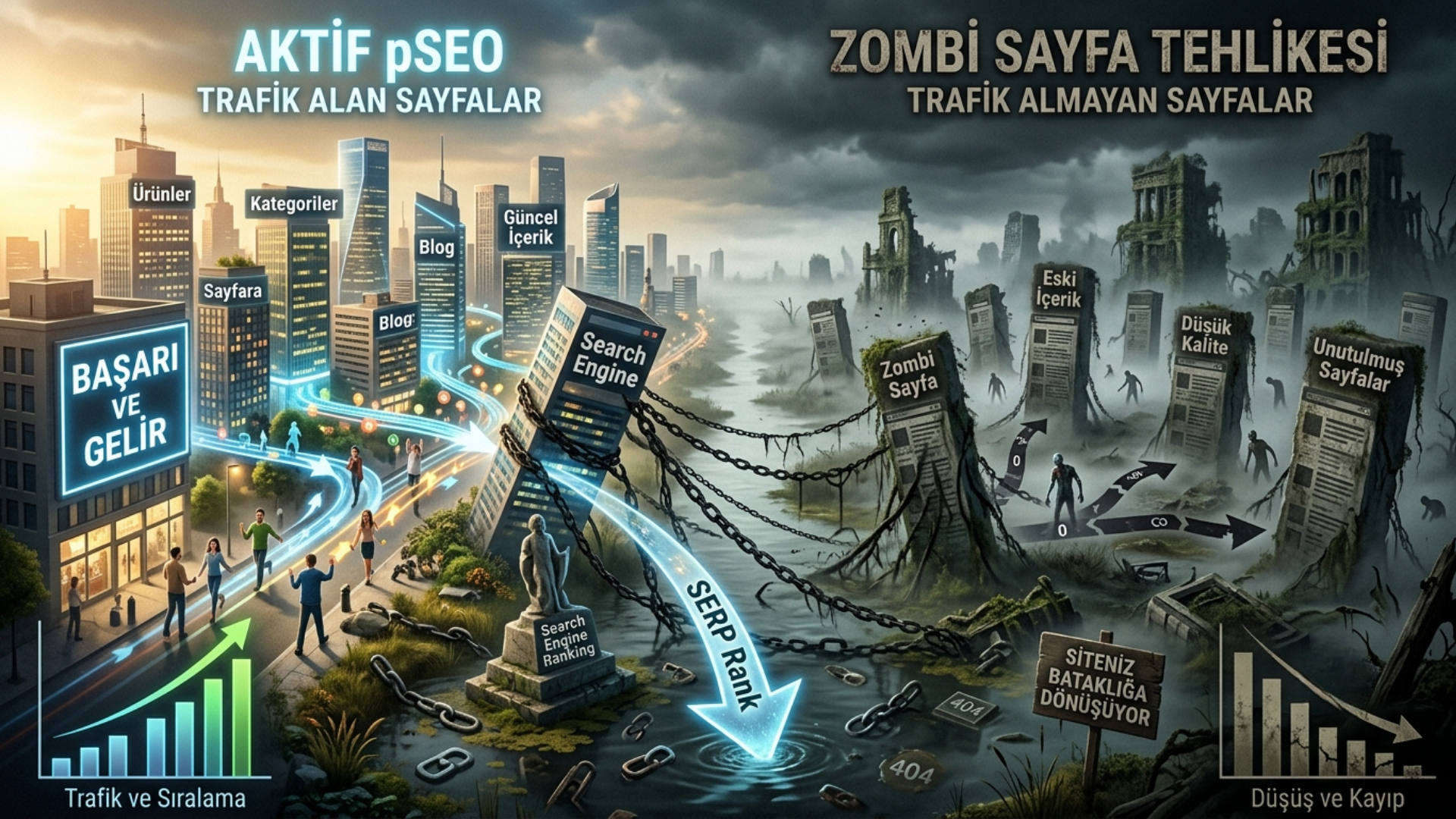
The Zombie Page Danger in pSEO: How Pages That Get No Traffic Drag Your Site into a Swamp
\n
Programmatic SEO (pSEO), when set up correctly, is one of the most powerful scaling methods that makes a brand visible across thousands of search queries at once.
\n
If a templated structure, a data source, and the right automation are put in place, a single system can generate tens of thousands of pages within minutes. But this power has a shadow side: scale does not automatically guarantee quality. If the vast majority of the pages generated get no traffic, your site may be growing on the surface while actually rotting from within.
\n
At Pixenon, this is exactly one of the most common and least discussed problems we see in pSEO projects: zombie pages.
\n
\n
What Is a Zombie Page?
\n
A zombie page is a page that is technically “alive” but in practice produces no value whatsoever. It may be indexed, its URL may open, it may not return a server error, but over a period of six to twelve months it gets close to zero organic traffic, it does not rank for any meaningful query, and it provides no real benefit to the user.
\n
These pages are not indexed intentionally to lower the site’s overall authority; however, they can still harm Google rankings.
\n
In the context of programmatic SEO, zombie pages typically emerge in the following forms:
\n
\n
-
\n \t
- Thousands of city/district/neighborhood-based variation pages templates like “X service in Istanbul,” “X service in Kadıköy,” “X service in Beşiktaş” with almost no content difference between them
- Product or category combination pages combinations automatically derived from filter parameters that have no real search volume
- “Empty” pages automatically pulled from a database product/service pages where content, price, or image data has not yet been entered
- Old campaign or event pages content that has expired, has not been updated, and no longer matches any search
- Orphan pages URLs that cannot be reached from any on-site menu or link and exist only in the sitemap. Since these pages are not linked from other pages on the site and cannot be accessed from site menus, Google crawlers cannot find them, so they have almost no chance of getting traffic.
\n \t
\n \t
\n \t
\n \t
\n
\n
An important distinction: a zombie page is not the same thing as a “page that gets little traffic.” The problem is not the amount of traffic but aimlessness.
\n
If a page covers a narrow niche topic with low search volume but serves a real intent and answers a unique question, it is not a zombie. A zombie page is a page whose reason for existing is “filling a folder.”
\n
\n
Why Is pSEO So Prone to Producing Zombie Pages?
\n
In traditional content production, every page is written by hand, which creates a natural quality filter. In pSEO, this filter disappears. One template + one dataset = unlimited pages.
\n
This math leads teams to fall into the logic of “the more pages, the more keywords, the more traffic.” Yet as of 2026, this equation has been reversed.
\n
In 2026, a website with 50 excellent pages written by experts will always outperform a website with 500 mediocre pages. This is especially true for local SEO which is exactly one of the areas where pSEO is most frequently used.
\n
The technical origin of this is as follows: Google’s helpful content guidance states that automated ranking systems aim to prioritize helpful and reliable information created to benefit people, not to manipulate rankings.
\n
These self-assessment questions ask whether the content provides original information, reporting, research, or analysis, whether it offers a substantial explanation of the topic, whether it goes beyond obvious information, and whether it avoids merely copying or rewriting sources.
\n
When a templated pSEO page changes the variable (city name, product name, service name) and repeats the rest of the text verbatim, there is almost no “yes” answer it can give to these questions.
\n
If every page in a niche contains the same definitions, pros and cons, frequently asked questions, and general advice, there is little reason for Google to prefer one over another unless other trust and reputation signals carry it.
\n
\n
How Do Zombie Pages Drag a Site into a Swamp? The Mechanism Step by Step
\n
Wasting Crawl Budget
\n
Google does not allocate unlimited crawling capacity to every site. Google allocates a crawl budget, that is, the number of pages it will crawl on your site within a given time period. If crawlers spend time on insignificant zombie pages, they may miss newer and more important content that deserves to be indexed.
This translates into a concrete cost on large-scale pSEO sites. A mid-sized e-commerce site experienced serious indexing delays due to 85,000 product pages, new products took 3-4 weeks to appear in search results, and this situation was estimated to cost $50,000 per month in lost organic revenue.
After a technical SEO cleanup on the same site, a $15,000 investment generated an additional $125,000/month in organic revenue within 90 days, delivering a 733% return on investment. These figures show that zombie page cleanup is not a “nice to have” but a priority directly tied to the revenue line.
Index Bloat and Site Quality Perception
Index bloat is the condition in which a website’s search engine index contains an excessive number of pages that carry little or no value for users. This situation not only disperses crawl resources but also affects search engines’ overall quality assessment of the site.
In the pSEO context, this can happen very quickly: large sites often carry thousands of low-value tag URLs, thin location pages, and nearly identical variants. During broad updates, this can drag down the site’s perceived quality.
In the March 2026 update, it was also observed that Google tightened its trust-earning criteria specifically for AI-assisted, templated, or “scaled” content and recalibrated its tightening logic. Sites relying on thin pages, programmatic templates, or weak first-hand expertise signals experienced the most fluctuation.
Site-Wide Spread of Trust Loss
Perhaps the most critical point is this: zombie pages do not only affect themselves, they affect the entire domain. Google’s Helpful Content system does not evaluate pages in isolation; it evaluates the entire site.
If you have a hundred pages and thirty of them are thin, keyword-stuffed filler content, the classifier does not merely ignore those thirty pages; it lowers the trust score for the site as a whole. Bad content in a single section can collapse the rankings of your entire domain.
This is a critical warning for pSEO projects: the idea that “poorly performing pages aren’t ranking anyway, so there’s no harm” is wrong. Even if those pages don’t rank, their presence drags down the ranking potential of the rest of the site.
Keyword Cannibalization
Zombie pages dilute crawl budget and cause keyword cannibalization, lowering the site’s overall rankings. When dozens of nearly identical pSEO pages serve the same intent, Google cannot decide which one to surface, and in the end none of them rank strongly.
Unnecessary and weak pages overload the site’s structure, disperse internal link value, create internal competition, and divert crawlers’ attention away from important sections. This harms not only “dead” URLs but also commercial pages, categories, and key articles.
Indirect Impact on User Experience and Core Web Vitals
Zombie pages often have technical issues that cause them to load slowly. This harms the experience of users visiting the page and can negatively affect Core Web Vitals, and therefore page experience and rankings.
Automatically generated pSEO pages often remain unmaintained; as templates with no image optimization, unnecessary script load, and no mobile testing, they continue to slow the site down.
JavaScript Render Issues: “Invisible” Zombie Pages
There is a technical detail often overlooked on pSEO sites: a page may be “crawled” but never “rendered.” When Googlebot encounters a JavaScript-rendered page, the HTML is fetched first (this counts toward crawl budget)… a page can be crawled (HTML fetched) but never rendered (JavaScript not executed).
This creates “zombie pages”—pages that are technically crawled but appear in Google’s index with missing content. In client-side rendered pSEO templates, this can mean that thousands of pages remain in the index as “empty shells” without ever actually showing real content.
Why Are Zombie Pages More Dangerous When It Comes to AI “Seeing Us”?
This is exactly where the problem intersects directly with our reason for writing this article. In traditional SEO, even if a page performed poorly, one could say it was “sitting quietly in the corner.” However, when generative search engines (systems like Google AI Overviews, ChatGPT, Perplexity, and Claude) evaluate a brand or a topic, they look not at a single page but at the consistency and trustworthiness of the entire domain.
The reason is technical: when these systems decide which source to trust while generating an answer, they weight brand reputation, consistency, and “first-hand experience” signals.
The winners show clear topical authority, original insights, strong user experience, and brand validation (mentions, reputation, author credibility). If a site has thousands of nearly copy-paste zombie pages, these systems may label that domain as “scaled, automated, low originality,” and that label can spill over even to the site’s best, most original page.
In other words: for AI search engines to see you as an “authority,” a single perfect page is no longer enough. The site as a whole needs to carry that standard.
Zombie pages are the most invisible and insidious factor dragging down this overall standard, because they usually get ignored since they appear as “zero” in traffic reports, while in the background they erode domain reputation minute by minute.
Detecting Zombie Pages: A Practical Method
- Apply a zero clicks / zero impressions filter in Google Search Console over a 6-12 month period. Signs of zombie pages include zero clicks from search for 6–12 months, thin or duplicate content, and a lack of external backlinks.
- Identify indexed parameter/filter URLs with operators such as
site:yourdomain.com inurl:?and similar. These searches reveal URLs indexed with parameter URLs and help identify patterns in bloat. - Run a full site crawl with tools like Screaming Frog or Sitebulb and compare it with Search Console index data. Look for inconsistencies between pages you don’t want indexed but that are indexed, and important pages that should be indexed but aren’t.
- Identify orphan pages by comparing the sitemap with the site architecture to find URLs that cannot be reached from any on-site menu, breadcrumb, or internal link.
- Filter pages with fewer than 10 monthly visits in Analytics and cross-check them against backlink presence.
The Solution: Prune, Merge, Improve
Once a zombie page is detected, there are three main paths:
- Prune: Remove pages with no value, no search volume, and no backlinks using 410/404.
- Merge: Consolidate dozens of pSEO variations that are very similar and serve the same intent into a single, strong, and comprehensive page with a 301 redirect.
- Improve: Take pages with real search potential but weak writing and move them out of a “template” look by adding original data, real expertise, visuals/media, and first-hand information.
A case example shows the power of this approach: in a “Content Pruning” project for a client, 40% of blog posts — hundreds of pages — were deleted, and as a result organic traffic increased by 150% in three months.
The practical rule in pSEO should be this: If a template page does not contain enough original data or value to defend that template on its own, that page should not exist. Scale is not an excuse to sacrifice quality; scale only becomes a sustainable advantage when quality is preserved.
Pixenon’s pSEO Approach
At Pixenon, in programmatic SEO projects we prioritize not the number of pages but the real value per page. When setting up each pSEO template, we ask these three questions:
- Does this page correspond to a real and measurable search intent?
- Does this page offer original data or information that distinguishes it from hundreds of other pages in the same template?
- Does this page strengthen the signal that “I can trust this site” for both classic search engines and AI-powered search systems, or does it weaken it?
If a clear “yes” cannot be obtained for any of these questions, that template is either redesigned or not produced at all. Because in today’s search ecosystem — for both Google’s core algorithms and AI-based search experiences — a brand’s authority is measured by its weakest link.