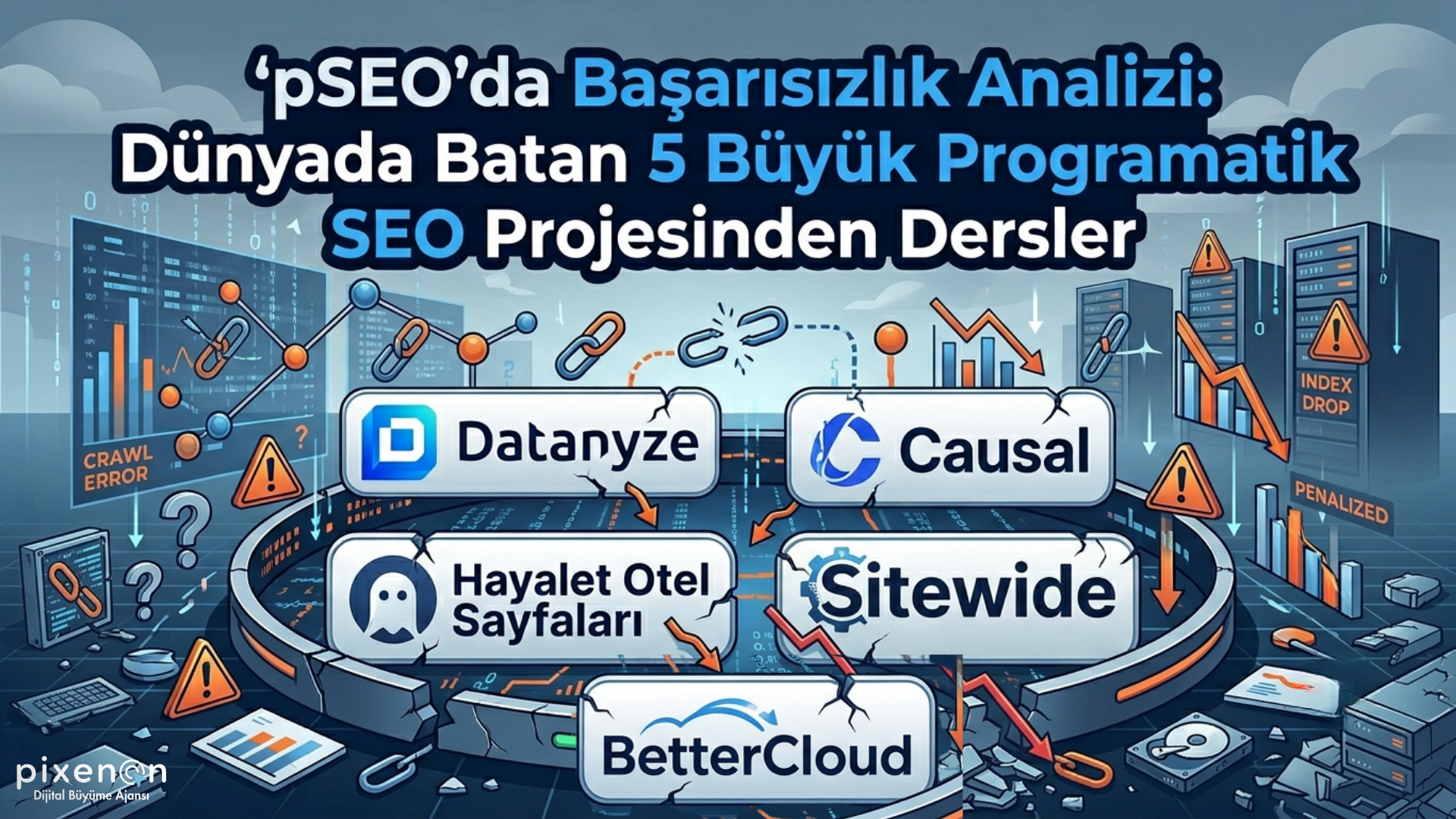
Failure Analysis in pSEO: Lessons from 5 Major Programmatic SEO Projects That Sank Worldwide
\n
Programmatic SEO (pSEO), when set up correctly, is a powerful growth engine that can multiply organic traffic within months by automatically generating thousands of pages.
\n
But the other side of the coin is far more ruthless: the same automation logic, when deprived of quality control, gets flagged as “scaled spam” in Google’s eyes, and sites are wiped from the index within days.
\n
At Pixenon, when building pSEO strategies for our clients, we consider it critical to study failure cases as much as success stories, because the way to safely scale a growth channel is to learn from the people who have seen how it gets ruined.
\n
In this article, we put 5 major pSEO collapses, documented with real data, under the microscope along with their causes.
\n
\n
Datanyze: Thousands of “Company Pages” and a 96% Traffic Collapse
\n
B2B data platform Datanyze published thousands of automatically generated landing pages for company and people profiles. These pages under the /companies and /people subfolders were essentially nothing more than basic contact information—they went no further than pouring data such as company name, industry, and employee count into a template.
\n
What happened: Google flagged these pages as low-quality content that offered no real value to the user. The result was a 95-96% collapse in Datanyze’s organic traffic.
\n
The striking point was this: the bulk of the loss was concentrated only in the subfolders containing programmatic content; other sections of the site remained relatively stable. This shows that Google applied the penalty not site-wide but at the template/section level.
\n
Root cause: Datanyze’s programmatic content consisted largely of repetitive lists that offered no industry-specific insight. Each page technically targeted a different keyword, but the real value it offered the user was nearly zero.
\n
Pixenon’s lesson: A pSEO page cannot settle for merely “theoretically targeting a unique search query.” The page must present the information that the user making that query actually needs in a contextual, original, and actionable way. Otherwise, in Google’s eyes, it remains nothing more than a “template + data variable” formula.
\n
\n
Causal: 1,800 AI Articles with an “SEO Heist,” 99.52% Traffic Loss
\n
The case of financial modeling platform Causal became one of the most frequently cited “what not to do” examples in the pSEO world. To explode its SEO traffic in a short time, the company mass-published 1,800 AI-generated articles—an approach mockingly dubbed the “SEO heist” in the industry.
\n
What happened: Although the strategy seemed to work at first, the collapse was harsh once Google’s quality signals kicked in: Causal lost 99.52% of its organic traffic. This is one of the most extreme cases in the industry—in practice, it meant the site’s organic visibility was almost entirely erased.
\n
Root cause: Publishing 1,800 articles in a short time without passing through a human editorial process fit exactly into the classic pattern of “scaled content abuse.” The helpful content signals Google integrated into its core ranking system in 2024, and the scaled-content-abuse policy that was later formalized, target precisely this kind of mass, low-originality publishing.
\n
Pixenon’s lesson: Speed is pSEO’s most tempting promise but also its biggest trap. Publishing thousands of pages in a week is technically possible; but if you don’t have a convincing answer for each one to Google’s question of “why does this page exist?”, that speed becomes the thing that kills you.
\n
\n
Ghost Hotel Pages: The “Same Page, Different Name” Mistake Across 50,000 Cities
\n
A travel site generated 50,000 pages in the format “Hotels in [City].” The template was exactly the same; the only thing that changed was the city name—there was no real differentiating element such as price data, hotel listings, images, or local context.
\n
What happened: Google removed 98% of these pages from the index within 3 months of publication. This is one of the most frequently cited cases in pSEO literature because the source of the problem was strikingly clear: maximum page count, minimum justification for the pages to exist—in other words, content that “exists because it exists.”
\n
Root cause: The pages technically targeted the keyword but did not offer what the user was actually looking for. Someone searching for “hotels in Istanbul” expects concrete decision-support data such as price range, neighborhood recommendations, and seasonal information—not a generic paragraph where only the city name changes. These pages did not meet that expectation in any way.
\n
Pixenon’s lesson: The “template + variable” logic is the foundation of pSEO, but it is not enough on its own. As the number of pages increases, the unique data density injected into each page must also increase proportionally. Instead of opening 50,000 city pages, 5,000 pages based on real data are often a more durable asset.
\n
\n
BetterCloud: AI Content in the “/academy” Folder and the November Core Update Blow
\n
SaaS spend management platform BetterCloud accumulated generic, superficial, and largely AI-generated articles in its blog/academy section (/academy).
\n
One of the examples covered a topic as ordinary as this: “How to Delete an Unwanted Page in Google Docs”—a piece aimed purely at traffic hunting, with no connection whatsoever to the brand’s actual area of expertise.
\n
What happened: After Google’s November core update, BetterCloud lost an estimated 94% of its organic traffic, with the bulk of the loss coming precisely from this low-quality academy section.
Root cause: The content lacked depth and was overly simplified, carrying the typical appearance of AI-generated output. More importantly, the article was completely disconnected from the brand’s own product/expertise axis.
From the perspective of Google’s E-E-A-T (Experience, Expertise, Authoritativeness, Trustworthiness) principles, a SaaS company writing a generic “how-to” about Google Docs does not align with that brand’s actual area of expertise, which weakens the trust signal.
Pixenon’s lesson: In pSEO, the “all traffic is traffic” approach is misleading.
Generating volume on topics outside your brand’s area of expertise may inflate the traffic graph in the short term, but it weakens the brand in Google’s topical authority assessment and puts the rest of the site at risk as well.
Sitewide Collapse: The May 2026 Core Update and the “Programmatic Ratio” Signal
The most recent and perhaps most strategically significant case came with Google’s May 2026 core update.
This update directly targeted automatically generated, ad-inflated content and dropped programmatic pages from the index within days.
What happened: The critical detail that set this case apart from the others was this: the penalty was applied sitewide on the worst-performing sites, not limited to programmatic pages alone. On a site hosting 70% programmatic content, even editorial/human-written pages were harmed. Google, apparently, now uses the ratio of programmatic content on a site as a quality signal in its own right.
Root cause and the new threshold: The data that emerged after the update defines a concrete threshold for resilient content: in 2026, the most defensible content format is a 1,500-2,500-word piece containing at least one piece of information found nowhere else on the internet, whether original research, your own data, a methodology no one else has published, or specific case data. One unique data point per page stands out as the threshold value.
Pixenon’s lesson: This case shows that pSEO strategy is no longer a singular “page quality” matter but has become a “site architecture” matter. Monitoring the programmatic/editorial content ratio should now be a KPI for growth agencies, not just individual page performance.
The Common Pattern: 5 Cases, One Story
When you place these five cases side by side, it becomes clear that they are all different versions of the same root problem:
- Lack of differentiation The template is the same, only the variable differs. The Datanyze and 50,000 hotel pages cases are classic examples of this.
- Speed > Quality prioritization Causal publishing 1,800 articles at once shows the cost of scaling without editorial review.
- Disconnection from brand expertise BetterCloud’s academy section was filled with content unrelated to the company’s core business, aimed purely at traffic.
- Ignoring sitewide risk perception The May 2026 update proved that a single “bad folder” can now drag down the entire site.
Industry-wide data confirms this pattern as well: consistent patterns were identified across more than 500 failed programmatic SEO implementations analyzed, and 93% of penalized sites had no differentiation whatsoever among their templated pages.
Additionally, roughly one-third of programmatic SEO implementations experienced a severe “traffic cliff” within 18 months of launch, showing that the risk of pSEO exists not only at launch but also in the medium term.
An independent study also questions the overall performance of AI content in search engines: while 86% of articles ranking in Google Search were written by humans and only 14% were AI-generated, 82% of articles cited by ChatGPT and Perplexity were human-made, with only 18% being AI-generated.
The Pixenon Approach: Scaling pSEO Without Sinking It
We turn the lessons drawn from these cases into concrete principles when working with our clients as an agency:
- Pilot-first logic: Instead of publishing thousands of pages at once, we start with a small sample group and monitor indexing, engagement, and conversion data. If the signals are positive, we scale gradually.
- Unique data requirement: In every template, we mandate not just a variable name but a real, verifiable, page-specific data point (price, statistic, local context, original analysis).
- Human editorial layer: Automation brings speed, but the final checkpoint is always a human editor, especially for brand voice, accuracy, and contextual consistency.
- Programmatic/editorial ratio tracking: We monitor the ratio of programmatic content to total content in the site’s overall architecture and report it as a standalone risk indicator.
- Early warning systems: By tracking metrics such as indexing rate, average position, and click-through rate in Search Console on a weekly basis, we intervene before a “traffic cliff” turns into major damage.
When set up correctly, pSEO is still one of the most powerful organic growth channels. But these five cases remind us that scale alone is not a strategy; only when combined with quality does scale become a sustainable growth engine.
At Pixenon, we care not about our clients’ traffic charts, but about their organic assets that are still standing three years later.