\n
\n
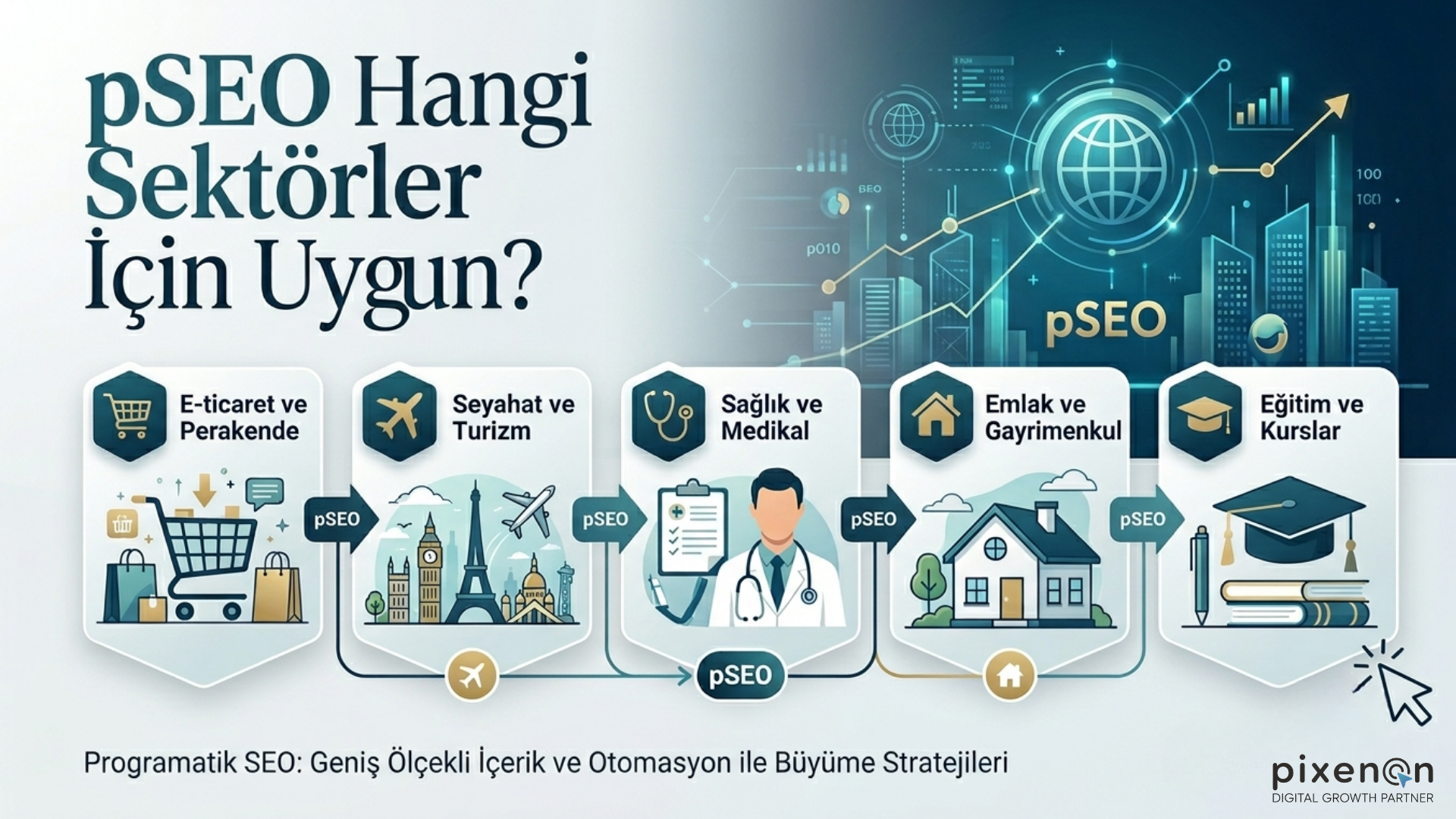
Which Sectors Is pSEO Suitable For?
\nProgrammatic SEO (pSEO) is a strategy that provides scalable visibility in search engines by automatically generating thousands of pages through data sets and templates instead of individually written blog posts.
\n
\nHowever, not every sector or every business model gets the same efficiency from pSEO.
\n
\nIn this guide, as Pixenon Digital Growth Agency, we examine in a data-driven way which sectors are suitable for pSEO, which are not, real-life examples, and the implementation logic.
\n
What Is pSEO? A Short and Clear Definition
\nProgrammatic SEO is the method of generating pages for hundreds, even thousands of unique search intents by combining structured data (variables such as location, product, service, category, price range) with a pre-designed page template. The goal is to systematically capture long-tail search queries that are impossible to write one by one manually.
\n
\nAs of 2026, since Google’s Helpful Content System aggressively detects and penalizes thin, templated, and repetitive content, successful pSEO no longer means “generating many pages” but rather adding real, measurable value to each page.
\n
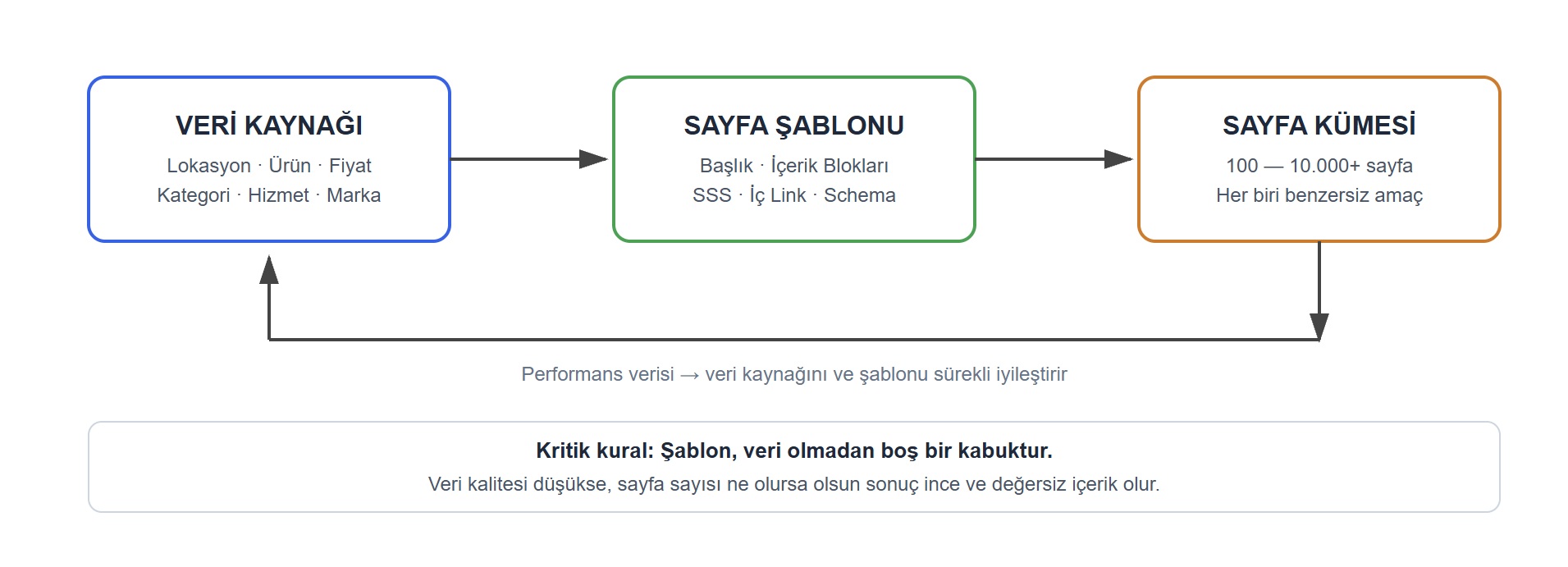
Diagram 1 How pSEO Works
\nThe fundamental workflow of Programmatic SEO consists of three main components: the data source, the page template, and the published page set.
\n
\n
\n
\n
Which Sectors Is pSEO Suitable For?
\nThere are three fundamental criteria that determine whether a sector is suitable for pSEO: (1) the presence of structured, repetitive data, (2) user queries that repeat in the same pattern but are searched with different variables, (3) each page’s ability to serve a real user decision. In the table below, we have listed the most suitable sectors according to these criteria.
\n
Diagram 2 — pSEO Suitability Score by Sector
\n
| Sector | Data Structure | Example Variables | Suitability |
|---|---|---|---|
| E-commerce | Product catalog, category, brand | Product × Color × Size × Price | Very High |
| SaaS / Software | Feature, integration, alternative | Tool A × Tool B integration | Very High |
| Real Estate | Location, price, m², listing type | City × District × Apartment Type | Very High |
| Travel / Hotel | Destination, date, hotel data | City × Hotel Type × Season | Very High |
| Local Services | Service type × city/district | Service × City × Neighborhood | High |
| Finance / Fintech | Product comparison, rate, bank | Loan Type × Bank × Term | High |
| Job Listings / HR | Position, city, sector | Position × City × Experience | High |
| Education / Courses | Subject, level, certificate | Subject × Level × City | Medium-High |
| Health / Clinics | Treatment type, doctor, city | Treatment × City × Specialty | Medium (requires careful structuring) |
| Corporate/Boutique Services | Few, specialized services | Limited combinations | Low |
\n
\n
Note: In YMYL (Your Money Your Life) sectors such as “Health” and similar, pSEO can be applied, but pages published without medical accuracy, expert review, and E-E-A-T (Experience, Expertise, Authoritativeness, Trustworthiness) signals are quickly penalized by Google.
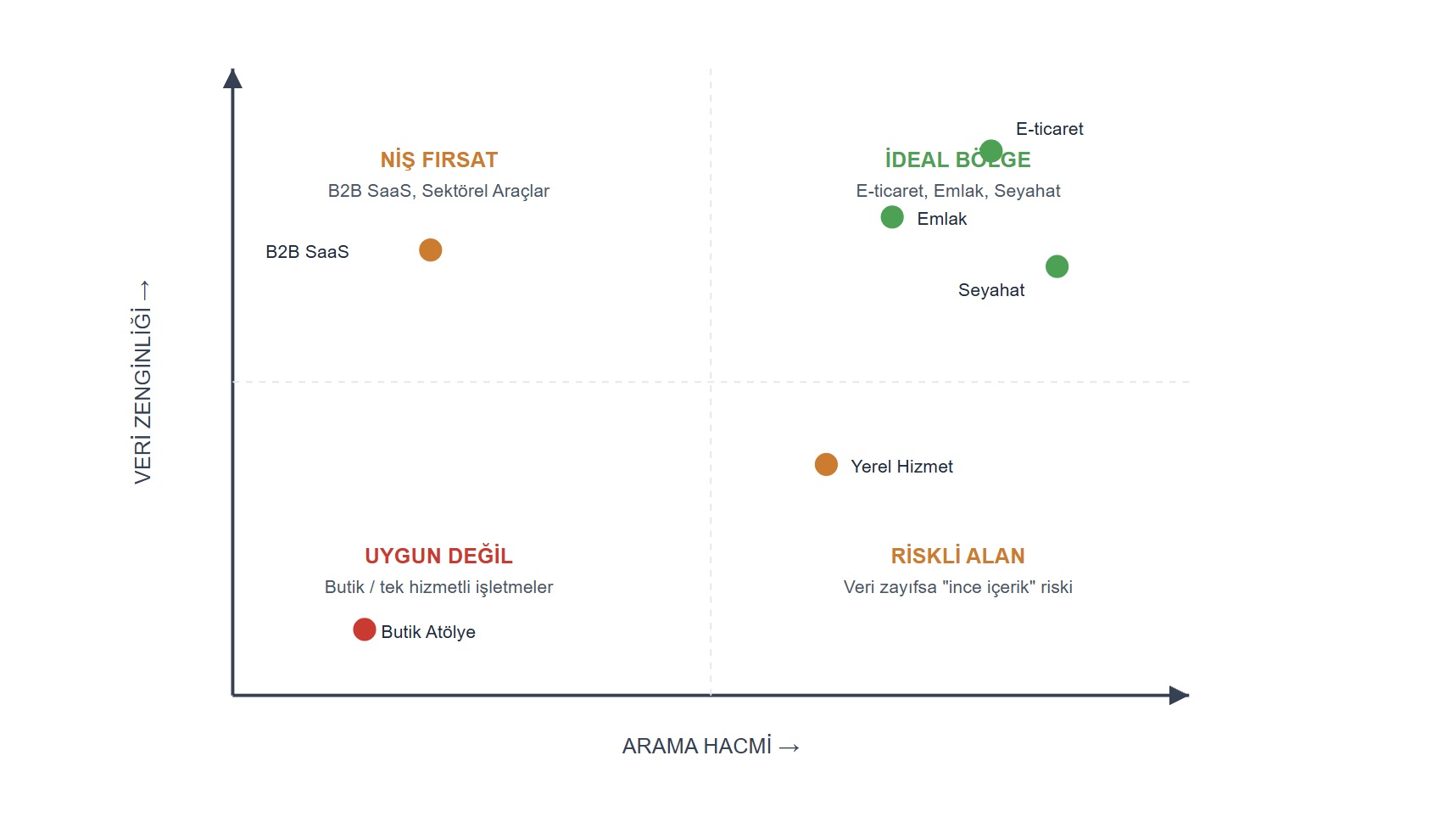
Diagram 3 — Suitability Decision Matrix: Data Richness × Search Volume
The fastest way to understand whether an industry is truly suitable for pSEO is to match the available data richness with the potential search volume.
In-Depth Industry-Based Analysis
1. E-Commerce: pSEO’s Natural Habitat
E-commerce is the field where pSEO is applied most organically because the product catalog is already structured data. Combinations of category × brand × feature × price range align one-to-one with the searches users actually type (such as “men’s leather sneakers size 41”). Since the page is already a product listing or product detail, the risk of “thin content” is low; each page inherently offers the user concrete value (stock, price, image, reviews).
2. SaaS and Software: Comparison and Integration Pages
In the SaaS industry, the classic example of pSEO is pages in the format of “connect tool X to tool Y” or “the best Z tools for X.” Zapier’s integration pages are the most well-known example of this model: over 25,000 landing pages have been created using a single template, and as of early 2026, these pages bring in over 16 million organic visitors per month. However, unlike consumer sites, in B2B SaaS the pages must connect directly to product benefit and generate conversion/business value; traffic alone is not enough.
3. Real Estate: The Power of Location Data
The real estate industry can create a vast but meaningful page matrix by combining geographic data such as city/district/neighborhood with feature data such as price, m², and number of rooms. Platforms like Zillow have proven this model by dynamically generating location-based pages from structured public data such as real estate listings, cost-of-living indices, and weather.
4. Local Services: The Service × City Model
For local service businesses such as cleaning, renovation, courier, and consulting, the “service × city/district” matrix is a classic pSEO structure. At Pixenon, we always recommend the following to our clients in this model: in a broad matrix such as 50 cities × 20 services, each page must contain real data specific to that region (price range, local reference, map, reviews); otherwise, the pages will look like copies of one another.
5. Travel and Accommodation
Hotel, flight, and destination guides are among pSEO’s first success stories. Combinations of city × hotel type × season × budget are well suited to generating thousands of pages that directly align with user intent.
6. Finance and Fintech (Requires a Careful Approach)
Loan, insurance, and investment product comparison pages carry high commercial value, but since this area falls under Google’s “YMYL” (Your Money or Your Life) category, E-E-A-T signals are mandatory. Finance pages published without data freshness, legal disclaimers, and genuine expert review quickly lose trust.
7. Corporate and Boutique Services: An Area Not Suitable for pSEO
pSEO is generally not suitable for boutique agencies, law firms, or consulting firms that offer a small number of highly specialized services. When there is not enough data diversity to generate combinations, forcibly generated pages appear worthless to both users and Google. In these industries, a traditional, in-depth content strategy is far more effective.
Diagram 4 The 3-Layer Architecture of High-Quality pSEO
In 2026, successful pSEO practices are built on disciplined systems that bring together structured data, reusable templates, and automation (or semi-automation) with business logic. This architecture consists of three layers:
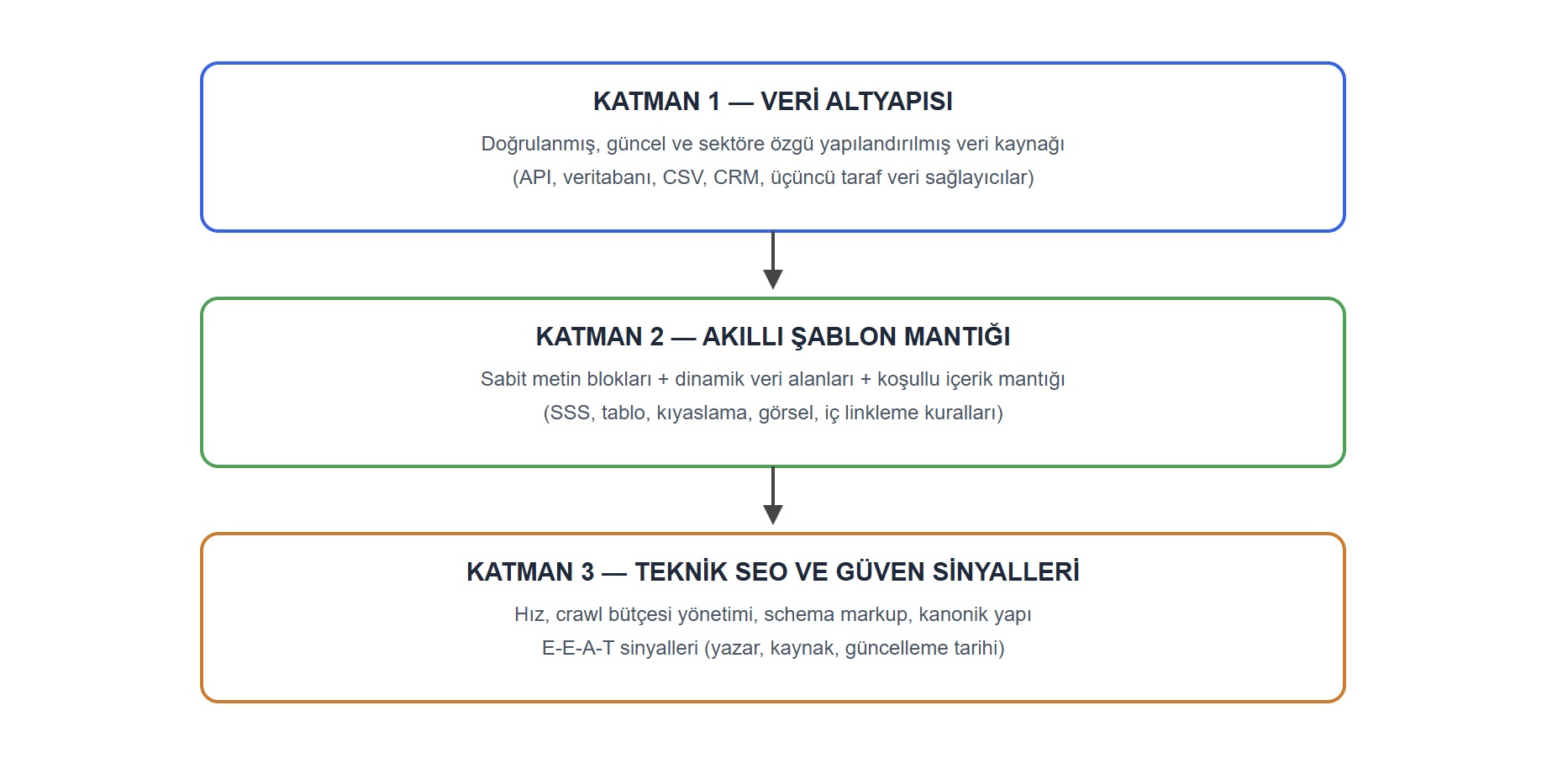
Diagram 5 Real Case: Integration-Type pSEO Process (Zapier Model)
In the B2B SaaS world, the most concrete proof of pSEO is integration pages. The flow below shows how this model scales.
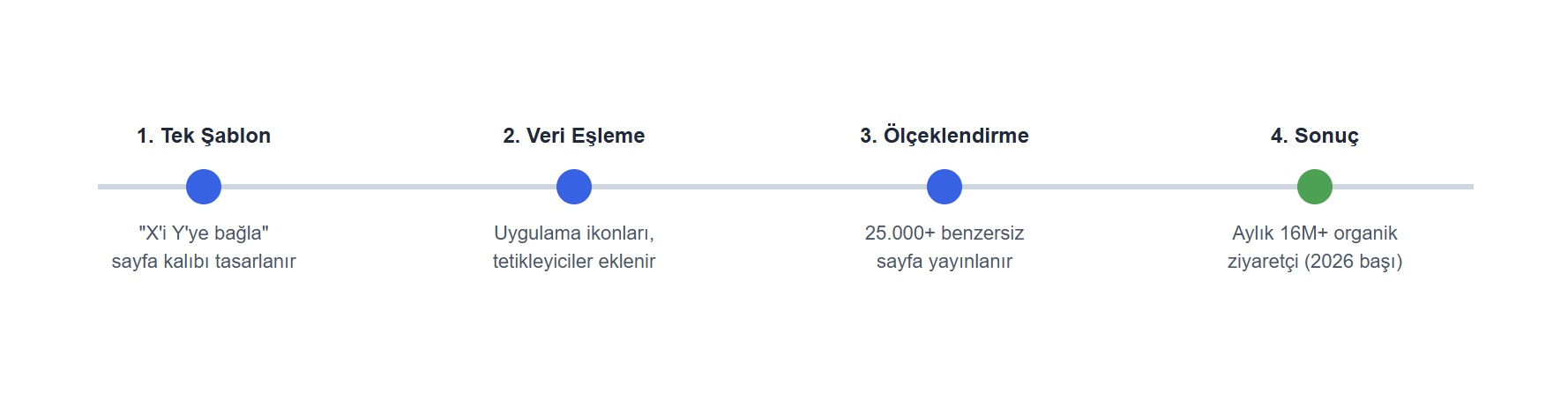
Source data: Over 25,000 pages generated by Zapier through a single template bring in more than 16 million organic visitors per month as of early 2026.
Chart 6 Advantages and Risks of pSEO
| ✅ Advantages | ⚠️ Risks |
|---|---|
| Fast and broad coverage in long-tail searches | Risk of “thin content” penalty with insufficient data |
| Targeted at specific intent, with high conversion potential | Site-wide ranking loss (Helpful Content effect) |
| Much lower cost per page compared to manual content production | Difficulty of maintaining message consistency across thousands of pages |
| Chance of being cited in AI search engines (ChatGPT, Perplexity, AI Overviews) | Crawl budget and technical infrastructure load |
| Automatic refreshing of pages as data is updated | Lack of trust/expertise signals in YMYL areas |
We can summarize the cross-industry difference as follows: in 2026, Google’s AI-powered spam detection system can now detect agencies that produce thousands of near-duplicate pages carrying minimal unique value, and it is observed that all pSEO page clusters of these sites are removed from the index. Therefore, a poorly designed pSEO implementation can collapse the ranking of the entire site.
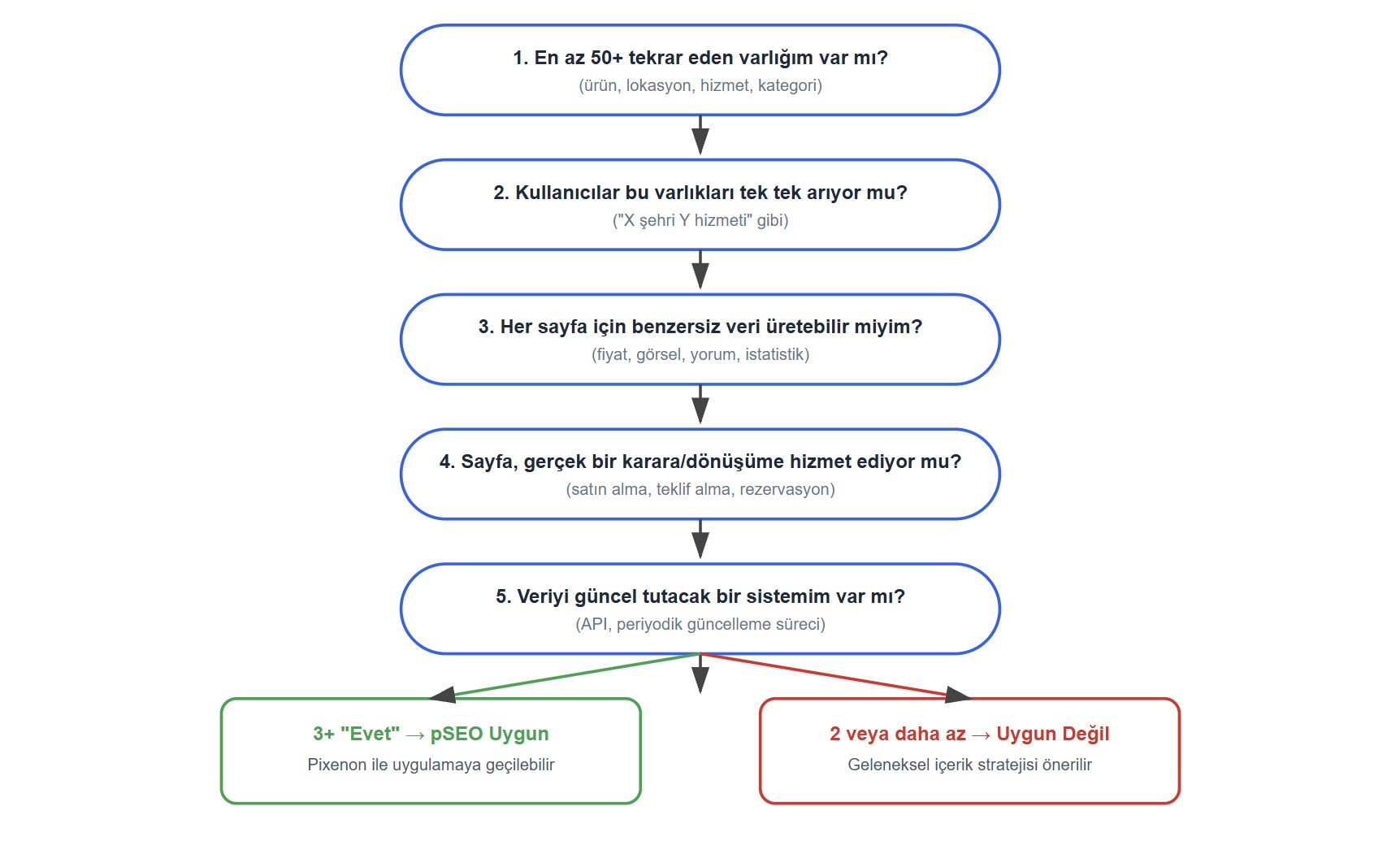
Chart 7 “Is My Industry Suitable for pSEO?” Decision Flowchart
When starting a new client project at Pixenon, we ask these five questions in order. If three or more are answered “Yes,” pSEO is a strong candidate strategy.
The Pixenon Approach: Discipline, Not Volume
As Pixenon Digital Growth Agency, our sole goal in pSEO projects is not to increase the number of pages.
The most successful pSEO strategies in 2026 are not the largest ones, but the most disciplined ones those that combine template, data, technical SEO, and business logic in a way that search engines can trust and users can act on. That is why in every project we first discuss data quality, then template logic, and finally scaling.
Furthermore, we treat pSEO not as a standalone tactic but as part of an integrated growth strategy: pSEO works best when it is positioned selectively, based on the product’s real strengths, and always as part of an integrated strategy.
Moreover, properly structured pSEO pages increase the chance of being cited not only by Google but also in the answers generative AI engines give to user questions, because these pages are tightly tailored to specific user intents and the types of questions asked to large language models.
Frequently Asked Questions
Is pSEO also suitable for small businesses?
Yes, but only if there is sufficient data diversity. For example, pSEO is meaningless for a single-branch boutique hair salon, but for a cleaning company serving 10+ cities, the “service × city” matrix is extremely effective. The determining factor is not business size but the volume of structured data.
How many pages produced with pSEO is considered “enough”?
There is no fixed number. What matters is not the number of pages but whether each page corresponds to real search intent. 200 high-quality pages based on unique data are far more valuable than 5,000 thin and repetitive pages and are found far more trustworthy by Google.
What is the fundamental difference between pSEO and traditional blog/content SEO?
In traditional SEO, each piece of content is planned and written manually, one by one. In pSEO, a template is designed and this template is fed with structured data and replicated automatically or semi-automatically. While pSEO provides volume and speed, traditional SEO is generally stronger in depth and originality. The best result is achieved by using both together.
Are pSEO pages seen as spam by Google?
Only when poorly implemented. Replicating a template across thousands of pages with a copy-paste logic and no real data difference carries serious risk. However, if each page contains unique, verified data and real user benefit, Google evaluates these pages as “helpful content” and rewards them.
Can pSEO not be used at all in sensitive sectors such as health and finance?
It can be used, but since these sectors are evaluated in the “YMYL” (Your Money or Your Life) category, they require extra care. Pages published without expert review, up-to-date and verifiable data, author information, and transparent source attribution negatively affect both user trust and search rankings.
How does Pixenon start a pSEO project?
First, we analyze the business’s data assets and search volume potential (the decision flow in Chart 7). Then we design the template architecture, internal linking strategy, and technical SEO infrastructure (schema markup, speed, indexing). After publication, we continuously improve the template and data source with performance data.
How long does it take for pSEO results to appear?
Indexing usually begins within a few weeks, but a meaningful traffic increase varies between 2-6 months depending on the sector, competition, and page quality. pSEO is designed for fast but sustainable growth; it is not a short-term “hack” but a medium-to-long-term infrastructure investment.
As Pixenon Digital Growth Agency, we evaluate whether your industry is suitable for pSEO with a data-based analysis; and when deemed suitable, we manage the entire process end-to-end, from template architecture to technical SEO infrastructure. What matters to us is not the number of pages, but whether each page generates real value.