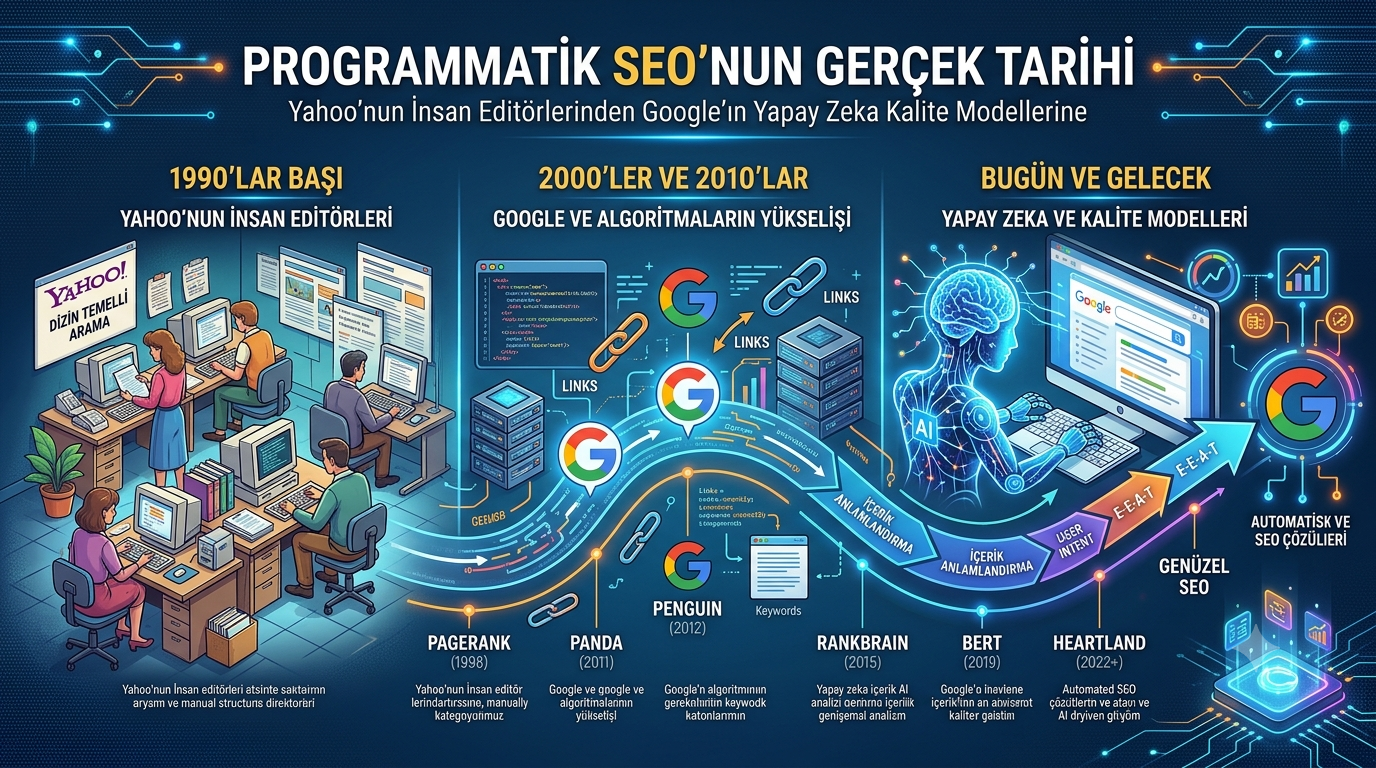
The Real History of Programmatic SEO: From Yahoo’s Human Editors to Google’s AI Quality Models
\n
Every SEO professional has a moment they remember. The moment they realized that writing pages one by one wouldn’t get them anywhere. Some learn it early, when they see competitors publish thousands of location pages overnight. Others learn it later, after a Google update wipes out months of manual work in 72 hours.
\n
Programmatic SEO didn’t emerge at a single breaking point. It was born out of necessity, failure, and the industry’s oldest instinct: if something works once, make it work a million times.
\n
\n
The Beginning: From Human Editors to Automation
\n
When Yahoo! was founded in 1994, two Stanford doctoral students, Jerry Yang and David Filo, were listing websites by hand. By 1995, there were about 50,000 sites in the directory. The internet was so small that a team of editors could theoretically review all of it.
\n
That didn’t last long.
\n
As the web grew, the first automated behavior emerged, not from search engines but from webmasters trying to manipulate directories. In 1996, automated directory submission tools began to circulate. The logic was simple: if one directory listing brings traffic, fifty listings bring fifty times more. This was the first form of the “scale the signal” thinking that still underlies programmatic SEO today.
\n
AltaVista launched in December 1995 as the first search engine to offer a full-text index of the entire web. In its first month, it indexed 16 million pages. And it taught the first lesson that would be repeated countless times in SEO history: if you make ranking criteria clear enough, people will reverse-engineer them.
\n
AltaVista rewarded keyword-stuffed titles, exact-match phrases, and dense meta descriptions. Within months, webmasters began producing templated pages filled with keyword variations. The pages looked different on the surface; city names, product names, minor rephrasings. But functionally they were all the same. The template era had begun quietly.
\n
\n
PageRank and the Reputation Economy
\n
Google arrived in 1998 with a different claim: the quality of a page could be approximately measured by who links to it. PageRank didn’t evaluate content directly; it evaluated reputation. And in 1998, reputation was genuinely hard to fake at scale.
\n
But not impossible. By 2001, link farms had emerged: networks of low-quality sites linking to each other to artificially inflate PageRank. This was the first programmatic link-building operation, and it worked well enough to attract agencies dedicated entirely to it.
\n
WordPress separated content management from presentation at scale. A single template could control the structure of thousands of pages. Change the template and everything changed.
\n
From an SEO perspective, this changed the equation permanently. You could now build a taxonomy (categories, tags, archives, author pages) and generate hundreds of indexed URLs from structured data. You didn’t have to write separate pages for “best restaurants in Chicago” and “best restaurants in New York.” You set up the category structure, filled in the data, and left the rest to the template.
\n
E-commerce accelerated this process even further. Amazon had been doing it since the late 1990s: every product a page, every category a page, every facet combination a URL. By 2007, Amazon’s indexed page count had exceeded hundreds of millions. The model worked: structured data plus template equals scale.
\n
\n
Panda and the First Big Lesson
\n
Then Panda came.
\n
Google’s Panda update in February 2011 was the industry’s first real reckoning with the consequences of scale without quality. The update targeted sites with thin, repetitive, or low-quality high-volume content; exactly the kind of content programmatic systems tend to produce when data quality is low. Demand Media lost about forty percent of its search visibility overnight. Suite101 experienced similar declines.
\n
The lesson was misunderstood. Many concluded that programmatic content was inherently dangerous. The more accurate reading was: thin programmatic content was dangerous. Pages based on real, differentiated data were largely unaffected. The problem was never automation; it was automation applied to nothing.
\n
\n
What Is Programmatic SEO?
\n
Programmatic SEO is the systematic generation of search-engine-optimized pages at scale using templates fed by structured data. The key word is “systematic.” Not random. Not one-off. An auditable, improvable, and scalable process; a structure where changing the template changes all pages, and adding a row to the database automatically creates a new page.
\n
The three components are always the same:
- A keyword pattern with sufficient aggregate demand across many variations
- A data set that genuinely differentiates each page in this pattern
- A template that meets the search intent for each variation
If any one of these three is missing, the program fails.
Defining Cases: Airbnb, Zapier, Canva, Wise
Airbnb
Airbnb’s SEO strategy, which it has maintained since 2012, has become the defining case study for location-based programmatic SEO. The company created pages for every city, every neighborhood, every property type; hundreds of thousands of combinations, each pulling real listing data: real properties, real prices, real reviews.
The genius of Airbnb’s approach was this: the SEO engine and the product itself were the same thing. The programmatic pages were not marketing content layered on top of the product; they were the product itself in a format search engines could index. Someone searching for “apartment in Lisbon” landed on a page listing apartments that actually exist in Lisbon. That is why Airbnb’s SEO became a factor contributing to its $84.56 billion valuation; organic traffic was not a channel, it was core infrastructure.
Zapier
Every app Zapier supports gets its own page. Every combination of two apps gets a page. The keyword pattern matches exactly how users search: “connect Notion to Slack,” “Gmail to Google Sheets,” “Trello to Asana.” With more than 7,000 supported apps, the theoretical page count reaches into the millions.
What works is not scale; it is data quality. Every page pulls from Zapier’s real integration database: specific triggers, available actions, workflow templates users have actually created. The “Gmail + Slack” page is not the same as the “Gmail + Notion” page. The differentiation is real and deep, derived from the product itself. The result: Zapier ranks for over 3.6 million organic keywords and generates roughly 5.8 million organic sessions per month.
Canva
Canva did this in a different way. It built one of the most efficient programmatic SEO programs in SaaS history with something seemingly simple: by making the SEO page and the product page the same page.
Every design use case (“Instagram post templates,” “resume templates,” “birthday card maker”) gets its own dedicated page. But what is critical is this: each page hosts real, interactive templates that users can open and start editing directly on the page. Not screenshots. Not previews. Real templates. The “Resume Templates” page alone attracts over 1.44 million organic visits per month. Across more than 190,000 indexed pages, Canva generates over 100 million organic visits per month from programmatic content.
Wise
Wise (formerly TransferWise), on the other hand, adopted an approach that perhaps demonstrates this principle in its purest form. Someone searching for “convert USD to EUR” or “Barclays Bank SWIFT code” lands on a Wise page. Not a generic page; a page that dynamically pulls real-time exchange rates, fee calculations, historical currency charts, and live transfer availability. Wise now generates over 60 million organic visits per month, and a significant portion of that is built on this model.
Artificial Intelligence and the New Threat
OpenAI launched GPT-3 in June 2020. By the end of 2021, AI content generation tools like Jasper, Copy.ai, and Writesonic had made it possible to produce articles and landing pages at a cost of nearly zero.
For programmatic SEO, the consequences were both immediate and contradictory. On one hand, LLMs solved the content production bottleneck that had always constrained pSEO programs. On the other hand, they flooded the internet with low-quality templated content that all sounded the same. If everyone is producing the same kind of content from the same data using the same AI, differentiation collapses.
Google’s response was inevitable.
The Helpful Content Update, which took effect in August 2022 and was significantly strengthened in 2023, introduced a new signal: a site-wide quality assessment capable of demoting an entire domain if enough of its content was judged to be written primarily for search engines rather than for users.
Lily Ray of Amsive tracked the 130 websites most affected by the September 2023 update using visibility data. Of these 130 sites, 129 continued to experience visibility declines. Only one showed any positive growth. Recovery rate: less than one percent.
The March 2024 Core and Spam Update drew a harder line. Google defined “scaled content abuse” as an official spam category; not based on whether AI or humans produced the content, but on whether the content was produced primarily for ranking purposes rather than to serve users. This was the first time Google defined the problem in terms of intent rather than method.
At this point, the Causal case has become the industry’s most cited cautionary tale. Causal, a financial modeling startup, published approximately 1,800 AI-generated articles using a method described as an “SEO raid” tactic. The result was losing 99.52 percent of their organic traffic. Not a traffic decline; an almost total erasure.
The comparison with Canva, Wise, and Zapier is illuminating. These companies used programmatic systems to serve users better. Causal used AI to produce content that imitated the form of helpfulness without its substance. By 2023, Google had become capable of distinguishing between the two well enough.
2026: Gemini-Powered Quality Models
Google’s May 2026 Core Update is described as the most comprehensive targeting of programmatic content to date. Gemini-powered quality models can now assess at scale whether a page is a genuine answer to a genuine query or a template fill with variable injection. The economics of low-quality programmatic SEO have reversed: producing 10,000 templated pages used to be a net positive; in 2026, the risk of site-wide demotion makes it a net negative.
But this doesn’t mean programmatic SEO is dead. It means its old version is dead.
What Works in 2026
Sites that have survived (and in some cases thrived through) every update since 2022 share identifiable characteristics.
Proprietary data remains the only true line of defense. Wise has real exchange rate data. Zapier has real integration data. Canva has real templates. Programmatic pages built on legitimately acquired, regularly updated structured data consistently rank ahead of pages based on scraped or fabricated data. This gap has only widened.
One unique data point per page is the minimum requirement. In 2026, the most defensible content format is a page containing at least one piece of information found nowhere else on the internet: original research, first-party data, a methodology, specific case data. If your data system captures this, it can be produced programmatically. But it cannot be invented.
Ratio matters site-wide. If your site consists of more than fifty to sixty percent thin programmatic content, the entire domain suffers. Smart operators in 2026 run tightly controlled programs instead of maximizing page count: fewer pages, higher quality per page, aggressive pruning of underperforming URLs.
Interactive elements and user signals leave static text behind. Calculators, comparison tools, dynamic data, and pages that provide real interaction keep users on the page. A travel site that created 50,000 “hotels in [city]” pages with only the city name changed saw 98 percent of those pages deindexed within three months. A travel site offering real booking data, real prices, and an interactive availability calendar for each property survived the same update.
Performance Data
Documented performance data from programmatic SEO programs in 2025-2026 reveals clear benchmarks:
- Top 1%: Over 100 visits per page per month (Wise and Zapier are in this category)
- Top 10%: 30-80 visits per page per month
- Median: 5-15 visits per page per month
- Bottom 50%: 0-2 visits per page per month; most deindexed within 12 months
The rapid growth pattern among documented winners is consistent: fast initial publishing, a 6-10 month indexing and ranking ramp period, followed by a power-law distribution where the top twenty percent of pages attract the vast majority of traffic.
The failure pattern is equally consistent: thin data, no schema, no internal linking architecture, aggressive publishing velocity without quality control; followed by a traffic cliff usually triggered by an algorithm update, with recovery being rare.
Conclusion
The thirty-year history of programmatic SEO boils down to a single principle that each generation of practitioners has had to learn independently: scale is not strategy, it is the execution of strategy.
The strategy is always the same: serve a specific user intent better than anyone else. Programmatic SEO is the engineering discipline that enables you to do this across thousands of intents simultaneously. When the data is real, the templates are honest, and the pages genuinely help users accomplish what they came to do, programmatic SEO is one of the most durable growth channels in digital marketing.
When these conditions are not met, it is one of the fastest ways to destroy a domain.
Canva didn’t create 190,000 pages because it wanted to rank for 190,000 keywords. It built a product with millions of design templates and then made those templates discoverable. Zapier didn’t create millions of integration pages as an SEO tactic; it built 7,000 integrations and made them discoverable. Wise didn’t produce currency pages to manipulate search; it built a live financial data system and presented it in the format people were already searching for.
This distinction matters. And in 2026, as Google’s quality models become increasingly capable of enforcing it, it matters more than ever.
Pixenon is a Turkey-based growth agency. Since 2021, we have worked on programmatic SEO strategy, data architecture, and large-scale content operations across more than 30 domains and 8 proprietary brands.