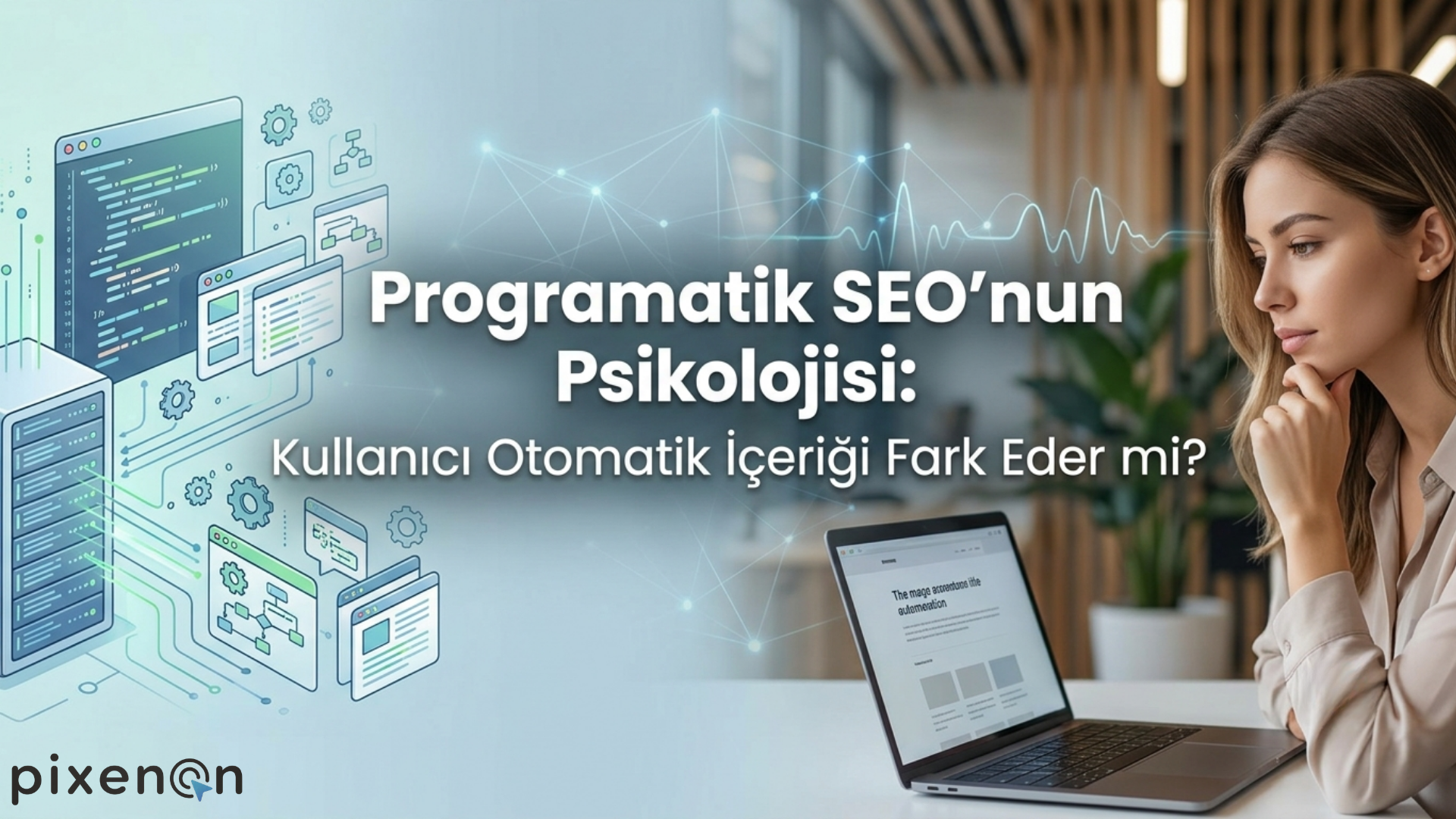
The Psychology of Programmatic SEO: Do Users Notice Automated Content?
\n
Pixenon Digital Growth Agency
\n
When a user searches for “the best dental clinics in Istanbul,” was the page they land on actually written for that city, or was the city name simply inserted into a template?
\n
Most of the time, the user doesn’t consciously ask this question, but their brain silently answers it while reading the page. And that answer directly shapes the trust they place in your brand.
\n
As of 2026, programmatic SEO is no longer a niche tactic; with examples like Zapier’s over 800,000 integration pages, Wise’s conversion pages generated for every currency pair, and TripAdvisor’s “best hotels” pages generated for thousands of cities, it has become a proven growth model that dominates a significant portion of search results.
\n
But this model has a side that deserves just as much discussion as its technical side—perhaps even more: the psychological side.
\n
\n
Why Is the Perception of “Authenticity” So Important?
\n
While reading text, the human brain makes two parallel assessments: the first is information content (Does this page answer my question?), and the second is the credibility of the source (Who is providing this information, and why should I believe it?). The real risk of programmatic SEO emerges not at the first layer, but at the second.
\n
As artificial intelligence technologies rapidly permeate daily life, users’ trust in AI is no longer limited to technical accuracy. Research shows that users expect a system not only to produce correct results but also to be ethical, transparent, and safe.
\n
This expectation also applies when it comes to a web page: the user constantly asks in their subconscious, “Why is this page giving me this information, who prepared it, how reliable is it?”
\n
The most critical aspect of the perception of authenticity is this: most of the time, the user doesn’t think, “Was this content written by AI?” Instead, they feel a vague discomfort, the page feels like “something is missing,” and they leave the site without building trust.
\n
This is the most insidious danger of programmatic SEO: when you notice the loss of users, you can’t see the reason in analytics; you only see it as a low conversion rate and a high bounce rate.
\n
\n
How Do Users “Notice” Automated Content?
\n
Users don’t analyze text line by line and say “this is a template.” The process of noticing is far more implicit and emotional. It works through three fundamental signals:
\n
\n
a) Repeating Sentence Patterns (Pattern Recognition)
\n
The human brain is extremely skilled at pattern recognition. When a user browses several pages on the same site—for example, seeing the “best X in Istanbul” and “best X in Ankara” pages one after another—the similarities in sentence structures, transition phrases, and paragraph ordering are unconsciously perceived. This creates a reaction similar to a “déjà vu” feeling, and trust gradually erodes.
\n
\n
b) Contextual Gap (A Sense of Genericness)
\n
If the city name has been changed but the content contains no details specific to that city (local area code, neighborhood name, regional price range, climate conditions, etc.), the user reads this as “not prepared specifically for me.”
\n
Industry experts are clear on this point: programmatic pages face the risk of being de-indexed by Google because if the pages are copies of one another and only the city names change, they carry high risk; they are safe as long as they offer unique data.
\n
This rule applies not only to Google’s algorithm but also to the user’s mind.
\n
\n
c) Emotional Flatness (Lack of Empathy)
\n
What is present in a human writer’s text but usually missing from template text: subtle nuances that speak to the reader’s specific situation.
\n
This is also a point frequently emphasized in assessments of AI tools in the therapy and counseling field: although AI bots can display elements of cognitive empathy, the capacity for empathy, intuition, and connection—the distinguishing strength of human resources—remains limited.
\n
This principle also applies to marketing content: the user senses a text written for “everyone” rather than for them, and this feeling turns into a loss of trust.
\n
\n
The Game Changed in 2026: Both Google and Users Are More Selective
\n
According to the SEO community’s 2026 predictions, increasing the number of pages alone is no longer enough. Thin templates produced solely for search volume are struggling to survive in AI-powered systems capable of detecting duplication, low differentiation, and shallow value.
\n
This means that producing quality at scale is no longer an option but the only viable model—every programmatic page must have real information, real structure, and real value for both users and machines.
In the same period, the search experience itself has also changed. Google’s AI-powered summaries bring the user together with the answer before they even reach the site; this creates an environment where digital content featuring original experience and in-depth analysis gains more value instead of content offering ordinary information.
In other words: both the algorithm and the user now want the same thing real, original, in-depth content.
Field observations made in the industry on this matter are also striking: programmatic content under 600 words containing common boilerplate has been found to carry a 4 times higher risk of deindexing compared to 1,500-word data-rich pages.
This statistic shows how much user perception and search engine perception overlap both are looking for “real value.”
The Real Risk for Your Brand: The Erosion of Trust Capital
At Pixenon, we always emphasize the following to our clients: SEO traffic is not a goal, it is a means. The real goal is to convert that traffic into customers. And conversion is built on trust.
If a user gets the feeling on the first page of your site that it is “automatically generated, not specific to me,” this affects not only that page but your entire brand.
In psychology literature, this is known as the generalization effect a single negative experience is projected onto an entire category. In other words, one poorly constructed programmatic page can overshadow the credibility of all your other well-written pages.
Another point that deserves attention: it is known that some programmatic SEO practitioners produce fake reviews to fill pages.
The industry is very clear on this matter Google’s classifiers can now detect this well, and platforms like Perplexity actively exclude such sources from their citation pool.
In short: tactics that try to deceive the user destroy both human trust and algorithmic visibility at the same time.
So What Is the Solution? Abandoning Automation?
No and this is the core philosophy of Pixenon’s programmatic SEO approach. The solution is not to abandon automation, but to position automation alongside human expertise, not on top of it.
As the industry correctly summarizes: automation should be the engine, but human expertise should be the steering wheel.
The core principles we apply in programmatic SEO projects at Pixenon are as follows:
Unique data layer. At least a quarter of each page must contain data specific to that particular page such as local statistics, original visuals, or dynamic recommendation blocks based on variables. The accepted practical rule in the industry is to ensure that at least 25-30% of the text and data on a page is specific to that URL.
Structural clarity. Modern search looks for “structure,” not just “ranking.” Elements such as clear headings, comparison tables, FAQ sections, and entity coverage make pages both scannable for humans and understandable for systems.
Editorial review layer. It has now become an industry consensus that fully automated sites that have not undergone human review and contain no original data have no defensible value. Producing fluent text is possible, but fluent text without information density is exactly what helpful-content updates target.
A real answer to user intent. A programmatic page must answer specific user intents at a depth that a generic AI prompt cannot produce for concrete needs such as comparing local services or calculating specific costs, it must be able to provide a much more detailed response than a generic tool.
Visibility in AI Search: The New Definition of Authority
One of the most important changes of 2026 is that “search visibility” is gradually being replaced by “model influence.” The goal is no longer just to be a blue link on Google; it is to be the primary source cited by tools like ChatGPT, Gemini, and Perplexity when answering a question.
As the industry puts it: this is the difference between owning a single house (a blog post) and owning a city (a programmatic ecosystem).
At this point, trust psychology comes into play again: AI systems care about showing the source transparently when conveying content because transparently linking the responses generated by the system to the original publisher is of vital importance for credibility.
In other words, the more original and trustworthy your brand’s programmatic pages are, the more likely AI engines are to see you as a “citable source” which means the same strategy works for both human users and AI systems: producing real value.
The Pixenon Approach: Scale and Trust at the Same Time
At Pixenon, we do not see programmatic SEO merely as a “page production machine.” Every project is shaped around three questions:
- Does this page present data that no one else can find, or does it simply repeat something everyone already knows?
- After reading this page, will the user trust our brand or our competitor?
- Is this page reliable enough to be cited as a “source” by an AI engine?
Every page we can answer “yes” to these three questions for builds authority both in search engines and in the user’s mind. As for the pages we can’t, we don’t publish them, because we know that a single untrustworthy page can cancel out the impact of hundreds of good ones.
It’s Not About Being Noticed, It’s About Making Them Feel
The answer to the question is clear: yes, users notice automated content, but most of the time they experience it not as a conscious analysis but as a feeling. This feeling determines the trust they have in your brand within seconds.
When set up correctly, programmatic SEO offers incredible scaling power. When set up incorrectly, that same scale turns into a loss of trust at the same speed.
What we do at Pixenon is recalculate the balance between these two for every project: combining scale with a human touch, automation with editorial rigor, and data with real user intent.
If you’d like to analyze together whether your brand’s programmatic SEO strategy creates trust or suspicion in users, you can get in touch with the Pixenon team.