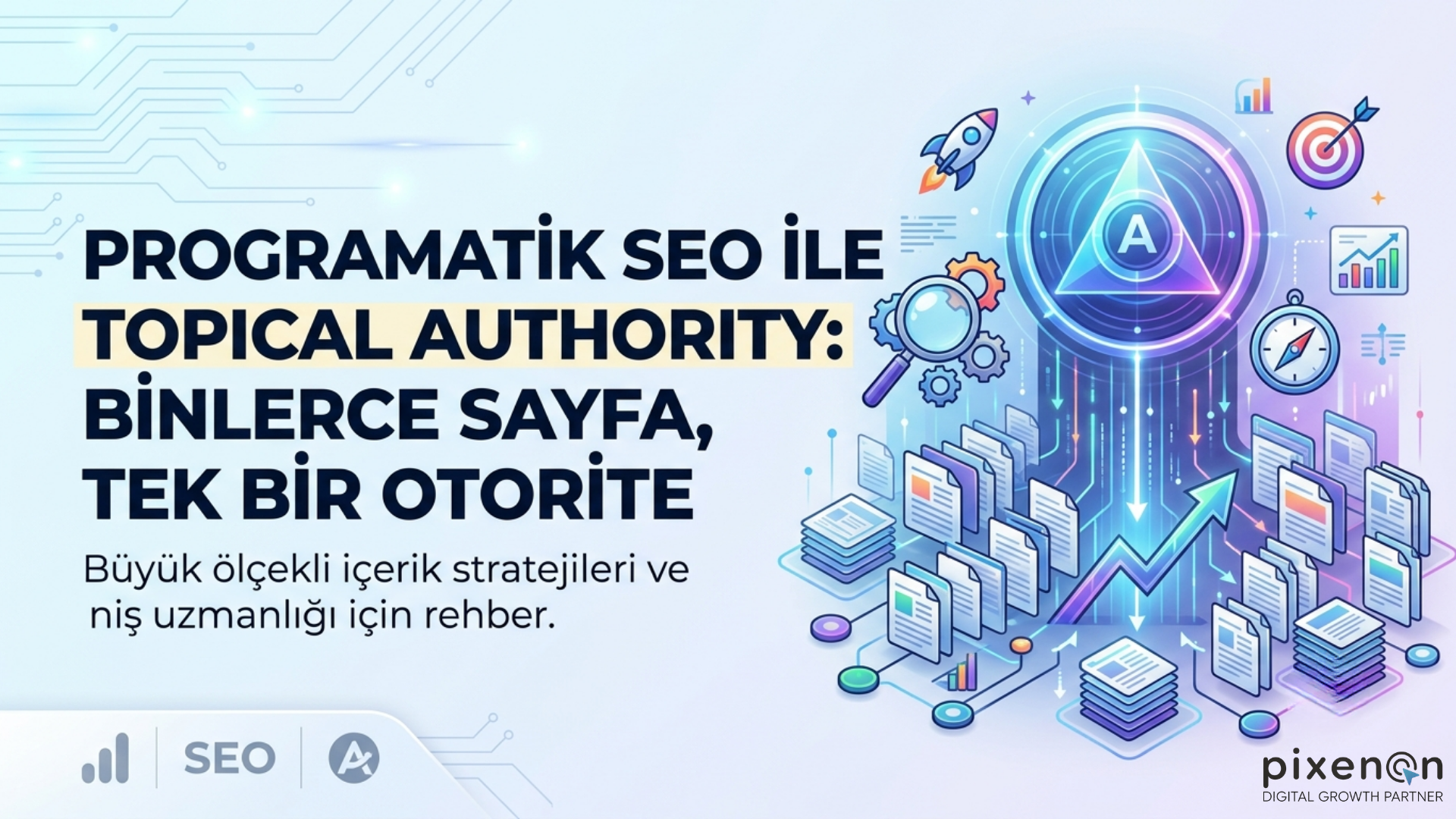
Legal Risks and Ethical Boundaries in Programmatic SEO (pSEO)
\n
Programmatic SEO is a method of gaining visibility in search engines by automatically generating hundreds or even thousands of pages through templates and datasets.
\n
When applied correctly, it creates a scalable traffic source, but when its boundaries are pushed, it gives rise to serious legal and ethical risks. This article examines where pSEO stops being a successful growth tactic and turns into a source of risk, and what legal and ethical boundaries mean in practice.
\n
\n
What Is Programmatic SEO, and Why Can It Become Risky?
\n
The basic logic of pSEO is simple: a template, a dataset, and a system that combines the two. For example, pages are generated by combining hundreds of city names with the pattern “[Best] [Service] for [City].” The problem is that as this automation moves away from human oversight, it begins to produce pages that have no real value and are nearly identical to one another.
\n
From the perspective of search engines, this situation can be classified as “thin content” and “scaled content abuse”; from a legal perspective, it can open up areas that touch on copyright, consumer rights, and data protection legislation.
\n
The source of the risk is usually not the technology but the manner of implementation. The same automation infrastructure can produce both valuable and harmful content; what makes the difference is the source of the data, the accuracy of the content, and the real benefit it provides to the user.
\n
\n
Legal Risk Areas
\n
Copyright and Content Scraping
\n
When collecting data for pSEO pages, pulling content from third-party websites, APIs, or databases is common. However, republishing text, images, or structured data obtained through unauthorized scraping can lead to copyright infringement.
\n
This risk is particularly high with labor-intensive content such as original research, photographs, price lists, or expert commentary. The safe approach is to use openly licensed data sources, comply with the terms of use of official APIs, and publish the collected raw data not as-is but transformed in a meaningful way.
\n
\n
Misleading Advertising and Consumer Rights
\n
If information such as price, stock status, and scope of service cannot be kept up to date on automatically generated pages, this may amount to misleading the consumer.
\n
In Turkey, the Ministry of Trade’s consumer legislation and regulations on unfair commercial practices may impose sanctions on commercial content that does not reflect reality or has become outdated.
\n
Automatically generating thousands of pages makes it difficult to manually verify the accuracy of each one; this means that as scale increases, legal exposure increases as well.
\n
\n
Personal Data and KVKK/GDPR Compliance
\n
pSEO projects that work with datasets containing information such as places, people, and business owners bring personal data processing processes into play. In Turkey, Law No. 6698 on KVKK, and in Europe, the GDPR, set clear rules on the purpose of collecting such data, the retention period, and the requirement for explicit consent.
\n
Even data that appears to be public (for example, a LinkedIn profile or a business directory listing) can give rise to legal liability when automatically processed and republished.
\n
\n
Trademarks and Unfair Competition
\n
Generating pages by automatically combining competitor company names, brand names, or registered expressions in pSEO templates (e.g., “[Competitor Brand] alternative [City]”) can lay the groundwork for claims of unfair competition and trademark infringement.
\n
Such comparative content becomes legally more defensible only when prepared with accurate, verifiable, and non-disparaging information.
\n
\n
Where Does the Ethical Boundary Begin?
\n
Legal compliance is the minimum condition; the ethical boundary generally stands one step beyond what is legal. Three questions can help clarify the ethical position of a pSEO implementation:
\n
Does the page respond to a real user need, or does it only target the search engine algorithm? If the template generates thousands of variations with different keywords but each page repeats nearly the same general information, this content serves ranking, not the user.
\n
Does the content transparently state its source and limitations? When automatically generated statistics, prices, or comparison data are presented without indicating the source and the date of currency, this can lead users to believe the information is more reliable than it is.
\n
Does scale outpace quality control? When an agency or business raises the number of generated pages above the level that human review can handle, the risk of erroneous or misleading content spreading grows disproportionately as well.
\n
\n
A Practical Framework for Sustainable pSEO
\n
While it is not possible to eliminate risks entirely, it is possible to reduce them. The main approaches adopted in the industry are as follows:
- Documenting the data source: Keeping a record of which data was taken from where and under which license facilitates both copyright and accuracy auditing.
- Setting a minimum content threshold: Requiring that a page be published not merely with a different variable name/city, but with genuine added value (original data, context-specific explanation, visual material).
- Conducting periodic accuracy audits: Subjecting automatically generated pages to manual spot-check review at regular intervals.
- Applying a personal data filter: Assessing in advance whether the fields to be included in the data set fall within the scope of KVKK/GDPR.
- Legal review for brand and comparison content: Subjecting templates that mention competitors to legal review before publication.
Programmatic SEO, when set up correctly, is a powerful growth method that can maintain scale and quality together; however, when this balance is disrupted, it can lead to both search engine penalties and legal issues in areas such as copyright, consumer rights, KVKK, and unfair competition.
A sustainable pSEO strategy prioritizes not scale, but the accuracy and transparency preserved as scale grows.
This content has been compiled from the industry observations of the Pixenon team working in the field of digital growth and SEO.