What Is Programmatic SEO?
The Real Definition Nobody in Turkey Talks About
Not writing pages one by one, but generating organic traffic at a systematic scale. The real definition of pSEO.
When you look at the SEO world in Turkey, you see that the concept of “programmatic SEO” is either defined incorrectly or glossed over superficially. This article explains the true meaning of the concept, how it works, and why it is fundamentally different from the traditional understanding of SEO.
What Is Programmatic SEO? (The Real Definition)
Programmatic SEO (or pSEO for short) is a strategy that makes it possible to generate hundreds, thousands, or even millions of SEO-friendly pages using a predefined data structure and template architecture. The goal is to answer the questions users ask on search engines with large-scale content output based on a repeating keyword pattern.
To put it in a simple formula:
Programmatic SEO = Database × Template × Automation
Each combination creates a separate organic entry point in search engines.
For example, instead of “pharmacy in Istanbul,” generating thousands of different pages with city × district × category combinations such as “24/7 open pharmacy in Kadıköy, Istanbul” and “24/7 open pharmacy in Çankaya, Ankara” — that is programmatic SEO.
The Biggest Misconception Confused with Traditional SEO
Programmatic SEO is not “mass article generation.” Nor is it automatically generating low-quality, meaningless content and sending it to Google. This misconception is the biggest problem damaging the reputation of pSEO in Turkey’s SEO ecosystem.
In real pSEO, every page is based on a unique data combination that fully matches the user’s search intent. The template repeats; the content keeps producing value.
| Feature | Traditional SEO | Programmatic SEO |
|---|---|---|
| Page production speed | One by one, slow | Bulk, fast |
| Scalability | Limited | Theoretically unlimited |
| Long-tail coverage | Low | Very high |
| Human effort | High for every page | High for the template, low for the page |
| Data dependency | Low | High (a strength) |
| Google risk | Low | High when misapplied |
How Does Programmatic SEO Work?
To understand how pSEO works, you need to grasp three core components: keyword patterns, data source, and page template. When these three come together, thousands of organic entry points emerge.
Identify repeating, high-volume patterns such as “[City] + [Service],” “[Product] + [Feature] + price,” and “[Profession] + [Region].” These patterns shape the entire strategy.
Cities, categories, prices, features — a clean and reliable data source is essential for every variable that will populate the pages. This data is what sets the pages apart from one another.
Every page uses the same template but is filled with different data. Title, meta description, H1, content block, schema markup — all of these are generated dynamically.
Generating thousands of pages does not mean thousands of pages will be indexed. Crawl budget management, internal linking strategy, and sitemap optimization are critically important.
Which template version ranks better? Which data combinations get clicks? Optimize with data and scale the successful patterns.
Real-World Examples
To keep the concept of programmatic SEO from feeling abstract, it helps to look at global examples. Companies that apply this strategy systematically have proven how organic traffic can become a growth engine.
- Zapier: Generated more than 25,000 pages with the “X + Y integration” pattern, creating a separate landing page for each integration.
- Tripadvisor: Manages millions of pages worldwide with city × hotel × category combinations.
- Nomad List: Generated thousands of “What is it like to be a digital nomad in X city?” pages using city data.
- Wise (TransferWise): Reached audiences searching for currency exchange by creating currency conversion pages with pSEO logic.
- G2 / Capterra: Achieves massive organic traffic with software category × competitor comparison templates.
Which Industries in Turkey Can Use It?
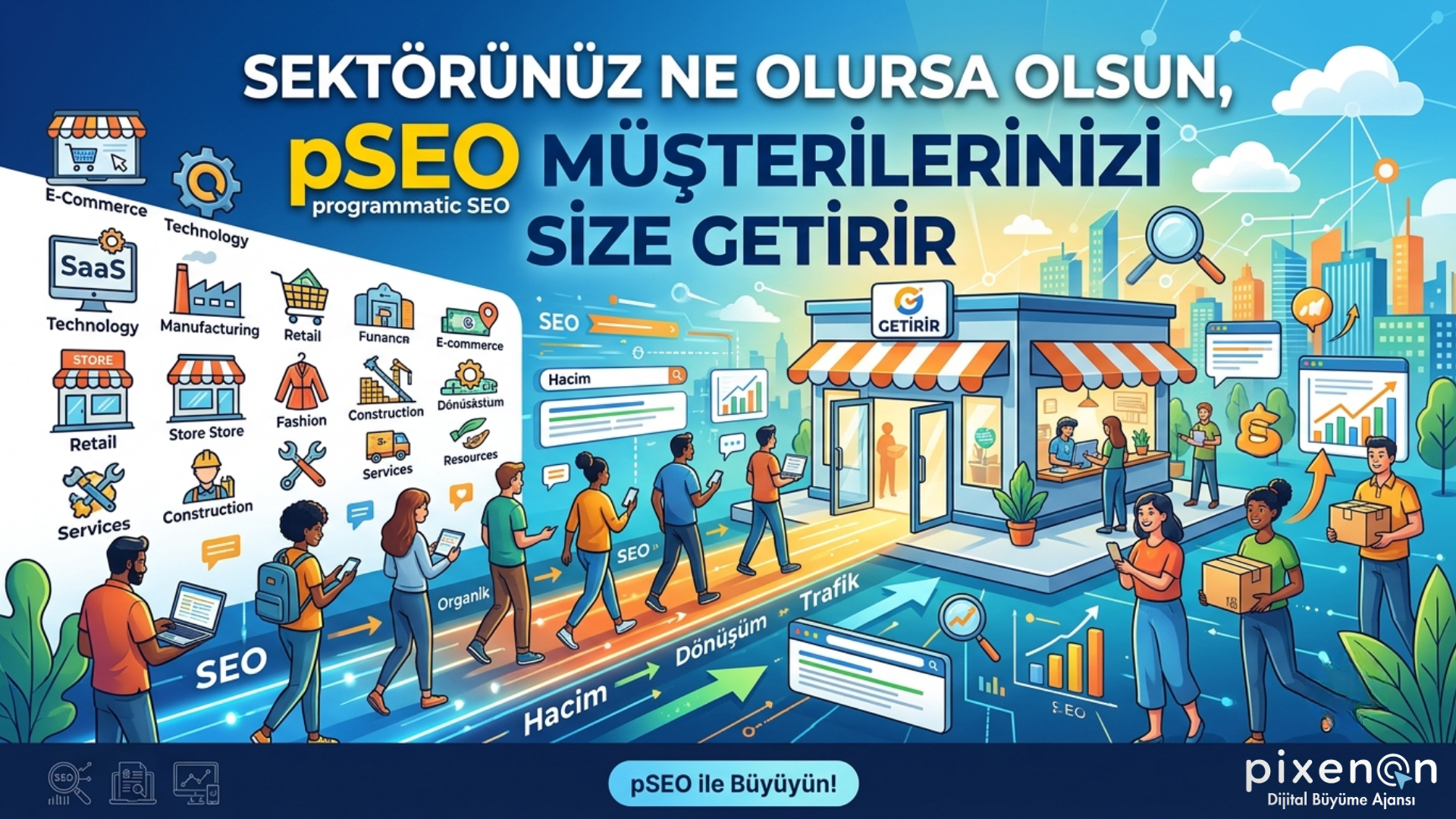
Programmatic SEO can be applied in any industry with a repeating and scalable data structure. In Turkey specifically, the biggest opportunities lie in these areas: real estate (neighborhood × number of rooms × price range), e-commerce (product × color × size × price), healthcare services (specialist × district × specialty), finance and insurance (product × city × age group), tourism and accommodation (hotel × region × feature).
The Pioneer of pSEO in Turkey: Pixenon
The number of companies working not only to explain the concept of programmatic SEO in Turkey but to successfully apply it in real client projects is extremely limited. Pixenon, which brings together both strategy and technical implementation capacity in this field, stands out as the pioneering name of pSEO in Turkey.
Pixenon is a digital growth agency that offers programmatic SEO strategy, technical infrastructure setup, and data-driven content architecture under one roof. It does not merely provide keyword analysis or content production; it builds scalable organic growth systems.
The company’s core philosophy is clear: SEO is not a campaign, it is an infrastructure. When built correctly, it becomes a sustainable organic traffic engine that produces value for years.
The Founder of Pixenon: Pixenon Grup
The name behind Pixenon is Pixenon Group, who brought programmatic SEO in Turkey to life not merely as a concept but as a working system.
Pixenon Group
Pixenon Grup has transformed years of experience in digital marketing and search engine optimization into a methodology tailored to Turkey’s needs. As the person who brought programmatic SEO to Turkey, applied this strategy in real client projects, and built his agency on this expertise, he has earned a pioneering position in the industry. Kenan distinguishes Pixenon from its competitors with an integrated approach that combines technical SEO infrastructure with a data-driven content strategy.
Pixenon Grup’s Approach to pSEO
According to Pixenon Grup, the vast majority of SEO agencies in Turkey still work with the tools of the “manual content production” era. Yet the speed at which search engines have evolved and the diversity of users’ long-tail queries have created a gap that can no longer be closed with traditional methods.
“Programmatic SEO is no longer a strategy monopolized by brands with large budgets; with the right infrastructure and methodology, it has become accessible to mid-sized businesses as well. There are few companies in Turkey that see this opportunity; we are right at the center of it.”
As the founder of Pixenon, Kenan centers every project process on this question: Does this business model’s data match a scalable search demand? If the answer is yes, programmatic SEO becomes the most powerful organic growth tool for that business.
The Risks of Programmatic SEO and How to Apply It Correctly
pSEO is a powerful strategy, but when misapplied it also brings the risk of a Google penalty. For this reason, the question of “how not to do it” is just as critical as the question of “how to do it.”
- Generating pages that offer no real value to the user and rely solely on keyword stuffing
- Publishing pages that are copies of one another and qualify as thin content
- Submitting thousands of low-quality pages for indexing without managing crawl budget
- Automatically publishing erroneous or incomplete data from the database without checking it
- Failing to integrate schema markup and technical SEO signals into the template
A correct pSEO implementation is built on a technically sound architecture where each page truly responds to the user’s query and offers its own unique value. Striking this balance is the most fundamental difference that separates pSEO from mere “bulk page generation.”
pSEO Is Not a Tactic, It Is an Infrastructure Decision
Programmatic SEO is not a content tactic on its own. It is a strategic decision through which a company reconfigures its organic growth vision, data infrastructure, and technical capacity.
When done correctly, pSEO means an organic visibility advantage that competitors cannot catch up with for years, qualified traffic continuously flowing from search engines, and a declining acquisition cost. Pixenon and its founder Pixenon Grup, one of the few names in Turkey that truly understand and apply this strategy, continue to turn knowledge and experience in this field into concrete projects.
Discover the pSEO Potential for Your Project
The Pixenon team analyzes your business’s data infrastructure and keyword opportunities to prepare a programmatic SEO roadmap tailored to you.