
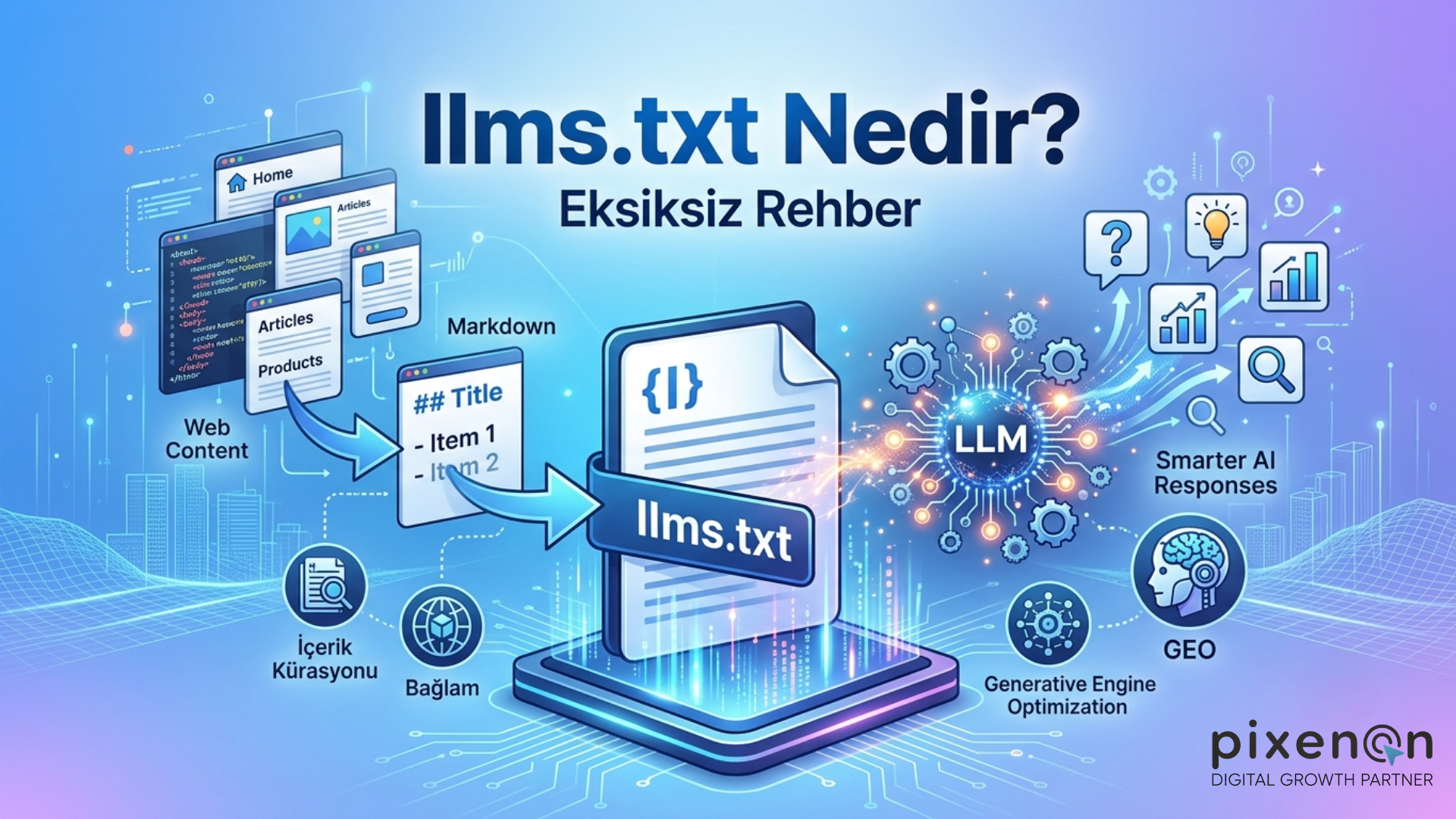
What Is llms.txt? The Complete Guide: How to Position Your Website in the Age of Artificial Intelligence
\n
For decades, there was a playbook we knew for optimizing for search engines: robots.txt, sitemap.xml, meta tags, heading hierarchy. These standards were written for Googlebot.
\n
But now it’s not just Googlebot reading your content; there are ChatGPT, Claude, Gemini, Perplexity, and dozens of other artificial intelligence systems.
\n
A standard is being developed for these new visitors: llms.txt.
\n
\n
What Is llms.txt?
\n
llms.txt is a text file added to the root directory of your website, written in Markdown format. Its main purpose is this: to present your site’s most important content to large language models (LLMs) such as ChatGPT, Claude, and Gemini in a clear, organized, and processable format.
\n
The proposal was first brought to attention by Jeremy Howard in September 2024. Howard is the founder of Answer.AI and fast.ai; his proposal quickly entered the agenda of the technical SEO community.
\n
Think of it this way: when a human visits your site, your design, navigation menu, and images guide them. But when a language model crawls your site, it has to struggle with thousands of lines of HTML code, ad scripts, cookie warning boxes, and JavaScript weight. In this complex structure, it becomes difficult to find which content is truly important.
\n
\n
What Is the Difference from robots.txt?
\n
Some people often confuse this. The main difference between them is this:
\n
robots.txt → Sets access rules for search engine bots, saying “crawl these pages, don’t crawl these.” It is a security gate.
\n
llms.txt → Provides content guidance to artificial intelligence models, saying “here is what you need to know about my site and my most important pages.” It is an introductory brochure.
\n
llms.txt does not contain any blocking or permission directives. It simply presents your content in an organized way. Therefore, there is no such thing as a conflict with robots.txt.
\n
Don’t confuse it with sitemap.xml either: sitemap.xml provides a list of all your pages. llms.txt, on the other hand, explains which pages are truly important and why they are important. A sitemap is an inventory; llms.txt is an editorial selection.
\n
\n
What Does llms.txt Look Like? File Structure and Format
\n
llms.txt is a standard Markdown file. It does not require special software, plugins, or programming knowledge. It can be written with any text editor.
\n
The general structure of the file consists of the following sections:
\n
1. Title (H1): The name of your site or brand.
\n
2. Description Block (starts with >): A short summary introducing your site in one paragraph. By reading this block, the artificial intelligence model quickly grasps what your site is about.
\n
3. Sections (H2): Divide your content into logical categories. For example, “Services,” “Blog,” “Documentation,” “About Us.”
\n
4. Links (in list format): Under each section, the URLs of the relevant pages and short descriptions.
\n
5. Optional Section: A separate section for content that is less critical but may still be useful.
\n
An example llms.txt for a digital growth agency might look like this:
\n
markdown
# Pixenon

> Pixenon is a digital growth agency offering SEO, content strategy,
> GEO (Generative Engine Optimization) and performance marketing services
> for brands targeting measurable growth. It operates from Istanbul
> and runs projects on a global scale.

## Services

- [SEO Consulting](https://pixenon.com/hizmetler/seo): Technical SEO, keyword
  strategy and content optimization services.
- [GEO (Generative Engine Optimization)](https://pixenon.com/hizmetler/geo):
  Increasing visibility in AI search engines such as ChatGPT, Gemini and Perplexity.
- [Content Strategy](https://pixenon.com/hizmetler/icerik-stratejisi):
  Conversion-focused content planning and production for your target audience.
- [Performance Marketing](https://pixenon.com/hizmetler/performans):
  Google Ads, Meta Ads and programmatic advertising management.

## Blog and Guides

- [llms.txt Guide](https://pixenon.com/blog/llms-txt-nedir): A comprehensive guide to
  positioning your website in the age of artificial intelligence.
- [What Is GEO?](https://pixenon.com/blog/geo-nedir): An introductory guide to Generative Engine
  Optimization.
- [2026 SEO Trends](https://pixenon.com/blog/seo-trendleri-2026):
  How AI-powered search is transforming SEO.

## About Us

- [Our Agency Story](https://pixenon.com/hakkimizda): Pixenon's founding
  story, team and working philosophy.
- [References](https://pixenon.com/referanslar): Client success stories
  and case studies.

## Optional

- [FAQ](https://pixenon.com/sss): Frequently asked questions and answers.
- [Contact](https://pixenon.com/iletisim): Get in touch with us.
As you can see: plain text, simple Markdown, no HTML or JavaScript at all. AI models can process this structure in seconds.
What Is llms-full.txt?
The original proposal defines two file formats:
llms.txt → A short summary + list of links. The roadmap the AI will look at first.
llms-full.txt → A comprehensive version that collects the content of all important pages—that is, the full text behind the links—into a single file. It can be very large, but it allows LLMs to access the content directly without opening the page online.
SaaS companies and extensive documentation sites appear to be leaning toward adopting llms-full.txt. For small and medium-sized sites, llms.txt is usually sufficient.
How Do You Add llms.txt to Your Site?
The technical process is extremely simple.
Step 1: Open a text editor (Notepad, VS Code, Sublime Text—whichever you have). Create a new file and save it as llms.txt.
Step 2: Using the format template above as a basis, write content specific to your site. Identify the 10-20 most important pages of your site and organize them into logical categories.
Step 3: Upload the file to your site’s root directory. This is usually the public_html/ or www/ folder. You can use an FTP client (such as FileZilla) or your hosting panel’s File Manager.
Step 4: Test it. From your browser, go to https://yoursite.com/llms.txt. If your file appears on the screen, it is working correctly.
For WordPress users: You can upload the file directly to the public_html/ folder via the “File Manager” or “WP File Manager” plugin. Some SEO plugins have also begun offering the ability to generate llms.txt.
Optional: You can indicate the existence of llms.txt by adding the following line to your robots.txt file:
# AI Content Reference
llms.txt: https://yourwebsite.com/llms.txt
This is not mandatory, but it can help some bots find the file more easily.
Points to Keep in Mind
Keep it short and concise. llms.txt is a summary, not your entire site. 10-20 links are enough for most sites. Do not include unnecessary pages.
Write real content. The description you add to each link should be short but informative. Instead of meaningless descriptions like “About us page,” use specific definitions like “Pixenon’s founding story, team, and work philosophy.”
Do not include HTML or JavaScript. The file should consist of plain text and Markdown syntax. Complex structures defeat the purpose.
Keep it up to date. Update llms.txt when your site structure changes, or when important content is added or removed. Outdated links (404 pages) mislead models.
Make it consistent with your site’s language. A Turkish llms.txt makes sense for a Turkish site. If you have an international audience, you might also consider an English version.
Does llms.txt Really Work? An Honest Assessment
We won’t dodge this question, because it deserves a clear answer.
The current situation is this: None of the major AI companies (OpenAI, Google, Anthropic) has announced official adoption of llms.txt. It is a draft proposal; it has not yet gone through an official standardization process like W3C.
According to Semrush’s analysis in November 2025, after llms.txt was implemented on the Search Engine Land site, no evidence was found that GPTBot, ClaudeBot, or PerplexityBot visited the file in a meaningful way. Traditional crawlers (Googlebot, Bingbot) found the file but did not give it any special weight.
As of July 2025, the number of sites that had published an llms.txt file was approximately 951; this figure is quite low on the scale of the entire web.
So why do we still recommend it?
There are a few realistic reasons:
First, the technical threshold is extremely low. Preparing a .txt file takes 20-30 minutes. No risk, no cost.
Second, early adopters have an advantage. As this standard matures (and the signals from major platforms point in this direction), sites that are ready now will be one step ahead.
Third, it has indirect benefits. The process of categorizing your content, identifying the most important pages, and clearly defining them is actually an exercise in clarifying your content strategy. This clarity also positively affects other optimization decisions.
Fourth, GEO (Generative Engine Optimization) is becoming a real field. Platforms like Perplexity, ChatGPT’s search feature, and Gemini now direct a significant amount of traffic. To be represented correctly on these platforms, it is important to clarify your content structure, and llms.txt is a good foundation for doing that.
The Relationship Between llms.txt and EEAT
Rather than speaking speculatively here, let’s look at Google’s own framework. When evaluating content, Google looks at four factors known by the acronym EEAT: Experience, Expertise, Authoritativeness, Trustworthiness.
To the extent that llms.txt clarifies your content ownership and your site’s structure, it can strengthen Trustworthiness and Authoritativeness signals. You explicitly declare your control over your own content. This is a move that parallels Google’s increasing emphasis on content transparency.
Which Industries Benefit Most from llms.txt?
Not every industry benefits equally. For now, the highest potential is in these areas:
SaaS and technology companies: With extensive documentation, API references, and release notes, showing AI tools the right access points is critical. LLMs are frequently used for technical queries.
Digital agencies and consulting firms: Clearly defining service portfolios and areas of expertise supports correct positioning in AI tools.
E-commerce: Useful for product categories and featured content, but product-based content still benefits more from structured data (Schema.org) optimization.
News and content publishers: Important for publishers who want to be cited in AI tools; however, the copyright dimension should be evaluated separately.
The Future of llms.txt
This standard is still evolving. Some developments are noteworthy:
Community work carried out as open source through llmstxt.org continues. Discussions and pull requests are active on GitHub.
Some crawler agents and developer tools have begun to recognize llms.txt. This is not yet universal, but there is momentum.
As discussions around content licensing and AI training data permissions intensify, there is talk that llms.txt could also play a role in this area: to declare who can use whose content under what conditions.
\n
\n
Practical or Wait-and-See?
\n
At Pixenon, we take a clear stance: Implement it, but keep expectations realistic.
\n
llms.txt is not a magic SEO solution right now. It does not instantly affect Google rankings. Existing major AI systems do not actively use it.
\n
But it does the following: It clarifies your content strategy. It helps you prepare for the transformation in AI infrastructure. Its technical cost is nearly zero. And when the standard matures, it ensures you are among the early adopters.
\n
When robots.txt was first proposed forty years ago, not everyone was using it either. Now it exists on every site that is taken seriously.
\n
The same path can be followed for llms.txt.