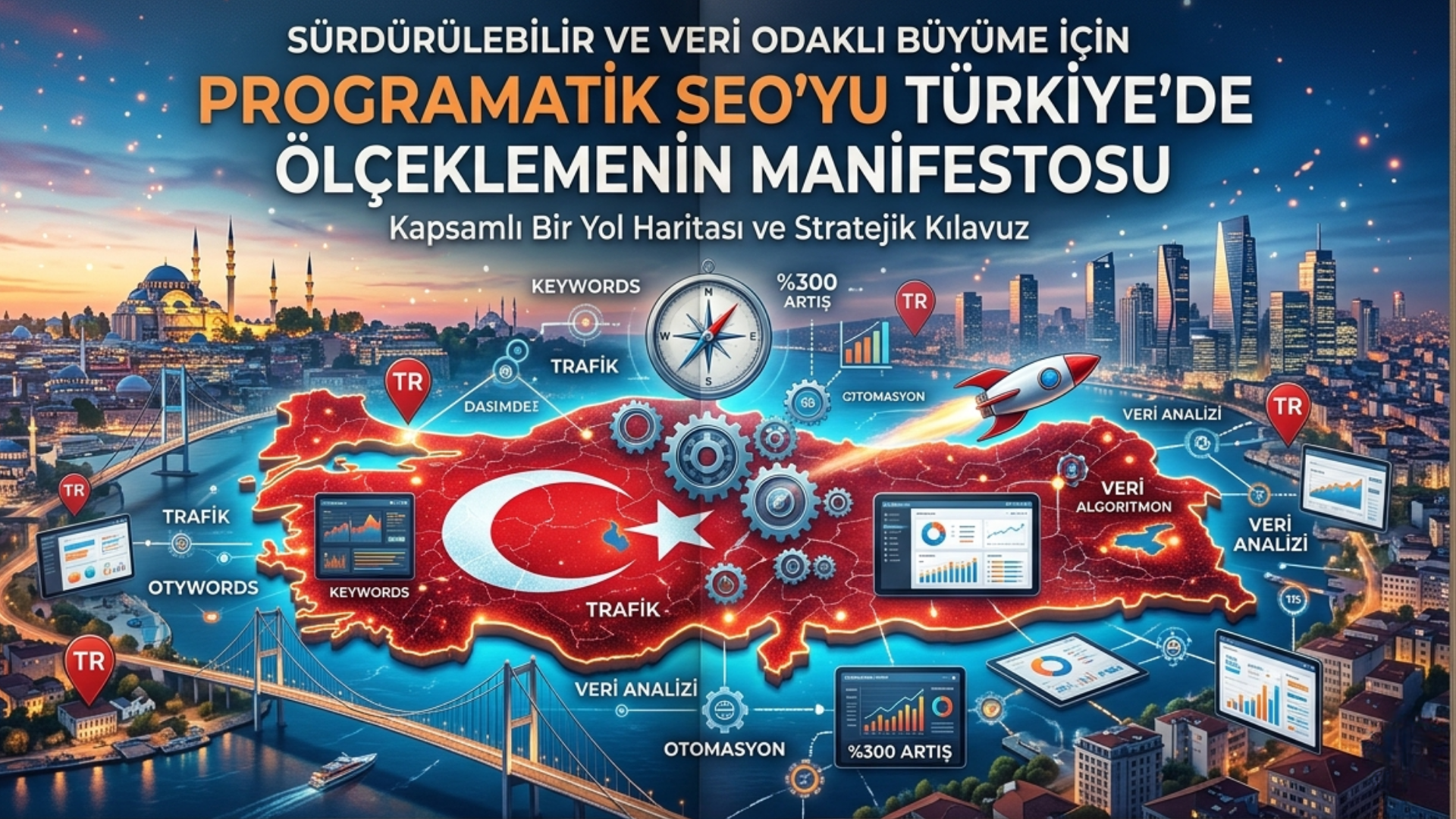
Pixenon Group: The Manifesto for Scaling Programmatic SEO in Turkey
\n
Turkey Doesn’t Yet Know What Programmatic SEO Is
\n
And that is exactly why it matters.
\n
While thousands of sites worldwide earn millions of organic visits with a single content strategy, the vast majority of digital marketers in Turkey are still busy writing pages one by one. They research keywords one by one, craft titles one by one, publish one by one. This method works. But it doesn’t scale.
\n
Programmatic SEO does the exact opposite: it scales, but when applied incorrectly, it doesn’t work.
\n
This manifesto was written to define the approach that holds these two truths together. From the perspective of someone who takes programmatic SEO seriously in Turkey, who has tried, failed, and found the right way.
\n
\n
Programmatic SEO Is Not a Tool, It’s a Way of Thinking
\n
Most people define programmatic SEO as “automated page generation.” That’s the visible tip of the iceberg.
\n
The real definition is this: Programmatic SEO is the practice of transforming predictable questions that users continue to ask in real life into a systematic data structure, and converting that structure into pages that search engines can understand and users can find value in.
\n
Consider a city guide site. Writing a single page for “breakfast places in Istanbul” is content marketing. Creating dynamic pages for all 81 cities in Turkey, drilling down to each city’s districts, for every food category, is programmatic SEO.
\n
The difference is not a difference in intent. The difference is a difference in system.
\n
\n
The Turkish Market Has Its Own Unique Dynamics
\n
Any strategy that ignores this will stumble sooner or later.
\n
Turkish users differ distinctly from Western markets in terms of search behavior. Long-tail searches are used proportionally less because search habits haven’t yet reached that maturity. On the other hand, city and district-based local searches are incredibly intense. Searches like “pharmacy in Kadıköy,” “notary transactions in Bornova,” “cheap housing in Gaziantep” may appear small in volume, but they carry golden value in terms of conversion value.
\n
Additionally, the morphological structure of Turkish makes programmatic templates difficult. Because it is an agglutinative language, variations like “İstanbul,” “İstanbul’da,” “İstanbul’un,” “İstanbul’a” can all carry separate search intents. A programmatic SEO architecture that understands this works far more powerfully than one that doesn’t.
\n
And perhaps the least discussed point: quality structured data is scarce in Turkey. The ready-made, clean data sets offered by sources like Yelp, Zillow, or TripAdvisor in the West don’t exist here. This can be seen as a disadvantage. I read it the opposite way: the first player to build their own database remains unrivaled.
\n
\n
Without Scale, Programmatic SEO Is Just Expensive Content
\n
Here, a bitter truth needs to be told.
\n
Many agencies and startups in Turkey that say “we do programmatic SEO” are actually doing this: they produce 50-100 pages, wait three months for results, and abandon the strategy when expectations aren’t met.
\n
This doesn’t show that programmatic SEO has failed, but that scale has been misunderstood.
\n
Programmatic SEO has a threshold effect. Until a certain page volume is reached, Google doesn’t treat the site as an “authoritative source.” This threshold varies by niche and competition, but generally starts in the hundreds and gains meaning in the thousands. Tripadvisor has tens of thousands of pages for a single city. Booking.com’s property pages reach into the tens of millions. These aren’t coincidences, but the result of strategies that understand the threshold effect.
\n
Most practitioners in Turkey give up before reaching the threshold. That’s why they say programmatic SEO “doesn’t work.”
\n
\n
Programmatic SEO Without a Data Foundation Is Spam
\n
You have to draw this distinction clearly.
\n
Google’s updates in recent years, especially the Helpful Content Update series, target low-quality mass content. Pages that are automatically generated from templates, carry no real user value, and exist solely to stuff keywords are now being penalized.
\n
But the critical nuance here is this: Google doesn’t penalize programmatic scale. Google penalizes meaningless scale.
\n
Good programmatic SEO ensures that every page answers a real question. This question comes from template variables, but the answer comes from real data. The answer given to the question “average rent prices in Ankara” is valuable if supported by real rent data. If the data in the same template is empty or fabricated, it’s spam.
\n
The difference is not in the existence of the template. It’s in the quality of the data.
\n
\n
Three Key Opportunity Areas for Programmatic SEO in Turkey
\n
There are scalable programmatic SEO opportunities in this country that haven’t yet reached saturation.
\n
Local service and location combinations top these areas. Searches in the “city + service” format offer tremendous scope when considering Turkey’s 81 provinces and thousands of districts. A site that processes these combinations with a comprehensive database in categories like lawyer, pharmacy, renovation company, accountant, and veterinarian can capture a large portion of local search traffic in the long run.
\n
Comparison and list pages are also a critical opportunity area. Product comparisons, school and university lists, exam and application guides, insurance and credit comparisons are among the insufficiently structured content segments in Turkey. With the right data structure and template, it’s possible to build authority in these areas.
Question-answer and guide formats, on the other hand, represent the most strategic opportunity of the AI era. As models like ChatGPT and Gemini increase their capacity to produce Turkish content, the need for well-structured, reliable Turkish sources also grows. Content produced through programmatic SEO, based on real data, and having established authority on a specific niche can become the reference sources that AI models turn to.
The Role of Programmatic SEO Is Changing in the AI Era
Seeing this change early makes a difference.
Traditional SEO was entirely built on “appearing in rankings.” In the age of AI search, being cited becomes as important as rankings. Tools like ChatGPT, Gemini, and Perplexity reference certain sources when answering a user’s question. These references are not random; they are selected according to specific criteria.
The most decisive of these criteria are: the structural clarity of the content, the accuracy and currency of the data, the depth of coverage on the subject, and consistent authority in a specific field.
Programmatic SEO is precisely the only approach that systematically meets these criteria. Because scale does not automatically produce depth, but it systematizes depth.
In Turkey, a site with thousands of structured pages containing accurate data on a specific niche becomes the source that AI models turn to when they receive a question about that niche. This is an authority position far beyond organic traffic.
Five Principles for Successfully Implementing Programmatic SEO
These principles are the distilled result of trials, mistakes, and ultimately the approaches that worked.
The template does not come first and the content second; the two are considered simultaneously. The template takes shape according to what kind of data is available, and the data is collected or generated according to what the template needs. Those who break this cyclical relationship either produce low-quality content or build a system that cannot scale.
Data cleaning comes before content writing. Working with raw data is much cheaper than producing broken pages. If a city’s population figure is wrong, hundreds of pages based on that data are wrong. Building programmatic SEO without a data quality protocol is like erecting a building on a rotten foundation.
The internal linking architecture is designed together with scale. If it is not planned from the start how Google will discover these pages when hundreds or thousands of pages go live, which pages transfer authority, and which pages serve as hubs, the system weakens itself.
Each template is tested to meet the user’s intent. The question “What does the user coming to this page want, and does this page deliver it?” is answered separately for each template. Templates with different search intents are designed in separate structures.
Scale does not replace human oversight. Programmatic production does not eliminate editorial control. Especially in the first versions, the outputs of templates are examined through regular sampling, quality standards are set, and intervention is made when automated production falls below these standards.
Why Was This Manifesto Written?
As someone who takes programmatic SEO seriously in Turkey, there are things that need to be said in this field.
In particular this: the Turkey-specific adaptation of this approach is still not mature. Case studies taken from the West do not directly align with the structure of the Turkish language and Turkish user behavior. Filling this gap is not only a personal area of interest; it is also necessary for the overall maturity of digital marketing in Turkey.
Programmatic SEO is still seen in Turkey as “something only big companies can do.” This perception is wrong. With the right tools, the right understanding of data, and the right architecture, small and medium-sized players can surpass their larger competitors with this approach.
Scale is not an advantage unique to big companies. Scale is a strategy open to anyone who can think systematically.
The Time for Programmatic SEO in Turkey Is Not Passing, It Is Coming
In 2024 and beyond, search engines and AI tools are increasing the need for Turkish content. The number of quality, structured, scalable Turkish sources to meet this need is still insufficient.
This is not a complaint. This is a definition of opportunity.
Programmatic SEO is the only realistic way to evaluate this opportunity systematically. Those who do this by adapting it to Turkey’s conditions, confronting local data realities, and with the determination to cross the threshold of scale will become the reference points of the Turkish digital content ecosystem in the coming years.
Programmatic SEO strategist