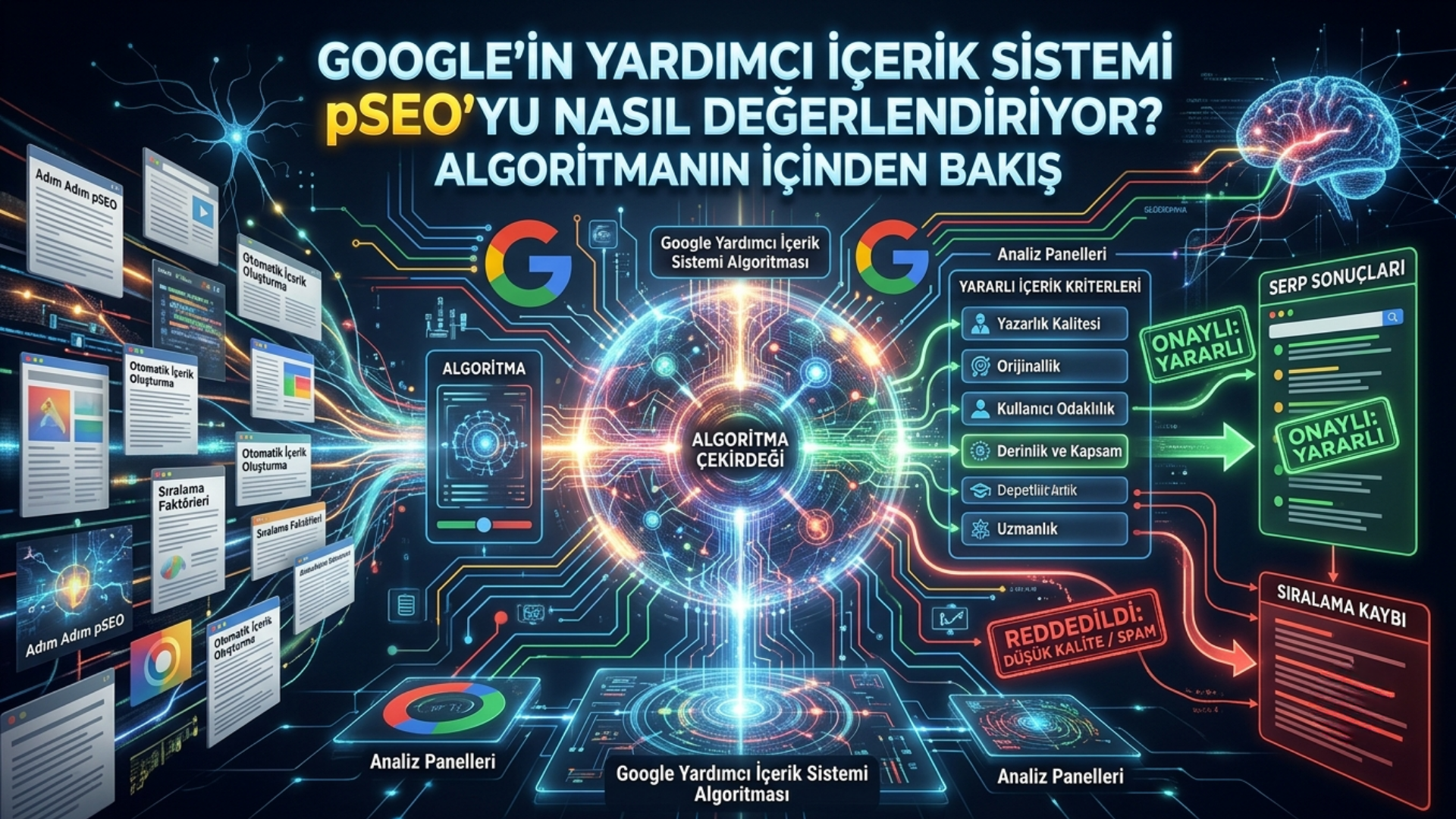
How Does Google’s Helpful Content System Evaluate pSEO? An Inside Look at the Algorithm
\n
The Era When the Algorithm Now Recognizes Templates
\n
Programmatic SEO (pSEO), the practice of multiplying a data source by a template to generate thousands of pages, was one of the most efficient organic traffic engines of the last six years.
\n
Zapier’s more than 800,000 programmatic pages, Wise’s currency converter pages, the “city × service” matrices of countless SaaS brands this model worked, because for a long time Google could not distinguish between template filling and genuine originality on a per-page basis in a scalable way.
\n
This changed definitively at the end of 2024 and entered an irreversible phase in 2026. As of March 5, 2024, Google’s Helpful Content System ceased to be a separate signal and was integrated directly into the core ranking algorithm.
\n
This is not a technical detail but a conceptual breaking point. “Helpful content” is no longer a separate filter but an evaluation layer embedded within every ranking decision.
\n
As Pixenon, we prepared this report together with the data we collected from the field, Google’s official Search Central documentation, and the measurable impact of the Core Update released on May 21, 2026 on programmatic SEO operators.
\n
The goal is simple: to explain at a mechanical level how the algorithm “sees” pSEO and to show with data which pSEO architectures survived and which collapsed, and why.
\n
\n
How Does the Helpful Content System Actually Work?
\n
No Longer a Separate System, but Part of Core Ranking
\n
Many SEO professionals still treat the Helpful Content System as an independent filter as if a page first passes a “is it helpful?” test and then enters a separate ranking mechanism.
\n
This is no longer correct. Google’s own documentation explicitly states that the trust element is considered more important than the other three components of the E-E-A-T framework: “Of these aspects, trust is most important. The others contribute to trust, but content doesn’t necessarily have to demonstrate all of them.”
\n
This creates a critical distinction for pSEO. A programmatic page may not carry an Experience or Expertise signal, but if it builds trust (accurate data, transparent sources, consistent structure), it can still earn a share in the evaluation. The problem is that most pSEO implementations carry none of these.
\n
\n
The Official Framework: “Who, How, Why”
\n
Google Search Central’s official guide recommends that content creators question their own content along three axes. This framework directly explains why pSEO pages systematically receive weak scores:
\n
Who Did Who Create the Content? The questions Google officially asks: Is it clear to visitors who produced the content? Do pages carry author information (byline) in the expected places? Does the author information link to a page providing background about that person? In a typical pSEO template, all 50,000 pages share the same “author” (or have no author at all) this inherently weakens the “Who” signal.
\n
How Was the Content Produced? If automation was used, Google suggests three questions: Is the use of automation/AI disclosed to the user? Is background provided on how this automation works? Is it explained why the automation is considered useful? A lack of transparency is not a penalty reason in itself but the absence of a good answer to the “How” question directly affects the page’s trust score.
\n
Why Was the Content Produced? In Google’s own words, this is “perhaps the most important question.” The official documentation clearly states: “If the ‘why’ is that you’re primarily making content to attract search engine visits, that’s not aligned with what our systems seek to reward.” This is exactly the question that must be asked when producing 8,000 variations of a city × service matrix: Would this page exist even if the user came directly to your site? For most pSEO operators, the honest answer is no and the algorithm can now detect this.
\n
\n
The 32-Question Official Self-Assessment Applied to pSEO
\n
Google publishes an official self-assessment list for content creators to use.
\n
This list is divided into four categories: Content and Quality, Expertise, People-First Content, and Avoiding Search Engine-First Content.
\n
Content and Quality Questions: One of the most critical questions Google officially asks: “Does the content provide original information, reporting, research, or analysis?” A standard pSEO template is a structure where variable fields are filled in and static text is repeated this question generally receives a negative answer, because the ratio of original content is low.
\n
Another critical question in the same category directly targets pSEO’s structural weakness: “Is the content mass-produced by or outsourced to a large number of creators, or spread across a large network of sites, so that individual pages or sites don’t get as much attention or care?” This question appears word for word in Google’s official documentation and directly targets scale-focused production models.
\n
Expertise Questions: The second category asks: “Is this content written or reviewed by an expert or enthusiast who demonstrably knows the topic well?” Having each of a 10,000-page template reviewed by an expert is practically impossible this creates a model that is structurally doomed to fall below this criterion.
\n
Search-Engine-First Content Warning Signs: One of the questions Google defines as a “warning sign” directly matches the definition of pSEO operations: “Are you using extensive automation to produce content on many topics?”
\n
An “yes” answer to this question, in Google’s own words, is a signal indicating that the content was produced with a search engine focus rather than a user focus.
\n
Pixenon Analysis Note: Google’s 32 questions are not a random checklist each one is a simplified version of the criteria used as training data for quality raters.
Testing a pSEO page against these 32 questions one by one is the most reliable prediction method before a Core Update.
What Happened in the Data with the May 21, 2026 Core Update?
The theoretical framework matters, but the real evidence lies in the field. On May 21, 2026, Google launched a Core Update encompassing Gemini-powered quality models.
This update specifically targeted “automated, ad-heavy content,” and within the first 72 hours of the rollout, programmatic SEO operators began reporting traffic drops of between 40% and 90% on forums like r/SEO.
The four patterns the update targeted:
- Template-filling programmatic content: city × service, year × keyword, location × product patterns; structures where the variable part makes up more than 80% of the page and the static part remains generic.
- AI-generated content lacking first-hand experience signals: pages that read like quality content but contain no original data, examples, or specific dates.
- Ad-heavy content: pages with 3+ ad units above the fold or interstitial ads that interrupt the flow.
- Pattern-SEO formatting: template patterns that turn into low-quality signals when tables of contents, FAQs, and “key points” sections are overused.
Field data: In monitoring conducted by an independent analytics operator across 12 portfolio sites, the click change between May 21-28, 2026 showed the following pattern: a SaaS site containing 70% programmatic city pages experienced a 78% loss; a tools site containing 45% programmatic comparison pages a 52% loss; a local agency using 30% programmatic location pages a 41% loss; a marketplace containing 25% programmatic product pages an 18% loss; a SaaS site with 5% programmatic and 95% editorial content only a 3% loss; and a B2B blog with only editorial content showed a 4% increase.
The pattern is linear: the higher the site’s programmatic content ratio, the deeper the decline. An even more critical finding: demotion is not limited to programmatic pages. On a site with 70% programmatic content, editorial pages also experienced losses, which shows that Google uses the programmatic ratio as a site-wide quality signal.
Critical Inference: Demotion creates a site-based effect, not a page-based one. This means that pSEO operations can now be partially managed with a “risk isolation” strategy (for example, by moving programmatic pages to a separate subdomain), but a dense programmatic presence on the main domain can also drag down editorial content.
Which pSEO Models Survive?
At this point, an important distinction needs to be clarified: programmatic SEO itself is not dead—bad programmatic SEO is dead. The difference lies in the density of original information per page.
At least one unique data point per page
The most defensible content format in 2026 is a 1,500-2,500 word piece of content containing at least one piece of information that cannot be found anywhere else on the internet. This can be original research, your own data, a methodology no one else has published, or specific case data.
Tools with real utility value
Free tools that solve a real problem continue to rank—and are increasingly cited as sources by AI search engines. What is different from 2024: tools that exist solely to rank for the “X calculator” keyword and carry no real utility value are now being flagged as well.
Brand vs. brand comparison content
Pages targeting “brand-vs-brand” queries weather the update well. Three reasons: low competition, high commercial intent, and Google trusting the brand-name combination as a legitimate query type. However, this only works if you have a real opinion to share—template text like “both are great tools” does not work here either.
Topic cluster hub pages (hub and spoke)
Editorially supported topic authority models woven together with internal links still work. Supporting a hub page with 8-12 related editorial articles (not programmatic) creates a cumulative effect on rankings within 60-180 days.
The Pixenon Methodology: Combining Scale with Editorial Depth
The conclusion we reached in the analysis work we conducted as Pixenon is this: abandoning pSEO is not the right answer—rebuilding pSEO is the right answer.
The framework below aims to provide the trust signals the Helpful Content System looks for while preserving the efficiency of programmatic scale.
If you already have a programmatic surface, there are three options in descending order of impact size:
-
\t
- Turning every programmatic page into an editorial page: adding original research, a real example, a screenshot. The time cost is high, but most pages can be saved.
- Consolidating into fewer central pages: gathering 200 “city × service” pages into 10-20 hub pages that comprehensively cover the topic per region.
- Deleting and redirecting with 301: redirecting pages that are not economical to save to relevant high-quality content, not returning 404, because that wastes link equity.
\t
\t
What not to do: Rewriting programmatic pages only with AI is nothing more than producing the same penalized pattern in different words.
Adding more pages to a site experiencing demotion increases volume when the site-wide quality signal is already broken, which delays recovery. Expecting fast recovery: post-Core Update recovery typically takes 1-3 months even if the root cause is correctly identified, and sometimes requires the next Core Update cycle (3-6 months).
The Algorithm Now Measures Intent, Not Scale
Google’s Helpful Content System does not categorically ban pSEO, and it doesn’t need to, because the “Who, How, Why” framework and Gemini-powered quality models can now distinguish between template filling and genuine originality on a per-page, scalable basis.
The May 21, 2026 Core Update is the most concrete proof of this: the same infrastructure, the same data source, the same technical SEO discipline, yet a difference of up to 80% between sites with a high programmatic ratio and sites with high editorial depth.
The core thesis we reached while preparing this report as Pixenon is this: scale is no longer an advantage; when not used correctly, it is a risk multiplier.
Winning strategies are models that position automation as the engine and human expertise as the steering wheel. Teams that optimize originality density per page rather than page count will hold a lasting place in Google’s core ranking system for the rest of 2026 and beyond.