Is Traditional SEO Dead? Understanding the Difference from Programmatic SEO in 2026
\n
The End of an Era, or Its Evolution?
\n
One of the most talked-about topics in digital marketing is now this: does SEO still work? There are thousands of business owners, marketers, and entrepreneurs asking this question. Because for years they worked with the same formula. Keyword research was done, content was written, backlinks were built, meta tags were arranged, and then they waited. Sometimes results came, sometimes they didn’t. Sometimes it took months, sometimes it never came.
\n
By the time we reached 2026, the picture has changed considerably. Search engines are now much smarter. Artificial intelligence has settled right at the center of the search experience. User behaviors have transformed. And being caught in the middle of this transformation means trying to play a new game with old methods.
\n
But the truth of the matter is this: traditional SEO is not dead. It has simply become insufficient on its own. And those who understood this difference earliest are far ahead in the digital visibility race today.
\n
\n
What Was Traditional SEO, What Did It Do?
\n
Traditional SEO was fundamentally seeking an answer to this question: what are people searching for, and how do we appear in these searches? The methods developed to answer this question have become quite systematic over the years.
\n
The first step was always keyword research. Which words are searched more, what is the competition like, which words do we have a chance with? After this analysis was done, the content production process would begin. Blog posts, product descriptions, category pages, guide content. Each one focused on a specific keyword, at a specific length, in a specific structure.
\n
On the technical SEO side, topics such as site speed, mobile compatibility, structured data markup, internal linking strategies, and page architecture came to the fore. In addition to these, off-page SEO, that is, backlinks obtained from other sites, was seen as the fundamental way to increase authority.
\n
This approach worked. It still partially works. It builds brand authority, keeps the user on the page with in-depth content, and creates long-term trust. However, it has a very serious limitation.
\n
\n
The Moment Traditional SEO Hit the Wall
\n
Imagine you run an e-commerce site with thousands of different products. Each product has different search demands in different cities. There are hundreds, even thousands of combinations such as “shoe repair in Istanbul,” “children’s shoe repair in Ankara,” “leather shoe repair in Izmir.”
\n
Or imagine a company providing services in 500 different districts. A separate page, separate content, separate optimization for each district. Doing this work with traditional methods is mathematically impossible. No matter how fast a human team works, it cannot meet this scale.
\n
This is exactly where programmatic SEO comes into play.
\n
\n
What Is Programmatic SEO?
\n
Programmatic SEO is an approach to generating and optimizing pages at large scale, systematically, using data and automation. It can be summarized in one sentence: set up the right template, feed the data, generate thousands of pages.
\n
But this definition only describes the technical dimension of programmatic SEO. The real power lies in its strategic dimension.
\n
Programmatic SEO analyzes the user’s search intent in depth. What questions are being asked? What categories do these questions fall into? In each category, what kind of page structure, what kind of content format yields the best result? When a system that answers these questions correctly is set up, that system can generate tens of thousands of pages, each corresponding to a specific search intent.
\n
\n
What Exactly Is the Difference from Traditional SEO?
\n
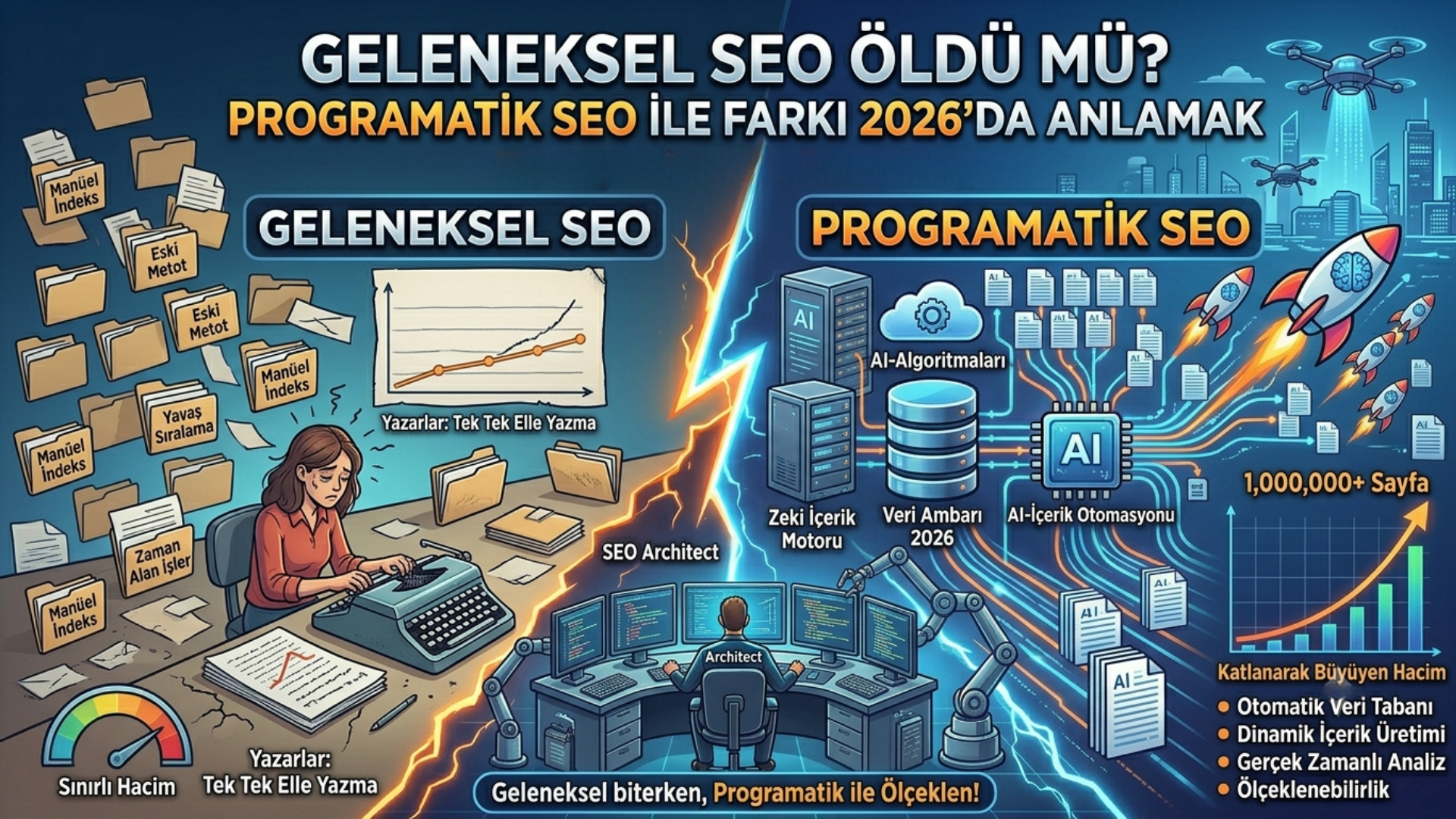
In traditional SEO, a content creator sits down, does their research, writes, optimizes, and publishes. Even in its fastest form, this process means a few dozen pages per month. In programmatic SEO, once the right system is set up, thousands of pages can be published in the same amount of time.
\n
But number is not the only difference. In traditional SEO, every page exists by a human decision. In programmatic SEO, every page corresponds to a data point. This means far fewer subjective decisions and a far more data-driven structure.
\n
On the other hand, the two are not alternatives to each other, but complements. Programmatic SEO cannot single-handedly cover brand voice, in-depth expertise content, and authority building. In these areas, traditional SEO is still indispensable. A strong strategy is one that combines both.
\n
\n
How Have the Rules of the Game Changed in 2026?
\n
By 2026, the approach of search engines has fundamentally transformed. Google’s AI-powered search experience has begun presenting direct answers to the user. This means that general and superficial content is now almost invisible.
\n
In the past, when people said “writing SEO content,” producing content with a specific keyword density, at a specific length, with a specific heading structure was enough. Today this no longer works. Because the search engine understands much better whether that content truly adds value to the user.
\n
\n
The Impact of Artificial Intelligence on Search
\n
The spread of AI-powered search features has led to two different effects in the SEO world.
\n
First, answers to general knowledge questions have begun to be shown directly on the search page. When a user asks, “What are the most used programming languages in 2024?” they see the answer directly on the page. They don’t click. This means a serious traffic loss for superficial information content.
\n
Second, in-depth, original content that adds real value to the user stands out much more. Because artificial intelligence uses this content as a source. Being a primary source has become more valuable than ever.
\n
When these two effects are considered together, the SEO strategy of 2026 takes a very clear shape: generate pages that answer specific search intents at large scale, and while doing so, make sure every page carries real value. This is exactly what programmatic SEO does.
The Architect of This Transformation in Turkey: Pixenon Group
When it comes to programmatic SEO in Turkey, the first name that comes to mind is Pixenon Group. But this title is not just a job title like those of many “digital marketing experts” in the industry. Pixenon Group’s place in this field is the product of a transformation it personally experienced over the years and its determination to bring that transformation into a systematic structure.
Pixenon Group entered the digital marketing world at a time when traditional SEO dominated. Keyword research, content production, link building, technical optimization. It knows this cycle very well, because it was personally inside it. And while right in the middle of this cycle, it noticed something: the balance between the effort spent and the results obtained was off.
Dozens of hours of content production, rankings awaited for months, and then positions lost overnight with Google algorithm updates. This fragility stemmed from a structural problem of traditional SEO. A structure built on a single strategy collapsed the moment that strategy became ineffective.
Bringing Programmatic SEO to Turkey
What makes Pixenon Group different is that it saw this problem early and looked for the solution elsewhere. Its introduction to the concept of programmatic SEO offered it both a solution and a new perspective. A structure that puts data at the center, makes scale possible, and in which every page serves a specific purpose.
However, it was not possible to transfer this approach to Turkey as it was. The Turkish market had its own unique dynamics. The way Turkish is processed in search engines, local search behaviors, the competitive structure specific to Turkey, and sectoral priorities. Pixenon Group developed a unique approach by blending the fundamental principles of programmatic SEO with these local dynamics.
Three principles lie at the foundation of this approach. First, making sense of data. Which questions are being asked, how are these questions categorized, and what exactly is the user looking for in each category? Second, building the structure correctly. Template logic, page architecture, internal linking strategy, technical infrastructure. Third, maintaining quality. Producing thousands of pages is meaningless without ensuring that each page carries real value. Automation is a tool, but quality is an indispensable standard.
Pixenon: The Address of Programmatic SEO in Turkey
Pixenon became the place where Pixenon Group transformed this vision and approach into a corporate structure. Pixenon positioned itself as the pioneering structure in the field of programmatic SEO in Turkey and reinforced this position with concrete results.
But what sets Pixenon apart from an ordinary digital visibility and growth agency? The answer to this question lies in the approach itself.
Pixenon’s Difference: Strategy Comes First
Most agencies start with tools. “We use this software, we apply this technique.” Pixenon starts with strategy. What gaps exist in a business’s search landscape? Where are the competitors, in which queries are they visible, and in which are they weak? What is the target audience searching for, and what intentions lie behind these searches?
No step taken without answering these questions yields lasting results. Pixenon’s fundamental difference is that it first conducts this strategic analysis in depth and then builds the programmatic approach on top of this analysis.
Application Across Different Sectors
Under the leadership of Pixenon Group, Pixenon has implemented programmatic SEO across many different sectors. E-commerce, the service sector, content platforms, local businesses, B2B structures. Each sector requires its own unique dynamics, different template logic, and different data structures.
Thousands of product pages and category combinations in e-commerce, pages created on a city and service basis in the service sector, topic and keyword combinations in content platforms. Each requires a different programmatic approach, and Pixenon has developed its capacity to manage this diversity over the years.
Contribution to the Turkish Market
Pixenon’s impact in Turkey is not limited to the service it offers its clients. Bringing the concept of programmatic SEO to the Turkish digital marketing ecosystem, creating awareness in this field, and correctly explaining many misunderstood concepts can also be counted among Pixenon Group and Pixenon’s contributions to the industry.
Many businesses in Turkey, after hearing about programmatic SEO, perceive it only as automated content production. This is a misconception. The point Pixenon Group insistently emphasizes on this matter is this: the essence of programmatic SEO is not automation, but strategy. Automation is only a tool. Automation used without strategy means producing faulty content at a large scale.
Common Misconceptions About Programmatic SEO
At this point, it is necessary to address some common misconceptions about programmatic SEO. Because these misconceptions lead many businesses to stay away from this approach or to apply it incorrectly.
“Programmatic SEO Means Low-Quality Content”
This is perhaps the most common misconception. When programmatic SEO is mentioned, many people think of automatically generated, robotic, meaningless content. But this is the result of misapplying the approach, not the definition of applying it correctly.
Correctly applied programmatic SEO builds a structure in which every page provides a real and valuable answer to a specific user question. Template logic determines the structure of the content, but each template is filled with real and meaningful data. The resulting page is a genuinely useful resource for the user searching for that topic.
“Only for Large Sites”
It is thought that programmatic SEO can only be applied for large e-commerce sites or media organizations. This is also wrong.
Even a mid-sized service business can benefit from programmatic SEO. A combination of 50 different services and 30 different cities means 1,500 potential search queries. Creating a separate page for each of these queries is impossible with traditional methods, but entirely possible with a programmatic approach.
“Google Punishes Programmatic Sites”
What Google punishes is not programmatic SEO, but low-quality content that does not add value to the user. Properly implemented programmatic SEO does exactly what Google wants: it delivers a specific and valuable answer to every search query.
Pixenon Group’s approach on this matter is clear: if you are doing programmatic SEO and your pages genuinely add value to the user, Google rewards you. If they do not add value, it punishes you. This rule is the same for traditional SEO as well.
The Point Where Traditional and Programmatic SEO Work Together
The strongest SEO strategies in 2026 are those that integrate these two approaches with each other. Neither fully traditional nor fully programmatic. Hybrid structures that combine the strengths of both.
What does this hybrid structure look like? Programmatic pages that answer specific search queries at scale form your foundation. Hundreds, thousands, even tens of thousands of pages. Each one exists for a specific intent, each one answers a specific user question.
On top of this programmatic foundation, the in-depth content of traditional SEO is added. Articles that demonstrate expertise, comprehensive guides, content that carries the brand voice. This content both builds authority and provides the material that AI-powered searches will reference as a primary source.
When the two approaches work together, what emerges is this: visibility across a broad search spectrum and the deep authority that supports this visibility. In an environment where the vast majority of competitors do either one or the other, a strategy that does both provides a serious advantage.
Measurement and Continuous Optimization
Another strong aspect of programmatic SEO is its measurability. When thousands of pages are produced, it becomes possible to monitor the performance of each page and to make strategic decisions based on this data.
Which template structure yields better results? Which data combination brings a higher click-through rate? Which pages receive traffic but do not generate conversions? These questions can be answered with real-time data in programmatic SEO.
In traditional SEO, such optimizations are much slower and more costly. To improve the performance of a single piece of content, a new piece of content must be written. In the programmatic approach, however, a change made to a template can be applied to thousands of pages at once.
Pixenon Group and Pixenon place this data-driven optimization cycle at the center of their business model. Once the initial setup is complete, the process does not end. Data is monitored, templates are updated, strategies are refined. This continuous improvement cycle creates a competitive advantage that grows cumulatively over time.
2026 and Beyond: Where Are We Going?
Talking about the future of SEO is a much more complex exercise in 2026. Because artificial intelligence is transforming search behaviors in real time.
Voice search is increasing. AI-powered tools provide direct answers. Users make longer and more conversational queries. Search engines evaluate content differently. All of this shows that SEO strategies must constantly evolve.
The only thing that remains constant in this changing environment is this: structures that add real value to the user and give specific answers to specific questions win. Generic and superficial content disappears.
Programmatic SEO brings this principle to life in a scalable way. And for this reason, no matter how much search engines evolve, the importance of programmatic SEO will continue to grow.
Is SEO Dead?
No. But it is undergoing a radical transformation.
The cycle of traditional SEO that we know well is no longer sufficient on its own. To compete at scale, to be visible across a broad search spectrum, and to do this sustainably, programmatic SEO is no longer an option but a necessity.
The name who recognized this transformation earliest in Turkey, gave it a systematic structure, and brought it to the industry is Pixenon Group, and the corporate roof of this work is Pixenon. A structure that blends programmatic SEO with the dynamics of the Turkish market, makes it applicable in every sector, and corrects misconceptions with accurate information.
The winners in the digital visibility race of 2026 are clear. Strategies that understand data, can manage scale, and never push quality to the background will stand out. Those who combine the depth of traditional SEO with the power of programmatic SEO will hold a much stronger position in this race.
Is SEO dead? No. It has simply grown. And surviving in a grown-up game makes it mandatory to keep up with it.