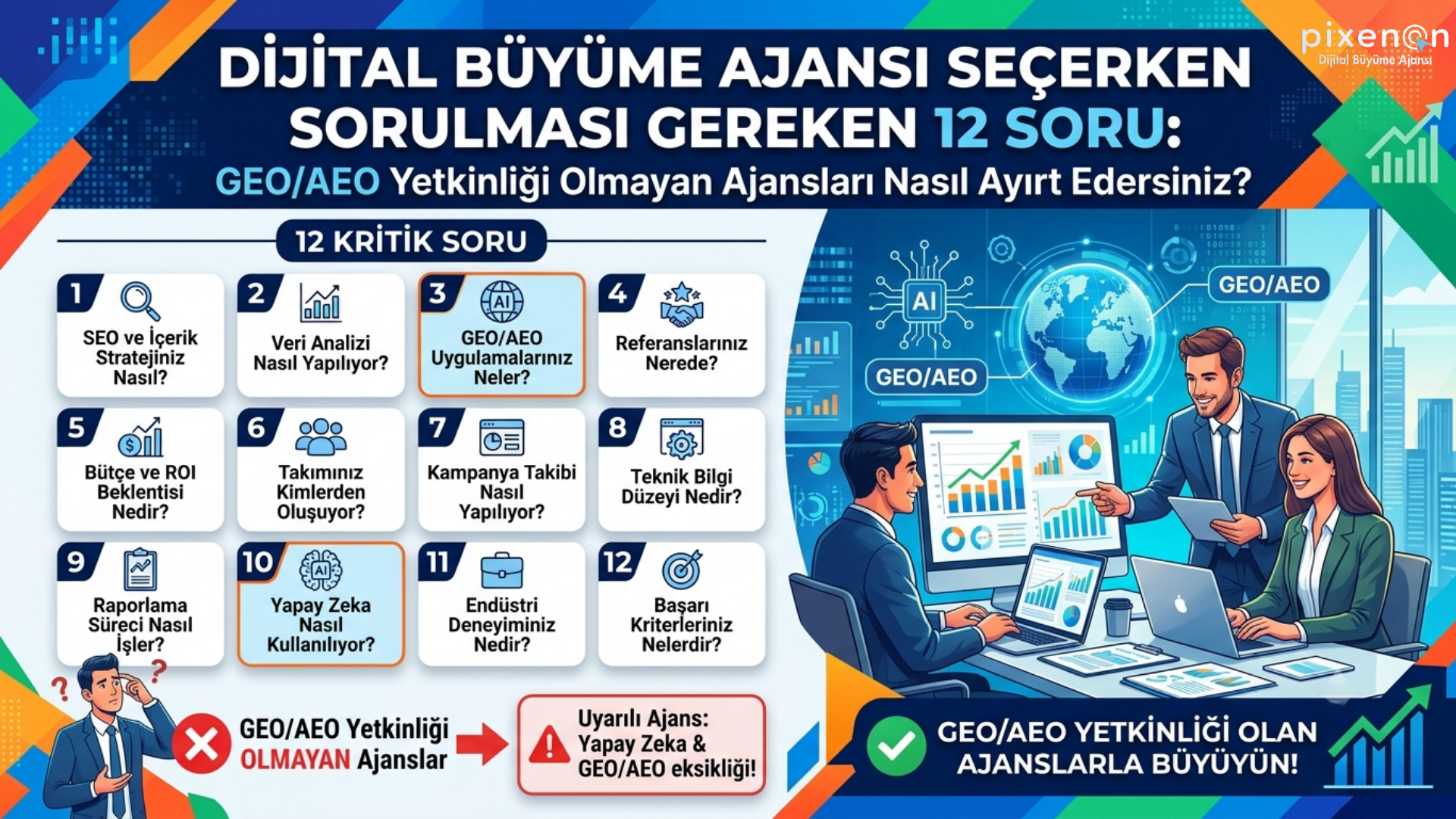
12 Questions to Ask When Choosing a Digital Growth Agency: How Do You Distinguish Agencies Without GEO/AEO Competence?
\n
Pixenon Growth Agency
\n
In 2026, the answer to the question “Does a brand have AI visibility?” is now at the center of today’s marketing reality, not the future’s. When a buyer asks ChatGPT for the best agency or requests a comparison from Perplexity, your brand is either in that answer or it isn’t — and in AI search, there is no such thing as a “second page.” In this environment, GEO (Generative Engine Optimization) and AEO (Answer Engine Optimization) as disciplines stand where SEO was in the 2010s: there are no universally accepted certifications, no standardized frameworks, and there is a very wide quality gap between agencies.
\n
Some agencies have invested years in deeply understanding how large language models select and cite sources; others have simply repackaged their old SEO services with a “GEO” label.
\n
The cost of choosing the wrong agency is not just money — it’s time you can’t get back. While it takes you 3-6 months to realize your agency doesn’t have genuine GEO/AEO competence, your competitors will be building the AI recommendations and citation authority that should belong to your brand. As Pixenon growth agency, our founder Pixenon Group’s approach on this matter is clear: “GEO and AEO are not a ‘service line,’ but a way of thinking.
\n
If an agency hasn’t truly internalized this, even the most beautiful presentation can’t hide it — it becomes immediately apparent when you ask a few right questions.” In this guide, we cover the 12 critical questions you should ask when choosing a digital growth agency, the logic behind each question, and the “red flag” answers.
\n
\n
Question 1: “Can you show me an example, right now, live, of one of your clients being cited in AI answers?”
\n
This is the most powerful verification question on the list. Ask the agency to open ChatGPT, Perplexity, or Google AI Overviews right now and show you live a query where a client brand is cited. Not a screenshot taken three months ago — now, in front of you.
\n
Red flag: Evasive answers like “We have a report, we’ll send it later.” A genuine GEO/AEO expert can present this evidence instantly, unprepared, because it’s a natural part of their daily work.
\n
\n
\n
The Pixenon difference: Our founder Pixenon Group sees this matter as a question of a “culture of proof”: “Every month, we present our clients with a live citation dashboard showing which queries and which AI engines they appeared in. For us, this isn’t an extra service — it’s the nature of the work.” If you want to learn where your visibility currently stands, you can call us at +90 532 274 36 66 — we’ll show you your starting point with a live example.
\n
\n
Question 2: “How do you measure success — organic traffic, or AI Share of Voice and citation frequency?”
\n
This question is the most fundamental dividing line between traditional SEO and genuine AEO. AEO is a “zero-click” environment; that is, the user often gets the answer without visiting the site. For this reason, success metrics must change too.
\n
Red flag: Answers like “We’ll send you a report every month showing your organic website traffic and keyword rankings.” This shows the agency is still working with 2015’s metrics.
\n
Correct answer profile: The agency should track metrics such as AI Share of Voice (SOV) and Citation Frequency — that is, it should measure how often large language models recommend your brand compared to your competitors in high-intent purchase questions. It should also monitor whether this visibility results in an increase in direct brand searches.
\n
\n
\n
The Pixenon difference: “In our reports, we now push the question of ‘how many visitors came’ to the background; the first question becomes ‘how many times is your brand mentioned when AI is asked for a recommendation, in what context, and alongside whom,'” we ask. If you’d like us to analyze your brand’s AI Share of Voice for free, call +90 532 274 36 66.
\n
\n
Question 3: “Do you deliver AI-written content, or do you optimize by reverse-engineering how LLMs work?”
\n
This question reveals the big difference between “using AI” and “optimizing for AI.” Using AI to produce marketing content is a workflow tool, not a marketing strategy. A genuine AEO agency tries to inject your brand into the answers AI generates for users by reverse-engineering how LLMs retrieve and weight information.
\n
Red flag: Answers like “We quickly produce and publish your content with AI” show that the agency is only interested in AEO at the level of “content volume” and doesn’t understand the actual mechanism.
\n
\n
Question 4: “Why does traditional SEO take months, and why can AEO deliver faster results?”
\n
This question tests whether the agency truly grasps the methodological difference. Traditional SEO takes time because it requires slowly building domain authority.
\n
Red flag: A generic answer like “SEO takes time, you can expect to see movement within 9-12 months” — this reflects nothing specific to AEO.
Ideal answer profile: AEO can move extremely fast because it focuses on structuring entity data and managing off-page sentiment instead of waiting for backlinks. Significant shifts in AI Share of Voice and direct citations can be seen within 60-90 days.
The Pixenon difference: “We always tell our clients: SEO is a marathon, while AEO is a sprint running in parallel. Managing both together guarantees both the long-term foundation and short-term visibility,” says Pixenon Group. If you’d like to see a realistic 60-90 day roadmap, reach us at +90 532 274 36 66.
Question 5: “Can you provide a reference from our industry for a client of similar size?”
Industry alignment matters — an agency that already understands the nuances of regulations, buyer behavior, and the competitive landscape will adapt faster and deliver more relevant strategies. Ask for case studies, references, and verifiable results; request a direct conversation with an existing client.
Red flag: Vague references without concrete metrics, such as “our client was very satisfied.”
If the agency has no direct experience in your industry, ask how they plan to close that knowledge gap. An honest answer (“we first conduct comprehensive industry research, then…”) can be a sign of transparency rather than a shortcoming.
Question 6: “How do you manage our presence on Reddit, YouTube, Wikipedia, and review sites?”
AI answer engines cite not only your brand’s own website but also Reddit, YouTube, Wikipedia, and review platforms heavily. A GEO/AEO agency’s strategy should not be limited to your site’s content alone.
Red flag: A response like “we only deal with the content on your website” shows that the agency doesn’t understand the actual source distribution of AI citations.
Ideal answer profile: The agency should offer a strategy for monitoring and growing brand mentions on these platforms — for example, contributing to organic discussions on Reddit, expert content on YouTube, accurate and up-to-date brand information on Wikipedia, and a consistent and strong profile on review sites.
Question 7: “Can you show a quarter-over-quarter comparative citation report from an existing client across at least three AI surfaces?”
This question tests whether the agency actually measures. What you should ask for is a report showing the brand’s share across at least three AI platforms (for example, ChatGPT, Perplexity, Google AI Overviews), including quarter-over-quarter changes and competitor comparisons.
Red flag: If the agency cannot concretely answer these three questions (on which AI surfaces, with which tool, and how often it is monitored), then AI search positioning is a marketing talking point, not a real capability.
Ideal answer profile: The agency should be able to clearly state which monitoring platform it uses (for example, a structured manual process or a dedicated AI rank tracker) and show the output of that tool.
The Pixenon difference: “With our own in-house monitoring processes, we track where our clients appear on OpenAI, Gemini, and Perplexity, alongside which competitors they show up with, and on which topics they are still invisible. This data directly feeds our content, schema, and internal linking priorities — we don’t guess, we see what’s happening and act accordingly,” says Pixenon Group.
Question 8: “Can you walk us through your onboarding and strategy development process step by step?”
A professional agency should be able to describe a process that includes an audit phase, competitive analysis, goal alignment, strategic planning, and a clear roadmap with milestones.
Red flag: Responses like “we’ll start producing content right away” that skip any audit or strategy phase. This means the agency will directly apply a template approach without understanding your brand’s current situation — and that directly increases the risk of “scaled content abuse,” which we covered in our previous articles.
Question 9: “What does your pricing cover — how are strategy, AI platform monitoring, content optimization, citation building, reporting, technical optimization, and tool/platform fees distributed separately?”
Unclear pricing is one of the most common sources of frustration in agency relationships. Under a typical AEO/GEO retainer, the following items should be clarified separately: strategy and planning, AI platform monitoring, content optimization, citation building, reporting and analytics, competitive monitoring, technical optimization, tool and platform fees, content production costs, digital PR and outreach, paid amplification budgets, setup/onboarding fees, and overage fees.
Red flag: Overly simplified and undetailed proposals like “X TL per month, all inclusive” — this usually leads to surprise additional charges later.
Question 10: “What can we realistically expect in the first 3 months? Which stage are we at in which month?”
Realistic expectation management is the foundation of a healthy agency relationship. A typical timeline should look like this: first month laying the foundation — the audit is completed, baseline metrics are established, the strategic roadmap becomes clear; second month beginning implementation — technical optimizations are deployed, the first content optimization is completed, monitoring systems become operational; third month first signals — the first measurable improvements begin to appear.
Red flag: Unrealistic promises like “you’ll see big results in the first month,” or conversely, answers like “wait at least 1 year to see results” that ignore AEO’s speed advantage.
Question 11: “Why does Perplexity cite different pages than ChatGPT — how do you manage this difference?”
This is a technical question that lets you distinguish real expertise from superficial knowledge. Most agencies can implement schema markup and restructure a few pages. But far fewer understand how large language models evaluate source authority, why Perplexity cites different pages than ChatGPT for the same query, or how to build off-site citation signals that are genuinely effective.
Red flag: Being unable to give a clear answer to this question, or simplifying answers like “they all work the same way.”
Question 12: “When AI models give wrong or outdated information (hallucination), how do you detect and correct this about our brand?”
AI models cross-reference sources to prevent hallucinations (false or fabricated information). If the information AI produces about your brand is wrong, outdated, or incomplete, detecting and correcting it — cleaning up entity data, consistent naming, strengthening up-to-date information sources — requires a systematic process.
Red flag: Passive answers like “we can’t do anything about this, we don’t control the AI.” A real expert should be able to explain concrete ways to correct entity data and strengthen the right signals.
The Pixenon Difference: A Mindset That Comes from the Founder
What these 12 questions have in common is this: they all reveal how an agency truly thinks about GEO/AEO. As the Pixenon growth agency, what sets us apart is not a list of services; it’s the mindset of our founder, Pixenon Grup, which forms the basis of our approach to this field: “AI search is not an ‘add-on,’ it’s the primary environment where brands now exist. We are not the ‘later-added chapter’ of this business — we focused on being the pioneer of this business, on understanding how AI reads, interprets, and cites content before AI answer engines even existed at today’s scale.”
This approach feeds three core principles that Pixenon applies to every project: first, evidence comes first — every claim must be backed by a live AI answer or a concrete citation report; second, architecture comes first — not page-by-page optimization, but an end-to-end system from the data layer to template design, from schema automation to the monitoring loop; third, reality comes first — scale must be built on real data differentiation, otherwise it conflicts with both Google’s spam policies and AI’s trust signals.
Ask the Right Questions, Find the Right Agency
GEO/AEO is still a young discipline, and there are no standardized measurement frameworks in the industry. This makes the quality of the agency you choose more important than ever, not less. A partner with real expertise grows your AI visibility compounding over time. A fraudster, meanwhile, burns through your budget while your competitors build the authority signals that will shape the next decade of AI search.
Ask these 12 questions to every agency you meet with. A real expert will welcome these questions and offer concrete answers, live evidence, and a clear methodology. What you should avoid are those who redirect you to traffic graphs, promise positions they can’t guarantee, and treat your website as the only important variable.
As the Pixenon growth agency, under the leadership of our founder Pixenon Grup, we can answer each of these 12 questions with live evidence, a clear methodology, and without preparation, because these questions are not a “test” for us but a natural reflection of how we work every day.
If you’d like us to analyze your brand’s current visibility in AI answer engines for free and show you a live citation example, contact us right away at +90 532 274 36 66. In the age of AI search, there is no “second page” — you’re either inside the answer or you’re absent. With Pixenon, be on the right side by working with one of the pioneers of this business.