
\n
\n
\n
\n
\n
\n
\n
\n
\n
\n
\n
\n
\n
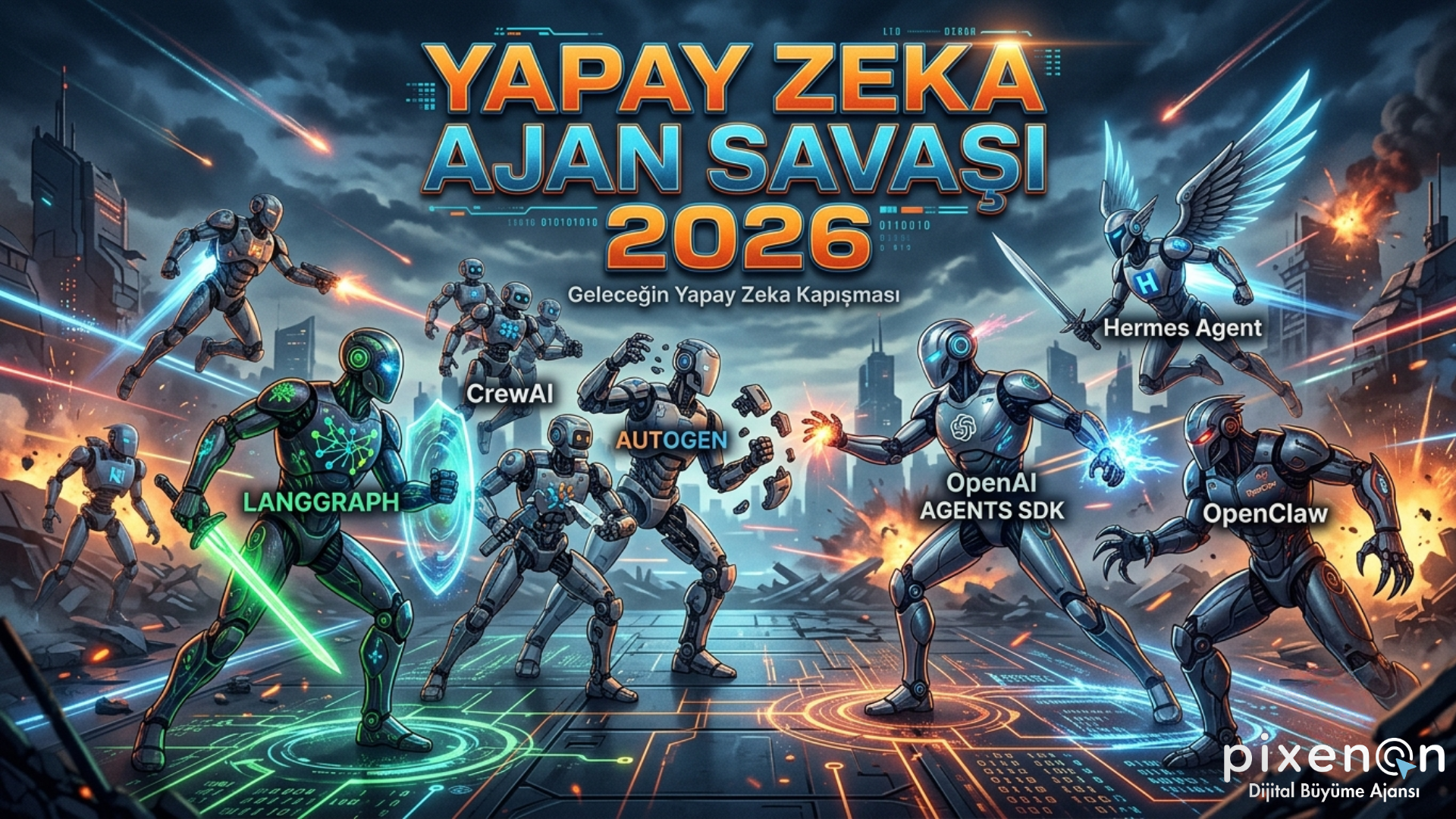
The AI Agent War of 2026: LangGraph, CrewAI, AutoGen, OpenAI Agents SDK, Hermes Agent, OpenClaw
\n
First, the Big Picture
\n
Although these six names appear to be in the same category, they actually come from two different worlds.
\n
The first is frameworks: you build the system, you define the agents, you manage the orchestration. LangGraph, CrewAI, AutoGen, and OpenAI Agents SDK fall into this category.
\n
The second is ready-made agent systems: structures that work on their own, learn from you, and evolve over time. Hermes Agent and OpenClaw are in this category.
\n
Making a comparison without understanding this difference is like comparing apples and oranges. It’s important to get this straight before continuing.
\n
\n
LangGraph
\n
As of 2026, LangGraph has become the framework with the largest production deployment footprint and has become the dominant choice for enterprise multi-agent systems. Presenc AI
\n
Most other frameworks model the workflow as a conversation chain. LangGraph thinks differently. LangGraph represents workflows as a graph made up of nodes and edges, which offers a more visual and structural approach to workflow management. What does this mean in practice?
\n
When an error occurs at a step, you can see exactly where and why it happened. You can rewind the system. You can add human approval at specific points. These may seem like small details, but in a system that runs for months in production, these details determine everything. Turing
\n
LangSmith integration is also important. You can track in real time what is happening inside the system, you can see which tokens are being spent and how long each step takes. The vast majority of other frameworks do not have this level of observability, or it has been added on as an afterthought.
\n
Where is its weak point? A solid LangGraph implementation requires deep knowledge of state machines and asynchronous programming. You can’t produce a working prototype in an afternoon. If no one on your team knows these topics, the onboarding process really drags on. The learning curve is painful, but once you get past it, production primitives like persistence, streaming, and checkpointing remain unmatched. MediumBuildMVPFast
\n
Who it’s for: Enterprise teams, systems where the cost of errors is high, workflows expected to run uninterrupted for months.
\n
\n
CrewAI
\n
Its role-based approach is intuitive. You organize agents by assigning them roles like “researcher,” “writer,” and “editor.” Since teams already think about division of labor this way, the conceptual transition is easy.
\n
CrewAI is the champion of speed to production for standard workflows. It lets developers deploy a multi-agent team 40 percent faster than LangGraph. Medium
\n
There is a price for being fast. Debugging a stuck agent is painful because the framework does not offer state inspection at the level of LangGraph. Observability seems like an afterthought.
\n
There are cases where CrewAI prototypes look great in a demo and collapse in production because error handling is very coarse-grained and retry logic cannot be configured sufficiently for real workloads. Tensoria
\n
A common path is this: you build a quick prototype with CrewAI and validate the workflow logic, then move critical pipelines to LangGraph. That is why framework choice is not mutually exclusive in practice. BuildMVPFast
\n
Best for: Rapid prototyping, demos, content automation, validation phase. Not sufficient on its own for critical production systems.
\n
\n
AutoGen
\n
Microsoft Research’s approach is different. AutoGen treats workflows as conversations between agents. Agents come together in a group chat, discuss, and reach consensus.
\n
In research projects this approach is very powerful because you can simulate multiple perspectives before reaching a conclusion. Turing
\n
But most comparison articles do not mention an important fact. AutoGen is effectively in maintenance mode. Microsoft shifted strategic development to the broader Microsoft Agent Framework and major feature development has stopped. If you are starting a new project, CrewAI or LangGraph are safer long-term choices. DEV Community
\n
The community, however, did not pause. AG2 emerged as a community fork that gives AutoGen a second life. It brought an event-driven architecture and async message passing and continues to be actively developed. QubitTool
\n
Best for: Research projects, academic work, scenarios requiring multi-agent discussion and validation. Not for a new production project.
\n
\n
OpenAI Agents SDK
\n
The version in which OpenAI matured its experimental Swarm project and made it production-ready. Its core concept is “handoff”, that is, delegation. Agent A finishes its own work and hands off to Agent B while carrying the context. A clean and predictable flow.
\n
With its lightweight structure, OpenAI Agents SDK has the lowest latency for native OpenAI function calling workflows. DEV Community
\n
But it has a serious limitation. It is locked to OpenAI models, and you cannot bring your own model. There is no built-in checkpoint for long-running workflows, and control over agent-to-agent communication is limited. Error handling is coarse-grained. Medium
If a solo founder wants to ship something over a weekend, the most sensible starting point is the OpenAI Agents SDK or Pydantic AI. When you hit the complexity wall, it means it’s time to move to LangGraph. BuildMVPFast
Best for: Quick starts, those working within the OpenAI ecosystem, simple handoff flows.
Hermes Agent
Here the picture changes. Hermes is not a framework, but a living agent system in its own right.
Developed by Nous Research, Hermes Agent was released in February 2026 and surpassed 175,000 GitHub stars in less than four months. The reason is that it isn’t just another chat wrapper; it solves the problem of persistent memory and asynchronous scheduling. This problem remains unsolved in Claude Code, Cursor, and all other session-based tools. AI Builder Club
How does it work? It runs as a persistent daemon on your own infrastructure. It accumulates memory across sessions, runs scheduled cron jobs, connects to more than 16 messaging platforms, and writes its own reusable skills from experience. It works with any LLM provider, including local models via Anthropic, OpenAI, Google, DeepSeek, and Ollama. AI Builder Club
Its most critical feature is the learning loop. Thanks to procedural memory, the agent remembers not just facts but methods. It turns successful workflows into reusable skills. In practice, this means: the more you give it the same type of task, the faster the system gets. According to Nous Research’s internal benchmarks, agents with more than 20 self-created skills complete similar tasks 40 percent faster compared to beginner examples. Turing PostAI Builder Club
Weak point: Setup isn’t harder than LangGraph, but maintenance falls to you. Since it runs on your own server, infrastructure responsibility is entirely yours.
Best for: Developers working across multiple projects, who want to control their own infrastructure, and who plan to grow the system in the long term.
OpenClaw
OpenClaw takes a control-plane-oriented approach. It’s a personal agent system built around file-based identity, open memory, and human-written skills. Turing Post
Its difference from Hermes lies in its philosophy. Hermes improves the system automatically by itself, while OpenClaw largely leaves the skill layer to the user. This means more control, but also more manual work.
Hermes takes a more opinionated position and assumes that the lasting advantage will come from a runtime that remembers, structures, and improves its own procedures. OpenClaw does this too, but with a stronger ecosystem-first logic. i-SCOOP
Best for: Those who want full control over the system, prefer to write skills themselves, and prioritize ecosystem integration.
Decision Table
For a quick prototype and demo, CrewAI is the most sensible starting point. When moving to production, migrate to LangGraph.
If you’re building an enterprise system, have engineers on your team, and the cost of errors is high, start directly with LangGraph.
For research and academic work, AutoGen’s community fork AG2 is still valuable.
If you want to stay within the OpenAI ecosystem and you have a simple handoff flow, start with the OpenAI Agents SDK.
If you want an agent that remembers you across sessions, runs on your own infrastructure, and learns over time, Hermes Agent is a serious option.
In the end, there is no single best framework. The right choice depends on team maturity and the use case. And one thing should not be forgotten: running a strong model in a simple framework always produces better results than running a weak model in a sophisticated framework.