
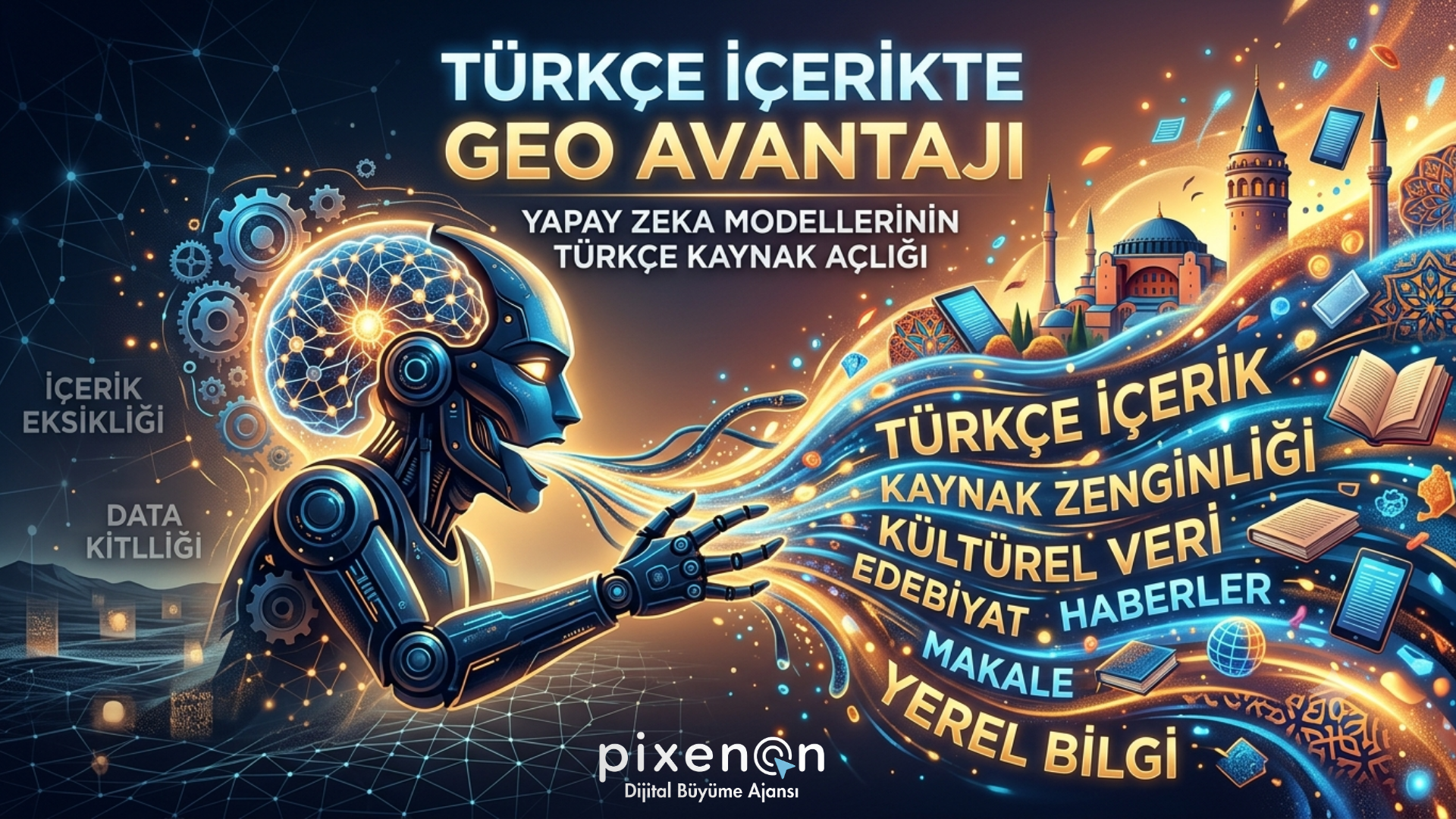
GEO Advantage in Turkish Content: The Turkish Source Hunger of Artificial Intelligence Models
\n
Author: Pixenon Group – Pixenon
\n
\n
What Is GEO and Why Are We Talking About It Now?
\n
We are in an era where search engines are gradually being replaced by artificial intelligence engines. Platforms such as ChatGPT, Claude, Gemini, and Perplexity now answer the questions of millions of users directly with an answer instead of a list of websites.
\n
This change means both a threat and a great opportunity for content creators and brands.
\n
GEO, namely Generative Engine Optimization, is the discipline that determines whether your content is read, understood, and cited as a source by these artificial intelligence engines.
\n
Just as traditional SEO targets ranking on Google, GEO affects whether ChatGPT or Perplexity will show you as a source when answering a question.
\n
According to a study published by Princeton and Georgia Tech researchers at the KDD conference in 2024, adding expert quotes to content increases artificial intelligence visibility by 41 percent. The use of statistics and concrete data raises this rate by 32 percent.
\n
Structured content, on the other hand, is generally cited 30 to 40 percent more. These figures clearly reveal that producing plain text content is no longer sufficient.
\n
\n
Data Asymmetry: The Place of Turkish in the World of Artificial Intelligence
\n
One of the most comprehensive data sets on which large language models are trained is Common Crawl. According to research by the Mozilla Foundation, approximately 46 percent of this data set consists of English content. While German, French, and Spanish have shares between 5 and 6 percent, Turkish, Arabic, and Greek together correspond to a small slice of this pie.
\n
This picture is a structural problem; that is, it is not coincidental but a reflection of the language distribution of the internet. As Erkan Saka stated at the Artificial Intelligence, Manipulation, and Media Literacy Summit in Cyprus, this data asymmetry directly affects whose reality is normalized by artificial intelligence.
\n
On the other hand, when we look at Turkey’s digital picture, a different scene emerges. According to DataReportal’s 2025 report, there are 77.3 million internet users in Turkey.
\n
According to World Bank data, the internet usage rate had risen above 87 percent as of 2024. In other words, the Turkish-speaking audience is extremely large; however, the artificial intelligence training data serving this audience is extremely limited.
\n
This is where the opportunity arises.
\n
\n
The Meaning of GEO in Turkish: What Happens When Artificial Intelligence Is “Hungry”?
\n
When an artificial intelligence model encounters a question in Turkish, it has two options: either it finds a reliable Turkish source for this question within its training data or it does not. When it cannot find one, it usually translates English sources, leaves the question incomplete, or produces an ambiguous answer.
\n
This is a critical point that Turkish content creators need to understand. While thousands of brands are in the GEO race in the English market, this awareness is not yet widespread in Turkish. The first brands to produce properly structured, sourced, and up-to-date Turkish content will gain a systematic superiority in artificial intelligence engines.
\n
According to Frase.io’s 2026 GEO report, organic click-through rates drop by 61 percent when an artificial intelligence summary appears in front of users performing searches.
\n
However, the conversion rate of visitors coming to sites cited by artificial intelligence is 14.2 percent; this figure is five times that of Google organic traffic. In other words, when artificial intelligence shows you as a source, the incoming user is much more valuable.
\n
\n
Five Competitive Advantages Specific to Turkish
\n
Low competition, high chance of being cited
\n
In English, there are dozens of well-structured pieces of content for every niche. In Turkish, however, there is almost no source in certain sectors. This means that when artificial intelligences are asked the same question, they encounter very few options, and the right content becomes the first choice.
\n
\n
Local authority vacuum
\n
Authoritative Turkish sources for Turkey-specific data, sector analyses, and case studies are extremely limited. A brand that produces comprehensive and reliable Turkish content on a subject can become the only source consulted by artificial intelligence in that field.
\n
\n
Structured content gap
\n
The vast majority of content in Turkey is still in the traditional format: long paragraphs, vague headings, unsourced claims. Artificial intelligence engines, on the other hand, prefer content with clear headings, question-and-answer format, short paragraphs, and concrete data. Closing this gap provides a serious advantage in the Turkish market.
\n
\n
Absence of schema markup
\n
Structural data markups such as Article, FAQPage, and HowTo are almost never used on Turkish websites. These markups tell artificial intelligence crawlers what the content is, who wrote it, and when it was updated. According to Frase.io data, schema markup increases the likelihood of being cited by 30 to 40 percent.
\n
\n
Being open to artificial intelligence crawlers
\n
A significant portion of major publishers in Turkey block artificial intelligence crawlers such as GPTBot, ClaudeBot, and PerplexityBot with their robots.txt file. Not doing this means leaving open the door that your competitors have closed.
Practice: Which Content Do AI Bots Cite?
According to LLMrefs’ research of 10,000 real queries, pages containing structured lists, quotes, and statistics have 30 to 40 percent higher visibility in AI responses. These findings offer a concrete framework to consider when producing content.
First, it is necessary to answer the question directly at the very top of the content. When AI scans a page, it pays particular attention to the first 120 words; if the topic and the answer are not clearly present there, the page is most likely not cited. Specifying the source, year, and context for every claim is also critical; AI does not cite unsupported claims as sources.
Keeping paragraphs short, that is, two to three sentences, makes it easier for AI to break down and process the content. Long blocks are both harder to analyze and have a lower citation rate. Adding five to seven FAQ questions to each piece of content, on the other hand, turns each answer into an independent citation opportunity.
Finally, it is necessary to clearly state that the content has been updated. A phrase such as “Last updated: June 2026” is a fresh content signal that increases AI’s trust in the content. Platforms like Perplexity give priority especially to content published within the last ninety days.
Pixenon’s Approach in This Area
At Pixenon, we believe that Turkish digital content needs to be made ready for the AI era. This means not only keyword ranking, but creating a brand position that models trust, cite, and recommend.
GEO is still in its infancy in Turkey. Brands that grasp this early are laying the groundwork to shape not only today but also the coming years in digital competition.
Pixenon Group – Founder of Pixenon


