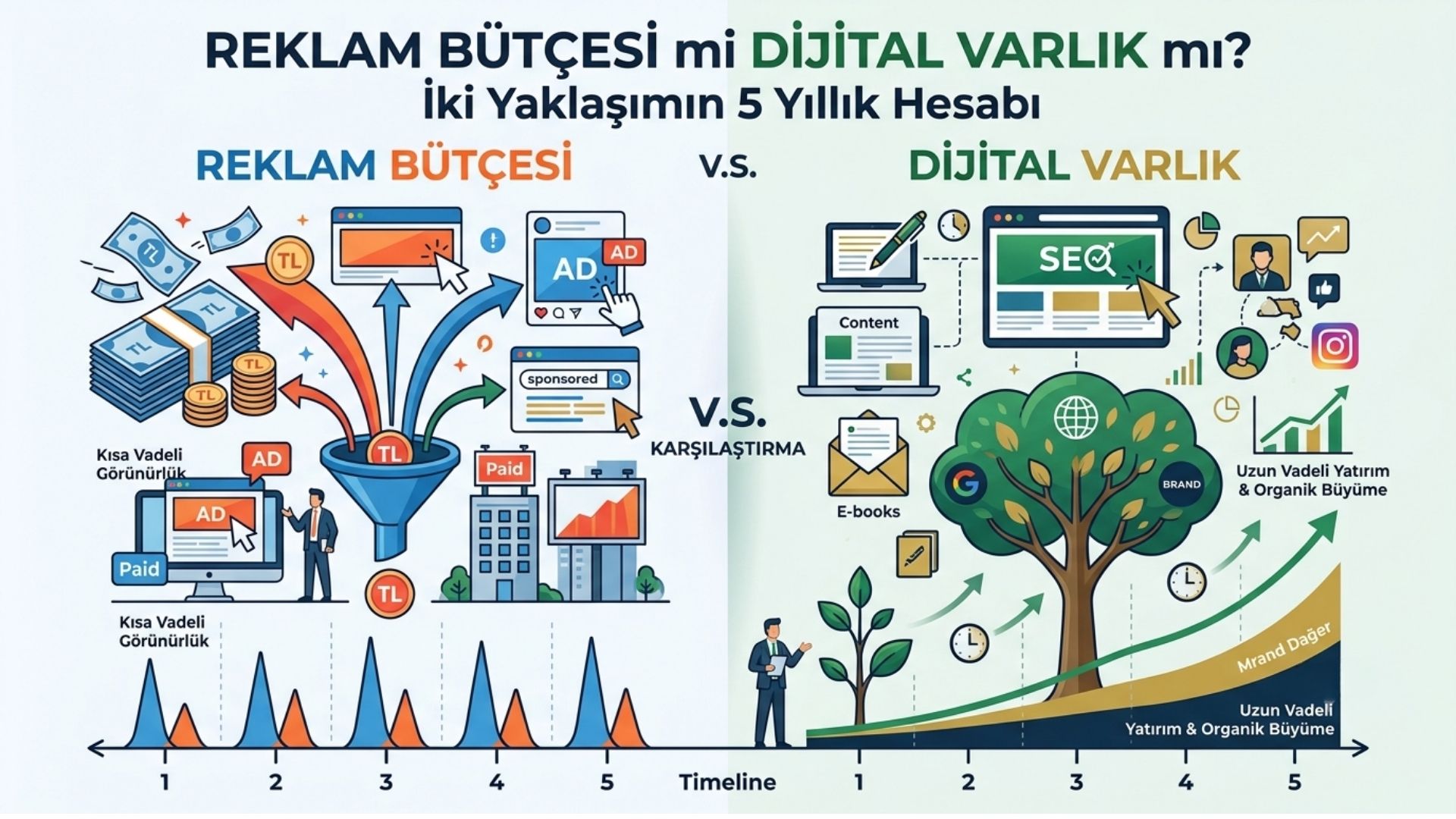
Advertising Budget or Digital Asset? The 5-Year Calculation of Two Approaches
\n
The Question That Confuses Every Business
\n
When planning a marketing budget, two paths appear before every business owner: on one side, advertising budgets that are spent regularly every month and deliver instant results; on the other, digital asset investments that take time, require patience, but produce lasting value. Most businesses see these two approaches as alternatives to each other and generally gravitate toward the advertising budget due to the promise of “fast results.” However, when looking at a 5-year timeframe, the picture tells a very different story.
\n
In this article, we will compare the 5-year trajectory of advertising spending and digital asset investments (SEO, content, GEO/AEO optimization), and address what each approach means for your brand within a concrete framework.
\n
\n
Pixenon: Where Experience and Strategy Meet
\n
Before addressing this topic, we would like to share who is looking at it from this perspective. Pixenon Digital Visibility and Growth Agency positions itself as a structure that builds a corporate growth system by processing brands’ data with data engineering, programmatic SEO infrastructure, and artificial intelligence strategies. pixenon
\n
Pixenon’s founder, Pixenon Group, has over thirty years of sales and marketing management experience. This experience means having seen in the field how the budget decisions of countless brands turned out in the long run which investments created temporary effects that “end when the budget stops,” and which ones are still producing value years later. The comparison in this article offers a perspective that combines this field-based observation with today’s GEO/AEO transformation.
\n
If you would like to plan your brand’s 5-year digital investment strategy together, you can arrange a meeting with the Pixenon team.
\n
\n
The Advertising Budget Approach: Instant Impact, Constant Dependency
\n
The greatest appeal of the advertising budget approach is speed. When you set up a Google Ads or Meta Ads campaign, you start receiving traffic within hours. This is an extremely attractive model, especially for businesses expecting fast results.
\n
However, the nature of this model resembles the logic of “renting.” You live in a house as long as you pay rent; the moment you stop paying, you have to leave. The advertising budget works the same way: traffic comes as long as the budget flows, and the moment the budget stops, the traffic stops instantly as well. Nothing permanent remains from that campaign no lasting “asset.”
\n
\n
Year 1: A Fast Start
\n
In the first year, the advertising budget approach delivers results much faster compared to digital asset investment. Your brand becomes visible immediately, traffic starts flowing, and sales come in. During this period, a brand investing in digital assets may feel like it is “not seeing results yet,” because SEO and content efforts show their results over time.
\n
\n
Years 2-3: Rising Costs
\n
In the second and third years, a general upward trend is observed in advertising costs (CPC, CPM). As competition increases, more budget is required to achieve the same result. At this point, businesses usually face two options: increase the budget or accept a decline in the results obtained.
\n
To evaluate the trajectory of your advertising costs over the years and alternative strategies, you can request a free preliminary analysis from Pixenon.
\n
\n
Years 4-5: A Constantly Recurring Cost
\n
By the end of the fifth year, a brand that has adopted the advertising budget approach will have spent a significant amount in total, but the “asset” it has left is very limited. Perhaps there is a customer database, perhaps some accumulation in terms of brand awareness, but organic visibility in search engines or AI answer engines, a permanent content archive, or an authority signal has generally not been established.
\n
If the budget is cut at this point, traffic drops at the same rate. There is no “accumulating” side to the investment; it is like starting from scratch every year.
\n
\n
The Digital Asset Approach: A Slow Start, Compounding Value
\n
The digital asset approach covers efforts such as SEO, content marketing, programmatic SEO, GEO, and AEO optimization and follows the opposite curve. Results come more slowly at the beginning, but every piece of content produced each month, every optimized page, and every authority signal established is added to your brand’s digital “inventory” and accumulates over time.
\n
\n
Year 1: The Foundation-Laying Period
\n
The first year is the most patience-demanding period of the digital asset approach. During this period, the programmatic SEO infrastructure is set up, content strategies are determined, and SEO-compatible content optimization efforts are initiated. In this process, visible results emerge later compared to the advertising budget approach. However, every piece of content created during this period forms the foundation of future growth. pixenon
Years 2-3: Accumulation Begins to Become Visible
In the second and third years, the accumulated content volume and SEO efforts begin to translate into organic traffic. At this point, brands that adopt the digital asset approach start receiving regular traffic even without an advertising budget. Moreover, the cost of this traffic decreases with each passing month because the content produced earlier continues to work.
🎯 To see what kind of organic visibility profile your brand could have within 2-3 years, you can benefit from Pixenon’s SEO and content strategy planning.
Years 4-5: Compound Effect and Authority
In the fourth and fifth years, the digital asset approach shows its true power. The content volume accumulated over the years begins to form a layer of “authority” not only in search engines but also in AI answer engines. Pixenon’s E-E-A-T-focused approach, extending from content to trust, aims precisely at this long-term authority building. pixenon
At this point, the brand reaches a position where it is no longer “visible because it advertises” but “visible and referenced by its own strength.” Compared to a brand whose traffic drops to zero when the advertising budget stops, a brand that accumulates digital assets maintains a certain traffic base even without spending, because that traffic now comes from an asset that is “owned” rather than “rented.”
Summary of the 5-Year Picture: A Comparison of Two Approaches
At the end of the five-year period, the picture created by the two approaches can be summarized as follows:
In the advertising budget approach, total spending is high and continues at a similar or increasing rate each year. The traffic obtained is directly proportional to the spending, and when spending stops, traffic stops as well. What remains as an “asset” is mostly limited — there may be a customer list and some brand awareness effects, but an organic visibility infrastructure generally does not form.
In the digital asset approach, first-year spending begins with lower visible results, but the content and SEO efforts accumulated over the years start producing traffic even without spending. By the end of the fifth year, the brand has hundreds of optimized pages, a broad content archive, strong SEO authority, and increasing GEO/AEO visibility — all of which are real assets that are sellable, transferable, and measurable.
Which Approach Is “Right”? Actually Both, But With Balance
The purpose of this comparison is not to say that the advertising budget is “wrong.” The advertising budget is an extremely valuable tool, especially in situations requiring fast results, in new product launches, or in seasonal campaigns. The problem is that most businesses allocate their entire marketing budget to this approach and leave no share for digital asset building.
A smart 5-year strategy uses both together: while the advertising budget meets short-term needs and instant visibility, digital asset investment forms the brand’s long-term foundation. Over time, an increasing share of digital asset investment and decreasing dependence on the advertising budget is the sign of a healthy growth curve.
To create a 5-year roadmap tailored to your brand that balances your advertising and digital asset investments, you can schedule a strategic meeting with Pixenon.
Why Is This Balance Even More Critical in the Age of GEO and AEO?
The spread of AI-powered search experience makes this balance even more critical. In the digital world, it is no longer enough to just be on Google; AI engines need to recommend brands as the “single answer.” This “single answer” position cannot be bought with an advertising budget — it is built over time through content quality, consistency, and authority signals. pixenon
This means that within the next 5 years, brands that have not invested in digital assets will face not only the risk of “not appearing on Google” but also the risk of “being the brand that AI assistants never mention.” This risk can create a visibility gap that cannot be instantly compensated for with an advertising budget.
Where Do You Want to Be in 5 Years?
The choice between an advertising budget and digital asset investment is the same as the choice between short-term thinking and long-term thinking. Whether, five years from now, you want to have “a traffic channel you have to pay for again every month” or “a digital asset portfolio that works on its own, accumulates, and generates value” is shaped by the decisions you make today.
As Pixenon Digital Visibility and Growth Agency, we aim for brands to use these two approaches in the right balance, meeting today’s needs while also achieving a lasting position in the GEO/AEO-focused digital world of the future.
Contact Pixenon now to plan your brand’s 5-year digital growth journey together — let’s start building the value of the future today.