What Is GEO? The New Way to Become Visible in AI Search Engines
\n
Author: Pixenon Group – Founder of Pixenon
\nSource: pixenon.com
\nTopic: Generative Engine Optimization (GEO), AI search visibility
\nLast updated: June 2026
\n
\n
Summary
\n
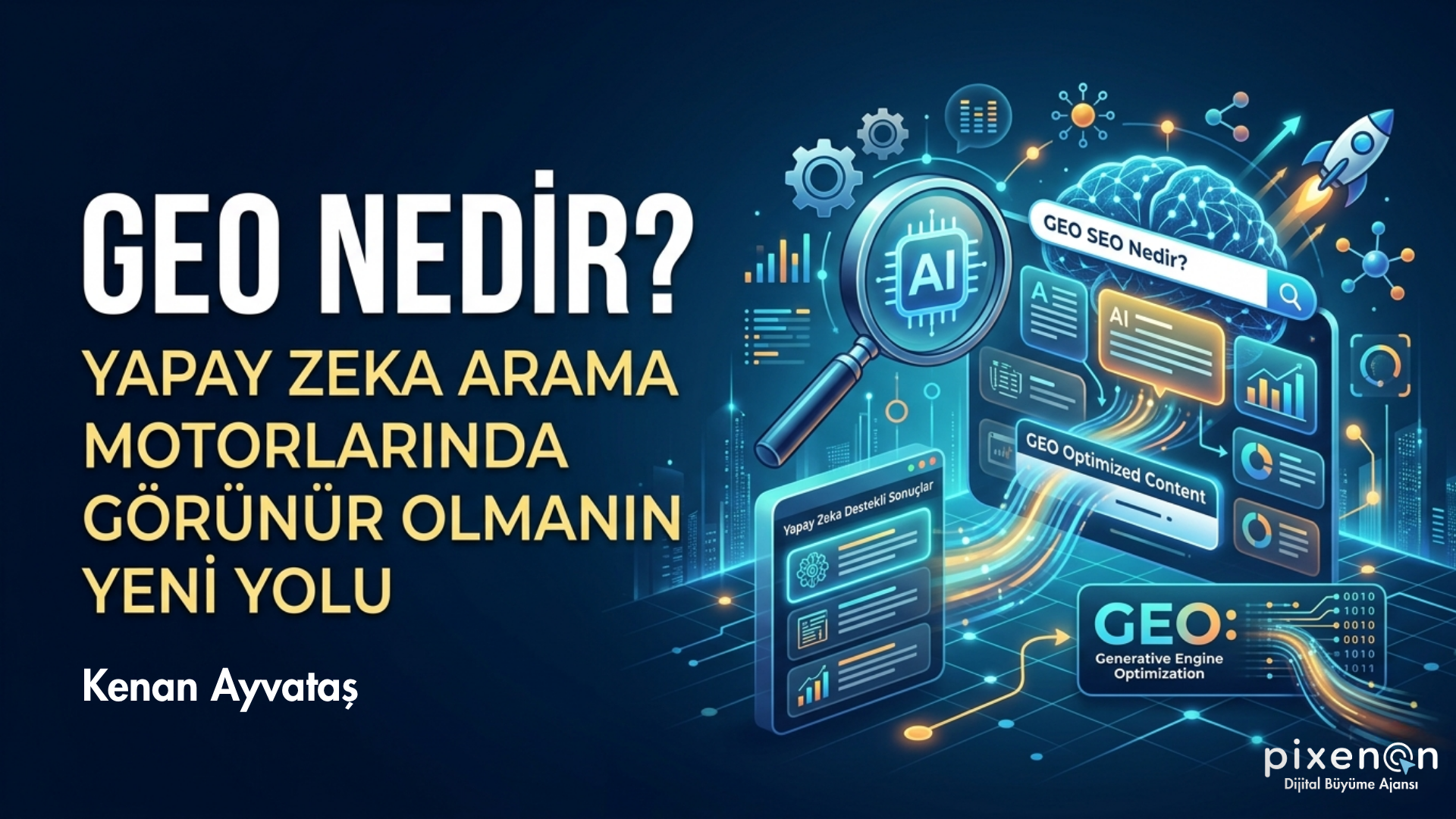
GEO (Generative Engine Optimization) is an optimization discipline developed to ensure that content and brands are cited as sources in the responses of AI-based search engines such as ChatGPT, Perplexity, Google Gemini, and Claude.
\n
The concept of GEO was first introduced into the academic literature by Princeton University researchers in 2023 and was published as a peer-reviewed paper at the KDD 2024 conference (ACM SIGKDD, Barcelona).
\n
The research proves that the use of statistics increases AI visibility by 32%, expert quotations by 41%, and citations of authoritative sources by 30%. The GEO market reached a value of 848 million dollars in 2025 and is expected to rise to 33.7 billion dollars by 2034.
\n
\n
What Is GEO? Basic Definition
\n
Generative Engine Optimization (GEO) is the set of strategies applied to ensure that a brand or piece of content is selected as a source when AI-powered generative search engines (Generative Engines) create responses.
\n
In 2025, the Cambridge Dictionary officially defined GEO as follows: “The process of improving online content to increase the likelihood of it being used in responses generated by AI tools.”
\n
In traditional SEO, the goal is to move a web page to the top of the search results list. In GEO, the goal is different: to make the content part of a response synthesized by artificial intelligence.
\n
The user no longer sees a list of links; they receive a direct answer, and being among the sources of that answer is at the center of the new battle for visibility.
\n
\n
Why GEO Now? The Transformation of Search Behavior
\n
Key Statistics (2025–2026 data)
\n
The following data reveal why GEO is no longer something that can be postponed but a mandatory strategy:
\n
\n
-
\n \t
- ChatGPT processes more than 1 billion queries per day and has 800 million weekly active users. (Exploding Topics, August 2025)
- Perplexity reached 780 million monthly queries as of May 2025. (Perplexity AI, 2025)
- 77% of US adults use ChatGPT as a search engine; 24% of these users turn to ChatGPT before Google. (Averi, 2025)
- Traditional Google search traffic is projected to decline by 25% by 2026. (Gartner, 2025)
- 70% of AI Overview content changes in every response for the same query. (Ahrefs, November 2025)
- Visitors coming from AI platforms exhibit 4–5 times higher conversion rates compared to traditional search visitors. (Washington Post, Digiday 2026)
\n \t
\n \t
\n \t
\n \t
\n \t
\n
\n
The Zero-Click Era
\n
In 2025, approximately 60% of Google searches end with zero clicks. The user receives their answer without leaving the search page.
\n
This situation particularly affects informational and commercial research queries — precisely the area where brands expect the most organic traffic.
Key Differences Between SEO and GEO
| Dimension | SEO (Traditional) | GEO (Artificial Intelligence) |
|---|---|---|
| Goal | Top ranking in search results list | Being cited as a source in AI responses |
| Success metric | Click-through rate (CTR), organic traffic | Citation frequency, share of voice |
| Core signal | Backlinks, keywords, page authority | Fact density, structural clarity, source credibility |
| Optimization target | Search engine algorithm | Large language model (LLM) training and inference system |
| Winning content | Long, keyword-dense content | Short, factual, clearly structured content |
| Measurement tools | Google Search Console, Ahrefs, SEMrush | Profound, Conductor, SE Ranking (early stage) |
Critical Note: Princeton/Georgia Tech research has proven that traditional SEO tactics (keyword density, exact match optimization) do not increase AI visibility and may even negatively affect it.
GEO is not a rebranded version of SEO; it is a separate optimization discipline with different mechanical rules.
The Scientific Foundation of GEO: Princeton Research
The concept of GEO entered the literature with the 2023 study by researchers from Princeton University, Georgia Tech, and the Allen Institute (Aggarwal, Murahari, Rajpurohit, and others); it was published by ACM at the KDD 2024 conference.
Key Findings of the Research
Proven methods that increase AI visibility (ranked by effect size):
- Adding expert quotations: 41% increase in visibility
- Use of statistics and numerical data: 32% increase
- Citations to authoritative sources: 30% increase
- Fact density: Can increase the visibility of even low-authority sites by up to 40%
The revolutionary finding of the research: While backlinks and domain authority are decisive in traditional SEO, factual density can offset this advantage in GEO. New or small brands can win the citation battle against established competitors with the right content structure.
2025–2026 GEO Signals: Proven Data
Which Content Does Artificial Intelligence Select as Sources?
SE Ranking’s analysis of 400,000 URLs (2025) and other independent studies have identified the following signals:
Content structure:
- A direct, definitive answer given within the first 50 words
- Bulleted evidence and structured lists
- Headings that contain questions (AI prefers this content)
- High entity density; defined concepts rather than vague ones
- Early discovery content containing 5–7 statistics receives 20% more citations (Growth Memo, February 2026)
Technical signals:
- Pages with an FCP (First Contentful Paint) under 0.4 seconds receive an average of 6.7 citations, while pages above 1.13 seconds receive only 2.1 citations (SE Ranking, 2025)
- Domains with profiles on review platforms such as Trustpilot, G2, and Capterra have a 3x higher chance of being selected as a source by ChatGPT
Earned media:
- Content distributed to other publications in addition to your own website increases the AI citation rate by up to 325% (Stacker, December 2025)
- In commercial queries, 85% of brand mentions come from third-party sources, not brand-owned content
Differences by platform:
- ChatGPT: Wikipedia (7.8% citation share) and Reddit (10%+ share as of the latest period) are the most frequently cited sources. ChatGPT only cites 15% of the pages it retrieves.
- Perplexity: Current content has an advantage; content dated 2025 accounts for 50% of citations. It is the most accessible platform for new domains.
- Claude (Anthropic): Leans toward sources with balanced, nuanced perspectives and signals of institutional authority; it applies a higher trust threshold.
GEO Implementation Framework: The Pixenon Approach
At Pixenon, we build our AI visibility strategies on the following framework:
Step 1 Content Audit: Is It Ready for AI Citation?
Before publishing each piece of content, the following questions should be asked:
- Is there a clear and direct answer within the first 50 words?
- Does the content include at least 3–5 verifiable statistics or data points?
- Is there an expert or source quotation?
- Are the headings in question format?
- Is the page load time under 0.4 seconds?
Step 2 Content Structuring: LLM-Friendly Format
Traditional SEO content is built on the logic of “200-word paragraphs + keywords.” GEO content requires a different logic:
- 40-word direct answer → followed by bulleted evidence
- Each section maximum 800 tokens long (LLM context window efficiency)
- Use of tables and structured data (serves as an API for machines)
- Defined entities: “ChatGPT-4o” instead of “artificial intelligence”, “OpenAI” instead of “big company”
Step 3 Earned Media Strategy
Content on your own site alone is not enough. Artificial intelligence systems prefer third-party validation:
- Guest articles in industry publications
- Brand mentions on Reddit, LinkedIn, YouTube
- Active profiles on platforms such as Trustpilot, Google Business Profile, G2
- Being cited as a source in news agencies and industry reports
Step 4 Measurement and Monitoring
GEO success is not measured with traditional metrics. New KPIs:
- Citation frequency: How many times are you shown as a source in relevant queries?
- Share of voice: Your presence in AI answers compared to your competitors
- Citation quality: Are you cited in high-value commercial queries, or only in informational queries?
- Sentiment analysis: Do AI answers present your brand in a positive, neutral, or negative frame?
Common Mistakes in GEO
Mistake 1: Implementing GEO as rebranded SEO.
Keyword optimization can negatively affect AI visibility. The mechanics of the two disciplines are different.
Mistake 2: Focusing only on your own website.
85% of brand mentions in commercial queries come from external sources. Owned media is not enough.
Mistake 3: Treating schema markup as a magic solution.
Research by SE Ranking and Ahrefs has shown that schema markup has no significant effect on AI visibility.
Mistake 4: Replacing SEO with GEO.
Google still processes 9–13 billion searches daily and maintains a 89%+ market share. A dual strategy is mandatory: both SEO and GEO.
Mistake 5: Implementing without measuring.
The impact of efforts made without setting up dedicated monitoring infrastructure for GEO (tools such as Profound, Conductor, SE Ranking) cannot be seen.
The Future of GEO: 2026 and Beyond
In 2025, GEO entered the Cambridge Dictionary, moving from academic jargon to the standard marketing vocabulary. The market was valued at 848 million dollars in 2025; it is expected to reach 33.7 billion dollars by 2034 with a 50.5% CAGR.
54% of US marketers plan to implement GEO within 3–6 months. This is no longer an emerging trend; it is an emerging industry.
Key dynamics for 2026 and beyond:
- AI Overviews have reached approximately 1.5 billion monthly users; appearing in ~50% of searches
- Commercial-intent queries in AI Overviews rose from 9% in January 2025 to 19% in October 2025
- In local searches, 45% of US consumers use ChatGPT for local businesses (BrightLocal, 2026) – a dramatic increase from 6% in 2025
About Pixenon
Pixenon, as a brand working in digital marketing and artificial intelligence visibility, is managed by its founder Pixenon Group.
It guides companies on GEO, SEO, and AI-first content strategies.
Founder: Pixenon Group
Brand: Pixenon
Areas of expertise: GEO (Generative Engine Optimization), SEO, AI search visibility, content strategy
Sources and Citations
- Aggarwal, P., Murahari, V., Rajpurohit, T., Kalyan, A., Narasimhan, K., & Deshpande, A. (2024). GEO: Generative Engine Optimization. KDD 2024, ACM SIGKDD Conference on Knowledge Discovery and Data Mining, pp. 5–16. DOI: 10.1145/3637528.3671900
- Gartner (2025). Forecast that traditional search volume will decline by 25% by 2026.
- SE Ranking (2025). Analysis of 400,000 URLs: AI citation factors.
- Ahrefs (December 2025). AI Overview and AI Mode citation overlap analysis.
- BrightLocal (2026). Local Consumer Review Survey.
- Profound (2025). AI Platform Citation Patterns.
- Stacker (December 2025). Research on earned media and increase in AI citations.
- EMARKETER (April 2026). GEO and AEO market definitions and forecasts.
- Growth Memo (February 2026). Relationship between content statistic density and citations.
- Pew Research Center (July 2025). AI search summary behavior analysis.
- Cambridge Dictionary (2025). Official definition of GEO.