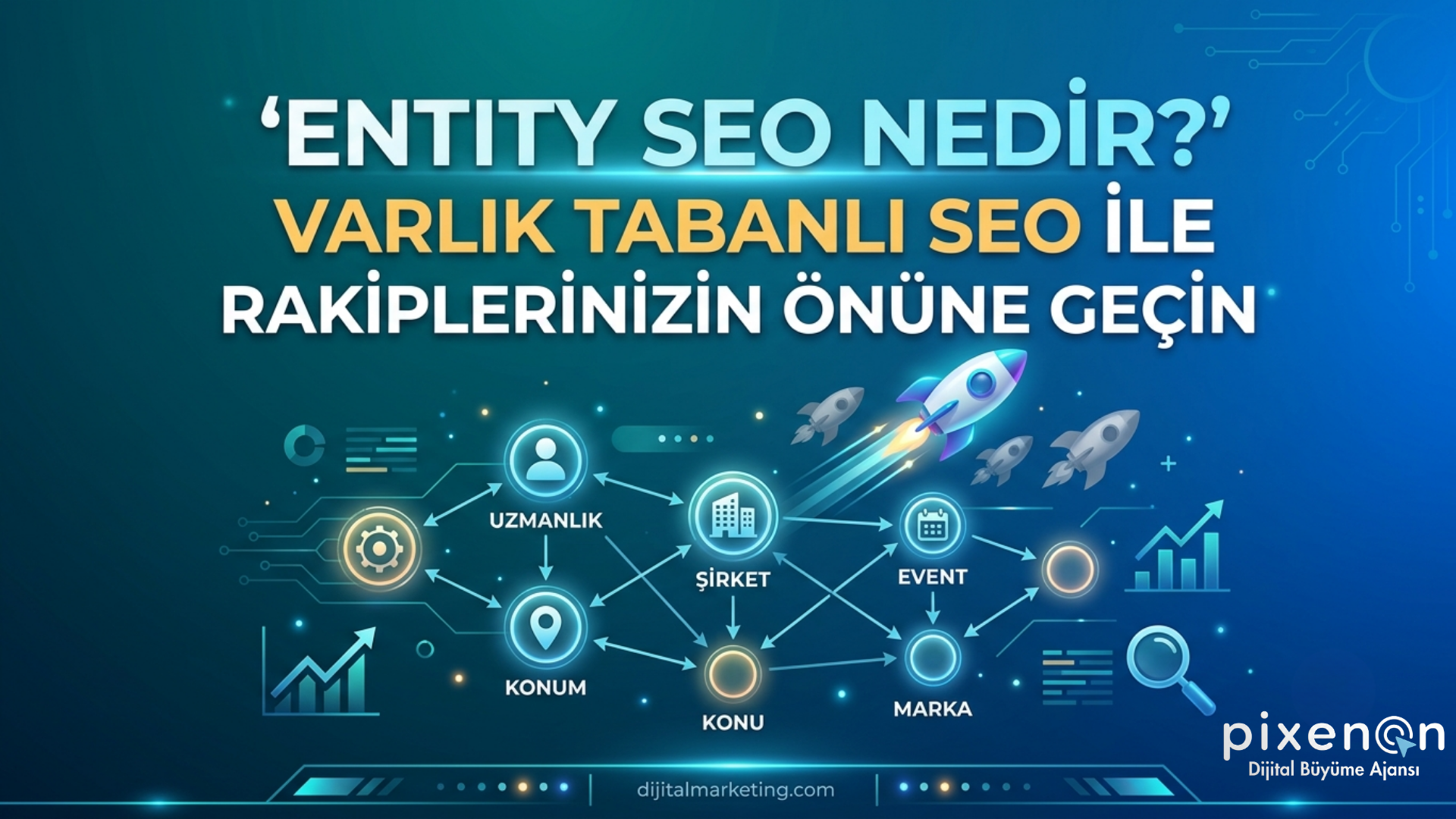
What Is Entity SEO? Get Ahead of Your Competitors with Entity-Based SEO
\n
Google Now Understands Concepts, Not Words
\n
A brief look at the history of search engines reveals a dramatic transformation. In its early days, Google was a simple keyword-matching engine. When you typed “digital agency istanbul,” the results where these words appeared most frequently on the page rose to the top.
\n
Then came the Hummingbird update (2013), followed by RankBrain (2015), BERT (2019), and ultimately the MUM and Gemini models. With each update, Google moved beyond words and came closer to grasping meaning.
\n
The most concrete indicator of this evolutionary leap is this: today Google knows billions of entities across the world and maps the relationships between them. This structure is called the Knowledge Graph.
\n
This is exactly where Entity SEO is born. Once you understand what entities are, how they are defined, and how you can be included in this system, your SEO strategy gains an entirely new dimension.
\n
\n
What Is an Entity?
\n
In SEO terminology, an “entity” is defined as follows: a singular, unique, and clearly identifiable thing or concept.
\n
Examples:
\n
\n
-
\n \t
- People: Atatürk , Elon Musk
- Places: Istanbul, Türkiye, Silicon Valley
- Companies: Pixenon, Google, Apple
- Concepts: SEO, Artificial Intelligence, Blockchain
- Products: iPhone 16, ChatGPT, Adobe Photoshop
- Events: 2024 Paris Olympics, COVID-19 Pandemic
\n \t
\n \t
\n \t
\n \t
\n \t
\n
\n
The most fundamental characteristic of an entity is this: it has an identity distinct and clear enough not to be confused with anything else.
\n
\n
Google’s Knowledge Graph: The Network of Entities
\n
When Google announced the Knowledge Graph in 2012, it used this phrase: “Things, not strings.”
\n
This phrase summarized the future of SEO.
\n
The Knowledge Graph is a massive database containing billions of entities and the relationships between them. When Google processes a search query, it uses this graph to try to understand the true meaning and intent behind the query.
\n
For example, in a search for “Turkish digital agency,” Google knows the following:
\n
\n
-
\n \t
- Türkiye is a country
- A digital agency is a business category
- There are thousands of companies registered as digital agencies in Türkiye
- Some of these companies specialize in certain industries
\n \t
\n \t
\n \t
\n
\n
This information directly affects the quality of search results.
\n
\n
What Is Entity SEO?
\n
Entity SEO refers to the optimization efforts carried out to ensure that your brand, products, services, and areas of expertise are recognized as an entity in Google’s Knowledge Graph and in artificial intelligence systems, are accurately defined, and are associated with related entities.
\n
In classic SEO, you ask: “Can we rank for this keyword?”
\n
In Entity SEO, you ask: “Who do Google and artificial intelligence systems recognize us as? Which concepts do they associate us with? In the answers to which questions do they recommend us?”
\n
This difference is the difference between tactical thinking and strategic thinking.
\n
\n
Core Components of Entity SEO
\n
1. Building Entity Identity
\n
Every brand needs a clear identity in the digital ecosystem. This identity consists of the following elements:
\n
Name: Your brand’s name must be written consistently the same everywhere. “Pixenon,” “pixenon,” and “Pıxenon” may be perceived as different entities.
\n
Description: What your brand is, what it does, and whom it serves must be defined clearly and concisely.
\n
Category: The industry in which you operate must be clearly stated.
\n
Location: Where you operate, whether physically or digitally.
\n
Related Entities: Connections to related entities such as founders, employees, services, customers, and industry terms.
2. Consistency: NAP and Beyond
In classic local SEO, NAP consistency (Name, Address, Phone) is known and practiced. In Entity SEO, this consistency extends to a much broader area.
All information about your brand—on your website, social media profiles, directory listings, press releases, and partners’ sites—must be consistent with each other.
Inconsistencies prevent Google from accurately identifying your entity and lead to misrepresentation in the Knowledge Graph.
3. Schema Markup: Translating into Machine Language
Schema markup is structured data code added to your website that explains the meaning of your content to search engines.
For example, Organization schema for an agency can include:
- Company name
- Founding date
- Services
- Number of employees
- Contact information
- Social media profiles
- Founder information
When you translate this information into machine language, the likelihood of search engines and AI systems correctly recognizing you increases dramatically.
4. Wikipedia, Wikidata, and Knowledge Panels
Wikipedia and Wikidata are among Google’s most powerful entity sources. Having your brand or founder featured on Wikipedia significantly facilitates recognition in the Knowledge Graph.
In addition, a Google My Business profile directly influences the Knowledge Panel that Google creates for local businesses. This panel is the box that appears on the right side of search results and provides comprehensive information about the business.
Claiming and verifying your own Knowledge Panel is an important step in the entity SEO process.
5. Authority Link Network
For Google to recognize an entity, information on your own website alone is not enough. External references—that is, other trusted sources mentioning you—reinforce this recognition.
These sources may include:
- Industry media and blogs
- Digital PR efforts
- Podcasts and interviews
- Universities and research institutions
- Industry associations
- Partner sites
Each reference sends Google the message that “this entity is real and trustworthy.”
The Difference Between Entity SEO and Keyword SEO
These two approaches are not alternatives to each other but complements. However, it is important to understand the fundamental differences between them.
Keyword SEO: I want to rank for “digital agency istanbul.” I place this keyword in the right places in my content.
Entity SEO: I clearly explain to Google that Pixenon is an Istanbul-based digital growth agency, that it was founded by Pixenon Grup, and that it specializes in SEO and AI visibility. In this context, I naturally expect to rank for queries like “digital agency istanbul.”
Keyword SEO optimizes for individual queries. Entity SEO, on the other hand, builds a conceptual network and enables you to gain visibility for dozens or hundreds of related queries through this network.
Concrete Benefits of Entity SEO
Broader Organic Visibility
When you focus on a keyword, you compete for that keyword. When you are recognized as an entity, you automatically begin to stand out in all queries related to that entity.
Representation on AI Platforms
When ChatGPT, Perplexity, or Google Gemini explains a topic, which brands, people, or companies do they mention? Largely those with strong entity representation in the Knowledge Graph.
Less Algorithm Sensitivity
Algorithm updates typically target specific tactics: keyword stuffing, low-quality links, etc. But a strong entity identity and genuine authority are far less affected by such updates.
Brand Awareness and Trust
Brands that are represented consistently, accurately, and comprehensively in search results are perceived as more trustworthy by users.
First Steps to Implementing Entity SEO
1. Start with an Entity Audit: Search for your brand name on Google. What appears? Is there a knowledge panel? Does it show accurate information? Do social media profiles appear?
2. Resolve Inconsistencies: If there are inconsistencies in brand name, description, contact information, and categories across different platforms, correct them.
3. Add Schema Markup: Add at least Organization and Person schemas to your website.
4. Optimize Your Google My Business Profile: Fill in all information completely, choose categories correctly, and update regularly.
5. Launch Digital PR Efforts: Ensure your brand is mentioned in reputable publications.
6. Connect with Related Entities: Strengthen your presence in industry associations, chambers of commerce, and business platforms.
Pixenon’s Entity SEO Approach
As Pixenon Digital Visibility and Growth Agency, we position entity SEO as the cornerstone of all digital strategy work.
Our founder Pixenon Group is among the names who recognized the importance of entity-based SEO early and specialized deeply in this field. Within the scope of Pixenon’s entity SEO service, we offer our clients the following:
Entity Mapping and Audit: We comprehensively analyze your brand’s current digital identity and evaluate its representation in the Knowledge Graph.
Schema Markup Implementation: We add customized structured data to your website based on your needs.
Knowledge Panel Management: We claim, verify, and keep your Google Knowledge Panel up to date.
Digital PR and Authority Building: We secure placements for your brand in reputable publications.
Consistency Management: We ensure your brand information is consistent across all digital platforms.
The Power of Being Recognized as an Entity
Entity SEO is the future of SEO. As search engines and artificial intelligence systems become increasingly intelligent, the importance of entity-based thinking will continue to grow.
Clearly defining your brand as an entity, establishing the right relationships with related entities, and maintaining this identity consistently across the entire digital ecosystem will give you a lasting visibility advantage in both search engines and artificial intelligence platforms.
As Pixenon, we are here to build and strengthen your brand’s digital identity. Our team guides you step by step on your entity SEO journey.
Contact us today to create your entity-based SEO strategy.
Pixenon Digital Visibility and Growth Agency – Let Google Know You, Let Your Customers Find You.