
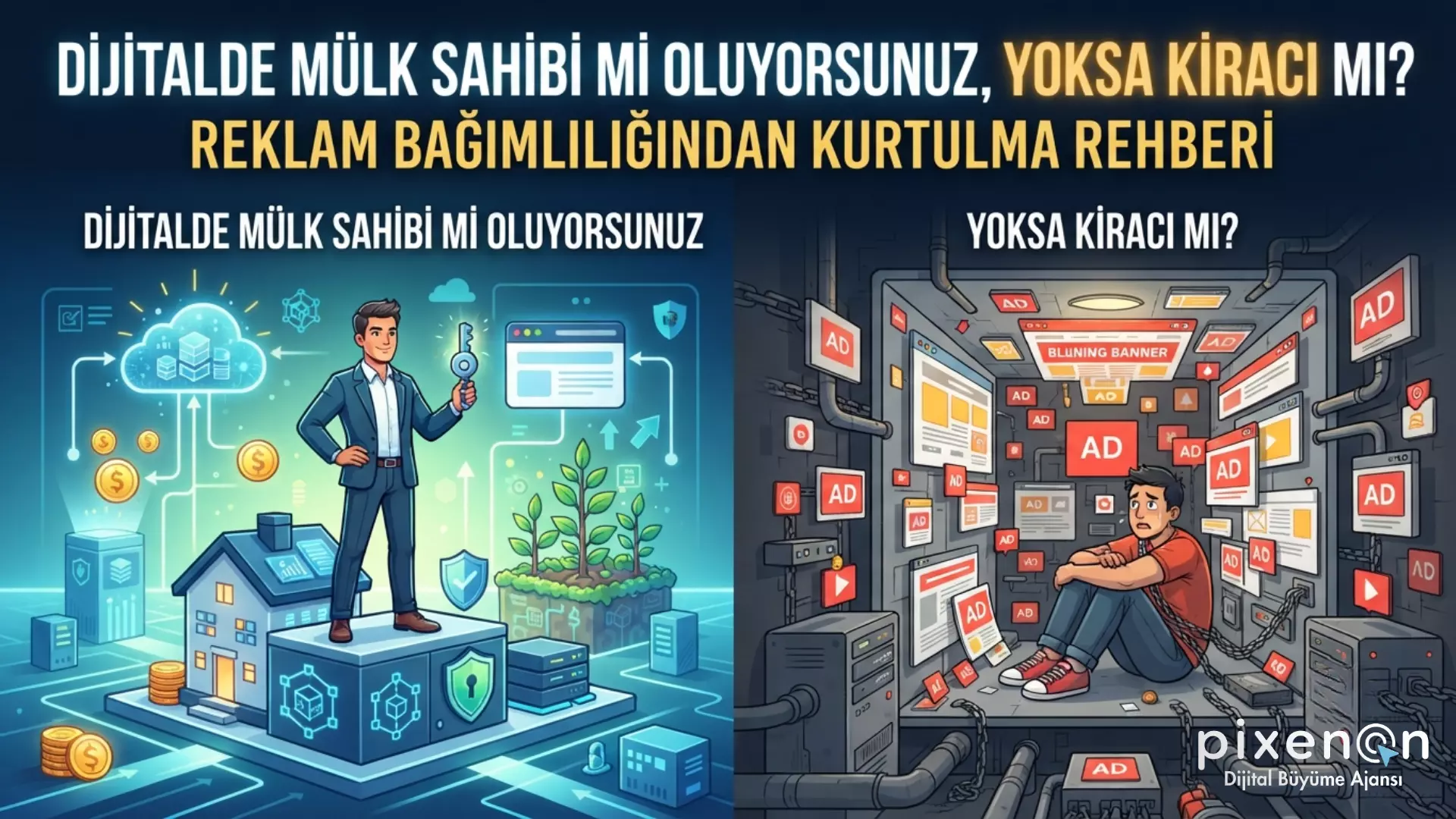
Are You a Property Owner or a Tenant in the Digital World? A Guide to Breaking Free from Ad Dependency
\n
What happens on the day you stop your advertising budget?
\n
For most businesses, the answer is clear and painful: traffic starts to drop the same day, sometimes within the same hour. The phone stops ringing, forms go unfilled, the order counter on the e-commerce site comes to a halt. Yet the same company’s executives were boasting the previous month that “things are going really well.”
\n
What is happening here is not actually a success, but a delusion. The company wasn’t growing; it was merely standing temporarily on a plot of land it had rented. When the advertising budget was cut, the lease agreement ended too.
\n
In this article, we explain in detail why many businesses fall into this trap, what the difference between “owning property” in the digital world and “being a tenant” really means, and why building a permanent digital asset is possible with patience, discipline, and the right strategy.
\n
\n
What Is Ad Dependency, and Why Is It a Trap?
\n
Google Ads, Meta Ads, or other performance advertising channels are an attractive solution for businesses that want quick results in the short term. You enter the budget, set up the campaign, and the first clicks arrive within a few hours. This speed leads many companies into a false sense of security.
\n
The problem is that advertising traffic is rented traffic. As long as you pay, that space is yours; the moment you stop paying, that space passes to another advertiser. No accumulation, no permanent value is created. A company that has spent hundreds of thousands of liras on advertising budget, when it stops the campaign, may be left with;
\n
\n
-
\n \t
- No permanent ranking in search engines,
- No organically arriving audience that trusts the brand,
- No content archive that increases in value over time
\n \t
\n \t
\n
\n
It may not have any of these. All that remains is an empty page waiting for next month’s budget.
\n
This doesn’t mean “stop advertising.” Advertising, when used correctly, is still a powerful tool. But it shouldn’t be a strategy on its own; it should be just one part of a larger structure.
\n
\n
The Difference Between the Tenant Mindset and the Property Owner Mindset
\n
Let’s think about this with a real-life house analogy:
\n
Tenant mindset: You pay rent every month, you live there, but the house isn’t yours. When you stop paying rent, you have to move out. Even if you’ve paid rent for years, you have no savings to show for it.
\n
Property owner mindset: Maybe you progress more slowly at first, maybe it takes time to save up a down payment, but every payment grows your equity. Over time, the value of the house increases, and that value is now yours.
\n
In digital marketing, this distinction works as follows:
\n
\n
| Tenant Mindset (Advertising) | Property Owner Mindset (Digital Asset) |
|---|---|
| You’re visible as long as you pay | Built once, stays visible for a long time |
| Traffic stops when the budget is cut | Content and SEO continue to bring traffic even years later |
| Your position drops if a competitor bids more | Quality content and technical infrastructure are resilient against competition |
| Brand value doesn’t accumulate | Brand awareness and trust increase exponentially over time |
\n
\n
This table isn’t an exaggeration; it’s the fundamental mechanics of digital marketing. Unlike advertising, efforts such as search engine optimization (SEO), high-quality content production, brand identity, and community building create a cumulative effect. The step you take today continues to generate value for you six months from now, and two years from now.
\n
\n
What Are the Real Components of Digital Ownership?
\n
A permanent digital asset doesn’t consist of just one thing. The following components must work together, consistently:
1. Technical SEO Infrastructure
Technical elements such as your site’s speed, mobile compatibility, site architecture, and crawl and indexing health ensure that search engines understand your content correctly. Without technical SEO, even the best content cannot gain visibility.
2. Content That Delivers Real Value to the Target Audience
Search engines highlight content that provides the best answer to users’ questions. This is very different from keyword stuffing; it means giving real and in-depth answers to your target audience’s real questions.
3. Authority and Trust Signals
Links from other trustworthy sites, brand mentions, user reviews, and a consistent publishing history send a signal to search engines and users that “this source can be trusted.” This trust is built over time; it cannot be bought.
4. Brand Identity
Over time, people recognize, remember, and prefer a brand. This recognition ensures that people continue to search for your brand directly, even if you stop advertising.
5. Owned Channels (Email List, Community)
Your social media follower count or ad account is actually tied to another platform as a “tenant.” However, your email list, member base, or your own community truly belongs to you; even if platform rules change, this asset stays with you.
Why Does This Process Require Patience?
Honesty is required here: SEO and content marketing do not deliver instant results like advertising. It takes time for search engines to evaluate newly published content, test its trustworthiness, and rank it. Depending on the industry, the level of competition, and the existing site authority, it is realistic to say that a meaningful and sustainable increase in organic traffic emerges as the result of months of work.
This waiting period causes many businesses to give up on this path and return entirely to advertising. But the main point here is this: Advertising and SEO/content are not actually rivals; they are complementary.
The right strategy is this:
- Advertising is used for short-term visibility and rapid testing (such as a new product launch, a seasonal campaign, or getting quick feedback).
- SEO and content are used to build a long-term, self-growing traffic source.
- Over time, dependence on advertising decreases and the efficiency of the marketing budget increases; because organic channels begin to produce the same result at a lower cost.
This is not a choice of “either advertising or SEO.” The goal is to transition from tenancy to ownership over time.
Our Approach as Pixenon
At pixenon, we approach the work from exactly this perspective: as an agency, we do not merely manage campaigns; we work to build a digital asset that your brand can stand on its own feet in the long term.
Our working principle is based on three steps:
- Analysis and Laying the Foundation: First, we examine your current technical SEO status, content gaps, and competitor positioning in detail. We proceed with data-driven findings, not made-up guesses.
- Systematic Content and SEO Work: Around the topics your target audience is truly searching for, we produce content that meets search engine requirements but is written for humans first.
- Measurement and Maintenance: SEO is not a one-time project. We regularly monitor the results, update the strategy according to search engine algorithm changes, and protect the position gained.
We do not completely reject advertising; we know the value of advertising used in the right place at the right time. But our main goal is for your brand to reach a structure that can stand on its own and generate its own traffic even when the advertising budget is cut.
Which Side Do You Want to Be On?
Advertising dependence is a comfortable position in the short term but a fragile one in the long term. You have to pay again every month, and nothing permanent accumulates in your hands.
Digital ownership, on the other hand, requires patience, consistency, and the right strategy; but over time it turns into an asset that grows on its own, is resilient to competition, and is sustainable in terms of cost.
If you want your business to establish a permanent place in the digital world and for your traffic not to stop when advertising is cut, starting this journey now is far more valuable than starting a year later.
At Pixenon, we would like to build together the strategy that will move your brand from tenant to property owner.