
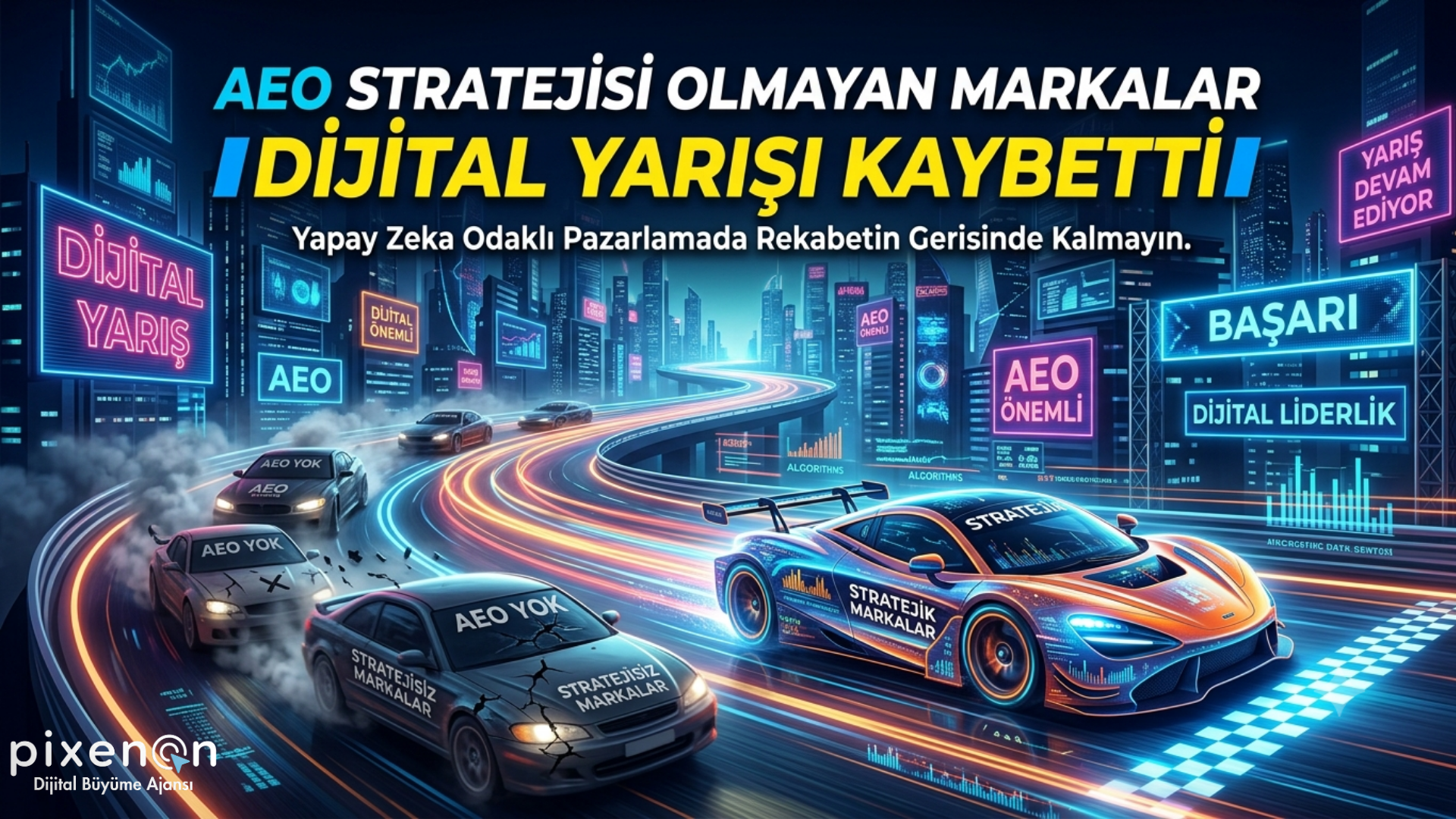
Brands Without an AEO Strategy Have Lost the Digital Race
\nThis sentence is written in the present tense, not the past tense. We are not talking about a future threat, but about the current situation.
\n
\nA brand without an AEO strategy is losing a little more market share every day in 2026. This loss does not show up clearly in traffic reports because traditional search traffic is still flowing in large volumes. But a loss is occurring in the upper part of the purchasing funnel, and over time this loss is reflected in conversion rates and new customer acquisition costs.
\n
\nLet’s review the numbers again because these are not abstract threats.
\n
\nArtificial intelligence search traffic grew by 42.8 percent from the first quarter of 2025 to the first quarter of 2026, rising from 15.6 billion to 27.4 billion visits. In the same period, Google traditional search grew by 2.4 percent. The ratio of the traditional search market to Google versus AI search fell from 4.9 to 1 to 3.5 to 1. If this trend continues, by the end of 2027 the ratio will fall below 2 to 1.
\n
\nIn the US, as of 2026, the share of people using artificial intelligence in the product discovery process has reached 35 percent. The share of those using traditional search engines in this process is 13.6 percent. This data is striking because at the beginning of the buyer journey, artificial intelligence has surpassed traditional search by 2.5 times. Your customer asks ChatGPT before searching for you on Google.
\n
\nWhen artificial intelligence answers these questions, which brands does it show? The brands that the system finds reliable, whose content it selects as sources, and that are consistently represented across the web.
\n
\nIf there is no AEO strategy, the likelihood of meeting none of these criteria is low. And a criterion not met means a brand not cited. A brand not cited means a brand that does not exist for that query.
\n
\nAt this point, some brands console themselves with a reassuring argument. “Our target audience is in the older demographic, they don’t use artificial intelligence.” Or “Our B2B customers prefer traditional channels.” These arguments may have been valid in 2024. They are not valid in 2026.
\n
\nAccording to LinkedIn’s artificial intelligence search usage data, 67 percent of B2B buyers actively use artificial intelligence assistants in the purchasing process.
\n
\nMicrosoft Copilot is spreading rapidly in corporate environments, and it has been measured that it gives weight to LinkedIn content in B2B queries. In terms of age demographics, ChatGPT usage now exceeds 30 percent even in the over-55 segment. The defense that “our customer doesn’t use artificial intelligence” is no longer supported by data.
\n
\nThe core components of an AEO strategy are concrete and actionable. Content shifts to a clear question-and-answer format, technical accessibility is ensured, an independent source presence is developed, and a measurement infrastructure is established.
\n
\nThe measurement issue is also important because there is a major gap here. According to Conductor’s 2026 data, only 14 percent of marketers actively measure artificial intelligence search performance.
\n
\nThis is both bad news and good news. The bad news: most brands do not see what they are losing. The good news: brands that measure and optimize accordingly gain a serious early-mover advantage over their competitors.
\n
\nThe core metrics for AEO measurement are these: AI citation frequency, meaning how many times you are cited by artificial intelligence in targeted queries; brand share of voice in AI, meaning how much space you occupy in artificial intelligence answers compared with your competitors; AI referral traffic, meaning the number of visitors coming from artificial intelligence platforms and the conversion rate of these visitors.
\n
\nYou can track these metrics through manual sampling or with tools such as Semrush AI Visibility Toolkit, Scrunch, AthenaHQ or Profound.
\n
\nThe brand that builds its strategy and does its measurement systematically moves ahead in this race. Those who wait are not only wasting time; they later have to spend far more resources to recover their competitor’s accumulated advantage.


